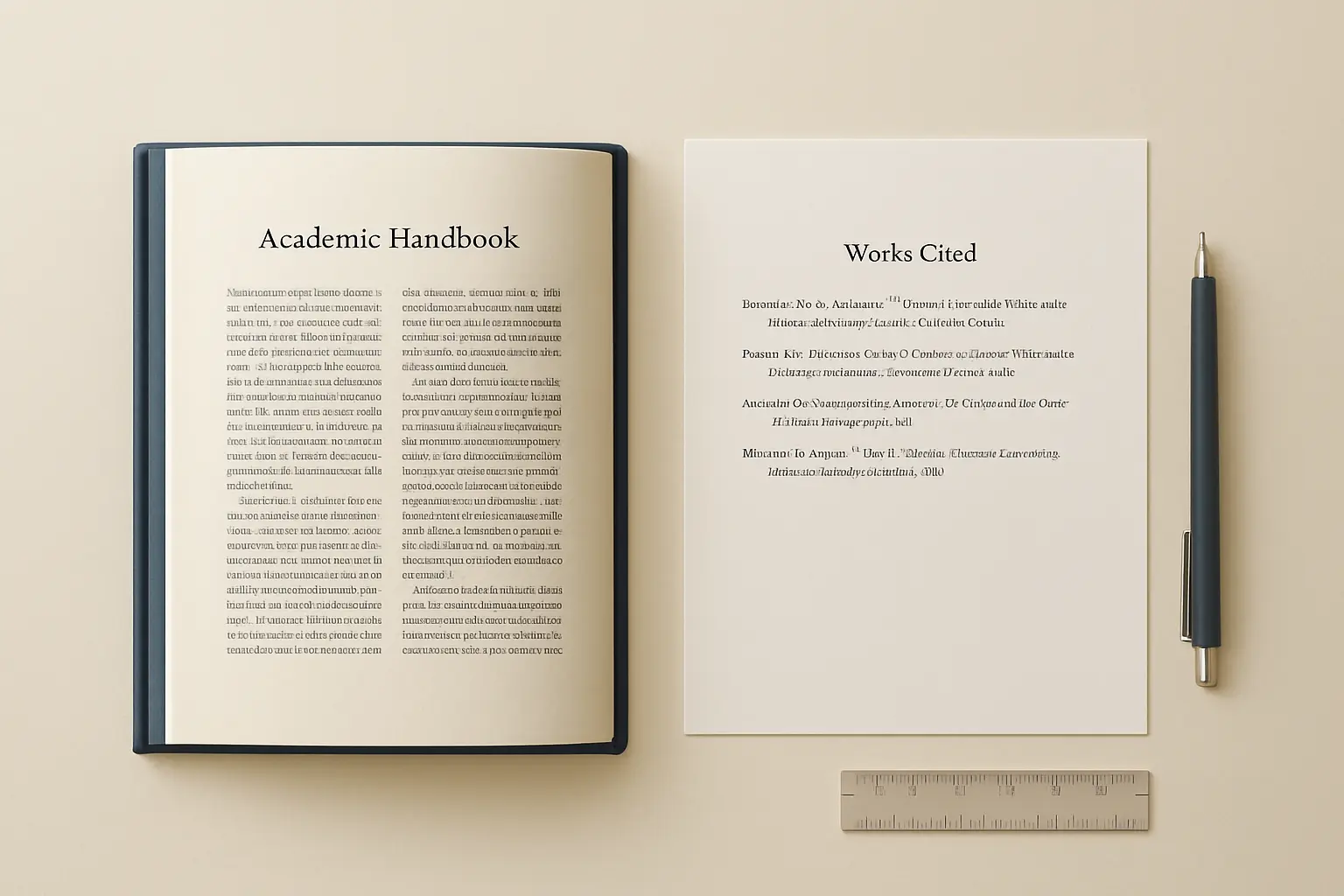
MLA 9 Format in 2026: Complete Guide with Copy-Paste Examples
Every year, thousands of students submit papers with citation errors that cost them marks — and most of those errors are fixable in under an hour with the right reference. MLA 9 format, defined in the 9th edition of the MLA Handbook published by the Modern Language Association in 2021, is the citation system of choice for literature, linguistics, humanities, and cultural studies courses across North America, the UK, and Australia. This guide covers the full ruleset: paper layout, in-text citations, the Works Cited page, and copy-paste examples for every common source type, so you can cite confidently in 2026.
What MLA 9 Actually Changed (and Why It Matters)
The 9th edition refined rather than overhauled its predecessor. If you learned MLA 8, the shift is minor. If you are coming from MLA 7, the fundamental change is that separate templates for each source type are gone — one flexible framework now handles every source. The five most practical updates in MLA 9:
- Specific font guidance added. MLA 8 was vague about font. MLA 9 names acceptable options — Times New Roman, Arial, Calibri — keeping the underlying principle: use a font where regular and italic styles contrast clearly enough to be distinct.
- Inclusive language chapter. A new chapter addresses bias-free writing, covering gender-neutral pronouns, person-first language, and capitalisation of racial and ethnic identities.
- Expanded digital source guidance. Clearer rules for URLs vs. DOIs, and new guidance for AI-generated text, social media posts, podcasts, and streaming content.
- Dropped abbreviations. “n.p.” (no publisher) and “n.d.” (no date) are removed. When an element is missing, simply omit it and continue with the next.
- Formalised optional elements. Beyond the nine required core elements, MLA 9 lists optional supplemental elements — such as original publication date or the city of publication for historical texts — that writers may add for clarity.
For a companion deep-dive on citing modern digital sources — including social media, podcasts, and streaming platforms — see the MLA Format Guide on Tesify, which covers the full container model applied to every format students encounter in 2026.
MLA 9 Format Paper Layout Rules
Before writing a word of body text, configure your word processor to meet these requirements. Instructors often deduct points for formatting errors even when content is strong.
| Setting | MLA 9 Requirement |
|---|---|
| Paper size | 8.5 × 11 inches (US letter) |
| Margins | 1 inch on all four sides |
| Font | 12-point Times New Roman, Calibri, or Arial (any legible font where regular and italic contrast clearly) |
| Line spacing | Double-spaced throughout, including the Works Cited page |
| Paragraph indent | 0.5 inch (one Tab press) for the first line of each paragraph |
| Running header | Last name + page number, flush right, 0.5 inch from top (e.g., Smith 1) |
| Punctuation spacing | One space after periods and other punctuation marks |
No separate title page is used in standard MLA papers. Identification information appears at the top left of page 1 instead.
First-Page Setup and Title
The upper left corner of page 1 carries a four-line block, each element on its own double-spaced line:
Instructor’s Name
Course Name and Number
Day Month Year (e.g., 15 June 2026)
Centre the paper title on the next double-spaced line after this block. Do not bold, italicise, or put the title in quotation marks — use standard title capitalisation. If the title contains the name of a longer work, italicise that title within it:
Drop one double-spaced line after the title, then begin the first paragraph, indented 0.5 inch. Your instructor may ask you to omit the header from page 1 — follow whichever instruction takes precedence.
In-Text Citations: Every Pattern You Will Need
MLA in-text citations are parenthetical: they sit inside the sentence, near the borrowed material, before the closing punctuation. The logic is minimal — give the reader just enough information to locate the full entry in Works Cited.
Single author with page number
Author’s last name and the page number separated by a space (no comma):
Memory is selective rather than reliable (Morrison 47).
If you name the author in your sentence, omit the name from the parenthesis:
Morrison argues that memory is selective rather than reliable (47).
Two authors
The research paradigm shifted significantly (Booth and Colomb 112).
Three or more authors
Use the first author’s last name followed by et al. (not italicised; period after “al”):
The results confirmed earlier findings (Smith et al. 89).
No named author
Use a shortened title in place of the author — italicised for longer works, in quotation marks for shorter ones:
The policy underwent significant revision in 2024 (“Climate Report” 14).
No page numbers (websites, most online content)
Cite by author name only. Do not invent or estimate paragraph numbers unless the source explicitly numbers them:
The guidelines were updated in early 2025 (Purdue OWL).
Multiple works by the same author
Add a shortened title after the author’s name to distinguish them:
The framing of identity shifts across texts (Said, Orientalism 23; Said, Culture 67).
The Container Model: MLA’s Logical Framework

The most important concept in MLA 8 and 9 is the container model. Any source sits inside one or more containers. A journal article is nested in the journal (Container 1). If you accessed that article through a database, the database is a second container. This structure lets a single template handle every source type.
The nine core elements — listed in fixed order for each container — are:
- Author.
- Title of source.
- Title of container,
- Other contributors,
- Version,
- Number,
- Publisher,
- Publication date,
- Location.
Elements that do not apply are simply omitted. A period ends element 2 (closing the source itself); commas separate elements 3–9 within Container 1, followed by a period. When a second container exists, the sequence repeats from element 3 onward for that container. Understanding this logic is more durable than memorising individual templates — when you encounter a source type you haven’t cited before (a newsletter, a Discord thread, a dataset), you can always map its parts to the nine elements.
Works Cited Page: How to Format It
The Works Cited page begins on a new page directly after the last page of your paper. Key rules, per the Purdue OWL MLA guide:
- Continue the running header (Last Name + page number) at the top right.
- Centre the heading Works Cited at the top. Do not bold, italicise, or enlarge it — it should look identical to body text, just centred.
- Alphabetise entries by the first element (usually author’s last name). If there is no author, alphabetise by the first significant word of the title, ignoring “A,” “An,” and “The.”
- Use a hanging indent: the first line of each entry is flush left; all subsequent lines are indented 0.5 inch. In Microsoft Word: Format → Paragraph → Indentation → Special → Hanging.
- Double-space all entries — no extra blank line between entries.
- Italicise titles of longer, standalone works (books, journals, full websites, films). Enclose titles of shorter works (articles, poems, chapters, episodes) in quotation marks.
- Prefer a DOI over a URL when one is available. Format it as a live hyperlink: https://doi.org/[DOI string]. No angle brackets required in MLA 9.
Copy-Paste Works Cited Examples (MLA 9)
Each entry below is formatted to MLA 9 specification. Copy, paste, then replace the details with your source’s information. Apply hanging indent in your word processor — the indentation shown here is illustrative.
Book — single author
Gleick, James. The Information: A History, a Theory, a Flood. Pantheon Books, 2011.
Book — two authors
Strunk, William, Jr., and E. B. White. The Elements of Style. 4th ed., Longman, 1999.
Edited collection
Ferguson, Margaret, et al., editors. The Norton Anthology of Poetry. 5th ed., W. W. Norton, 2005.
Journal article with DOI
Adichie, Chimamanda Ngozi. “African ‘Authenticity’ and the Biafran Experience.” Transition, no. 99, 2008, pp. 42–53. https://doi.org/10.2979/TRS.2008.-.99.42.
Website — with named author
Dean, Jeremy. “19 Reasons Why This Is an Age of Conformity.” PsyBlog, 20 Nov. 2012, www.spring.org.uk/2012/11/19-reasons-why-this-is-an-age-of-conformity.php.
Website — no named author
“MLA Formatting and Style Guide.” Purdue OWL, Purdue University, 10 May 2024, owl.purdue.edu/owl/research_and_citation/mla_style/mla_formatting_and_style_guide/mla_formatting_and_style_guide.html.
YouTube or online video
TED. “The Danger of a Single Story | Chimamanda Ngozi Adichie.” YouTube, 7 Oct. 2009, www.youtube.com/watch?v=D9Ihs241zeg.
AI-generated content
The MLA Style Center updated its AI citation guidance in 2023. Because AI output cannot be retrieved by a reader in the same form, MLA recommends describing the prompt in the body of the paper and including an entry in Works Cited when a citation is required:
“Describe the economic causes of World War I in three paragraphs.” ChatGPT, version GPT-4o, OpenAI, 12 June 2026, chat.openai.com.
Always disclose AI use explicitly in-text as well, and check your institution’s policy — acceptable use varies widely. For a full cross-style breakdown of how to handle this, see our guide on citing AI-generated content in APA, MLA, and Chicago.
Five Common MLA 9 Mistakes and How to Fix Them
-
Comma between author and page number. Write
(Smith 47), not(Smith, 47). MLA uses only a space — the comma is always wrong. - Bolding or enlarging “Works Cited.” Centre it — that part is correct. But do not bold, italicise, underline, or change its size. It should look identical to your body text.
- Using “n.p.” or “n.d.” for missing elements. MLA 9 removed both abbreviations. When a publisher or date is missing, omit the element entirely and move to the next.
- Forgetting the hanging indent. This is the single most common formatting error. Every Works Cited entry must use a hanging indent: first line flush left, all continuation lines indented 0.5 inch.
- Adding access dates to stable websites by default. MLA 9 makes access dates optional for most online sources. Include one only when a page has no publication date or its content changes frequently (live databases, social media profiles, wikis).
If your paper also includes websites cited in APA style for a different course or project, our guide on how to cite a website in APA 7 covers the parallel rules and where the two systems diverge.
Frequently Asked Questions
What is MLA 9 format?
MLA 9 format refers to the citation and paper-layout system defined in the 9th edition of the MLA Handbook, published by the Modern Language Association in 2021. It is the standard style for literature, linguistics, and many humanities disciplines, specifying 1-inch margins, 12-point legible font, double-spacing, parenthetical in-text citations in the format (Author Page), and a Works Cited list built from nine core elements arranged in a container model.
How is MLA 9 different from MLA 8?
MLA 9 (2021) made five main refinements to MLA 8 (2016): it named specific acceptable fonts (Times New Roman, Arial, Calibri); added a chapter on inclusive and bias-free language; expanded guidance on digital sources including AI tools and social media; removed the abbreviations “n.p.” and “n.d.” for missing publication information; and formalised a list of optional supplemental elements writers can add for clarity. The core nine-element container model is unchanged from MLA 8.
Do I need a title page in MLA format?
No. Standard MLA 9 papers do not use a separate title page. Your name, instructor’s name, course name and number, and the date (Day Month Year format) go in the upper left corner of page 1, each on its own line. The paper title is centred on the next line below. Some instructors require a title page for longer projects — follow their specific instructions when given.
How do I cite a website with no author in MLA 9?
Begin the Works Cited entry with the title of the page in quotation marks. The full format is: “Page Title.” Website Name, Publisher or Sponsor, Day Month Year of publication or last update, URL. In the in-text citation, use a shortened version of the title in quotation marks: (“Page Title”). Do not use “Anonymous” unless the source is actually signed with that word.
Should I use a DOI or a URL in my Works Cited entry?
Prefer a DOI when one is available. DOIs are permanent identifiers assigned by publishers; they remain stable even when a journal changes its URL structure. Format a DOI as a hyperlink: https://doi.org/[DOI string]. Use a URL only when no DOI exists. MLA 9 does not require angle brackets around DOIs or URLs, and does not require you to write “Accessed” before the access date for most stable sources.
How do I cite ChatGPT or another AI tool in MLA 9?
The MLA Style Center (style.mla.org) recommends describing your prompt and disclosing AI use in the body of the paper, then listing the tool in Works Cited. Format: “Your exact prompt.” ChatGPT, version [model], OpenAI, Day Month Year, URL. Because AI output is not retrievable by readers in its exact form, always include an in-text disclosure as well. Check your institution’s academic integrity policy — many universities restrict or prohibit AI-generated text in assessed work.
Format Your Thesis References Automatically
Getting every Works Cited entry right by hand is time-consuming, and a single misplaced comma can affect your grade. Tesify structures your thesis or dissertation chapter by chapter and formats in-text citations and Works Cited entries to MLA 9, APA 7, Chicago, or Vancouver specification — flagging inconsistencies before you submit. It is free to start, with no credit card required.