
Research Methodology in 2026: Types, Examples & How to Choose
Your supervisor has returned your research proposal with three words underlined: justify your research methodology. You know roughly what you want to study. You have a research question, a literature review in progress, and a sense that you will need to collect some data. But the methodology chapter — the section that explains the philosophical and practical architecture of your entire study — remains a blank page.
This guide resolves that. It maps all three major research methodology types — qualitative, quantitative and mixed methods — against the questions they are built to answer, explains the sampling and analysis decisions nested inside each, and provides a four-question decision framework grounded in Creswell and Creswell (2023) and Braun and Clarke’s work on qualitative analysis. By the end, you will be able to name your methodology, justify it coherently, and structure a methodology chapter that holds up under examination.
Research methodology is the systematic framework governing how you collect and analyse data to answer your research question. The three main types — qualitative (words, meaning, interpretation), quantitative (numbers, measurement, hypothesis testing) and mixed methods (both) — are not equally valid for every question. You choose based on your epistemological stance, the nature of your research question, the maturity of existing theory in the literature, and your practical constraints.
What Is Research Methodology?
Research methodology is the systematic framework that governs how you collect, organise and analyse data to answer your research question. It sits inside a broader research design, which in turn reflects your philosophical stance — your beliefs about what constitutes knowledge (epistemology) and what exists in the world (ontology).
Creswell and Creswell (2023) identify three foundational layers of any research design: the philosophical worldview (post-positivist, constructivist, transformative or pragmatist), the research strategy (survey, case study, grounded theory, experiment), and the specific methods (questionnaires, interviews, observations, statistical tests). These three layers must cohere. A constructivist worldview cannot sit comfortably with a randomised controlled trial as the primary design; a post-positivist worldview cannot justify an open-ended phenomenological study without substantial theoretical explanation of the mismatch.
The methodology chapter is not a summary of what you did — it is a reasoned justification of why you chose to do it that way. Examiners consistently flag methodology chapters that describe procedures without linking them to epistemological rationale. The two-move logic of every methodology section is: what I did and why this was the appropriate choice.
Qualitative Research: When Meaning Matters
Qualitative research generates non-numerical data — words, images, patterns, experiences — to understand how people interpret and construct meaning in their worlds. It sits within a broadly interpretivist or constructivist epistemology: the researcher accepts that reality is socially shaped and that context is inseparable from meaning.
Core Qualitative Traditions
Creswell and Poth (2018) identify five major qualitative traditions, each suited to a different type of question:
- Phenomenology: explores the lived experience of a phenomenon — for example, how doctoral students experience the transition from structured coursework to independent research. The goal is to identify the essential, invariant structure of that experience.
- Grounded theory: builds substantive theory inductively through systematic data collection and constant comparative analysis. Particularly appropriate when no adequate theory yet exists for a process or social phenomenon (Charmaz, 2014).
- Ethnography: studies culture or community through prolonged immersion — participant observation, field notes, interviews and artefact analysis. The researcher becomes an instrument of the study.
- Case study: examines one or more bounded instances in depth — a single programme, policy, organisation or individual. Yields rich contextual understanding rather than generalisable law.
- Narrative inquiry: analyses personal stories to understand how individuals construct identity, sequence and meaning across time.
Qualitative research suits questions that begin with how, what does it mean, or what is the experience of. It is appropriate when the literature is thin or contested, when context cannot be stripped from the phenomenon, or when the aim is to generate hypotheses rather than test them.
For a detailed side-by-side comparison of when to choose each approach, see our dedicated guide on qualitative vs quantitative research.
Quantitative Research: When Numbers Answer
Quantitative research generates numerical data and tests hypotheses or establishes relationships between variables. It operates within a post-positivist worldview: the researcher assumes that an objective reality exists and can be measured, even if imperfectly, and that replication and falsification are the hallmarks of valid knowledge.
Common Quantitative Designs
| Design | Best suited for | Causal claim? |
|---|---|---|
| Randomised controlled trial (RCT) | Testing interventions; maximising internal validity | Yes (strongest) |
| Quasi-experimental | Pre-existing groups; ethical constraints on randomisation | Partial |
| Cross-sectional survey | Descriptive and correlational questions at scale | No |
| Longitudinal cohort | Tracking change over time in the same participants | Partial (temporal precedence established) |
| Structural equation modelling | Testing theoretical models with multiple latent variables | No (correlational) |
Quantitative research suits questions that ask how much, how many, is there a relationship between, or does X cause Y. It requires a clearly defined population, a valid and reliable instrument, and a sample size justified by power analysis — ideally pre-registered before data collection begins.
Mixed Methods: When You Need Both
Mixed methods research integrates qualitative and quantitative data within a single study. The defining feature is integration: each strand informs, extends or triangulates the other. Running a survey and a focus group within the same project but treating their outputs separately is multi-method work, not genuine mixed methods design.
The pragmatist worldview underpins most mixed methods work — rather than committing philosophically to one paradigm, the researcher asks: what combination of tools best answers this question?
Creswell and Creswell (2023) describe four principal designs:
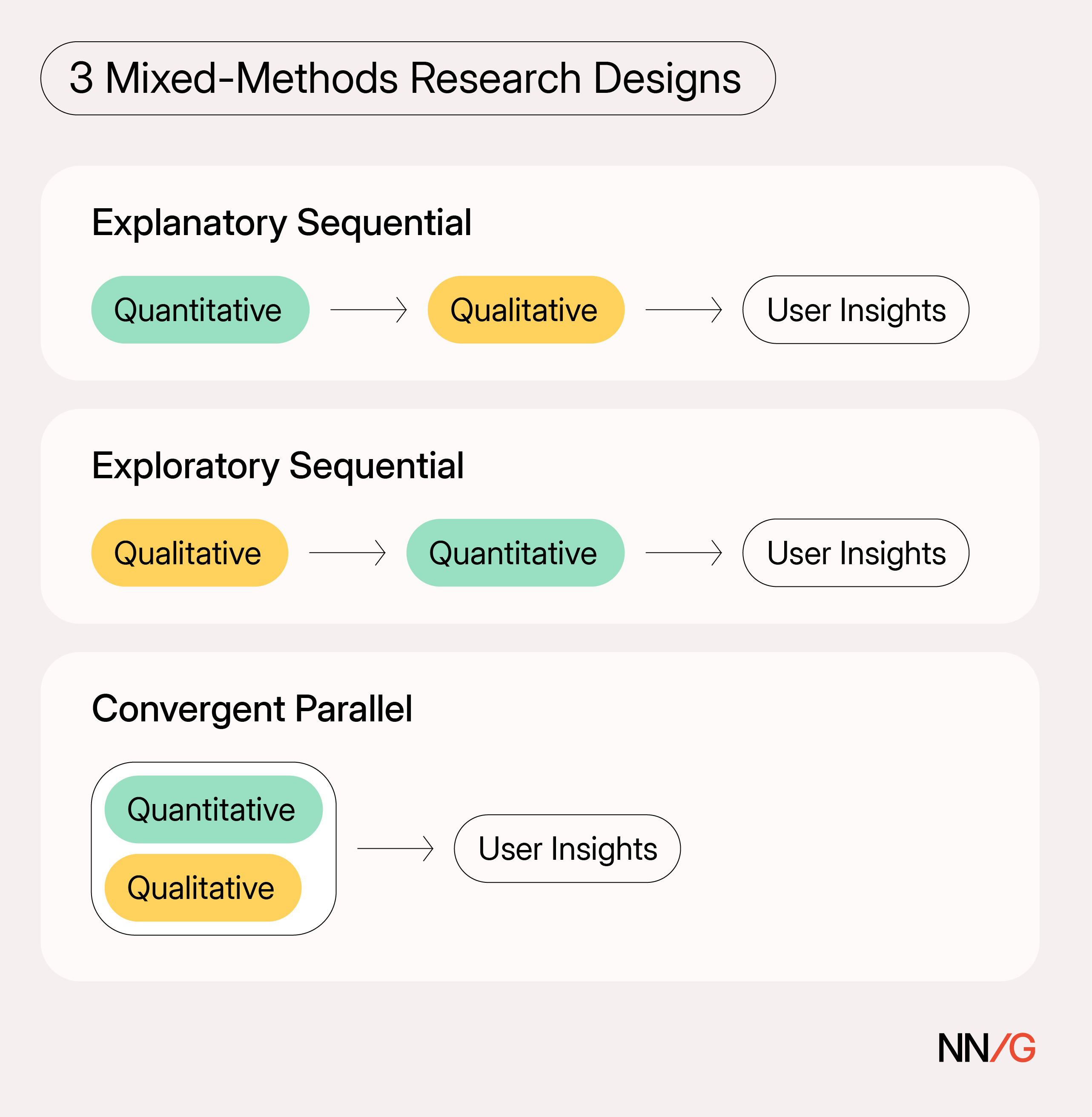
- Convergent parallel: both strands collected simultaneously and merged at interpretation. Useful for validating qualitative themes against survey data, or for explaining unexpected numerical patterns with interview evidence.
- Explanatory sequential: quantitative first, qualitative second to explain the numbers. The quantitative phase identifies patterns or anomalies; the qualitative phase investigates why they exist. Common in education and health research.
- Exploratory sequential: qualitative first to generate constructs or scale items, then quantitative to test them at scale. Particularly useful when no validated instrument exists for the construct under investigation.
- Embedded: one dataset is nested inside a dominant design — for example, open-ended interview questions embedded within a randomised controlled trial to capture participant experience of the intervention.
For annotated dissertation examples across disciplines, the tesify.app guide on choosing the right research methodology approach for your thesis walks through each design type with real study illustrations.
The Four-Question Decision Framework
Adapted from Creswell’s three-worldview model, this framework navigates you to the right research methodology without guesswork:
Question 1 — What kind of knowledge am I producing?
Are you measuring an external reality that exists independently of the observer (post-positivist)? Or are you interpreting meanings that participants construct through lived experience (constructivist)? Your answer establishes your epistemological stance before any method is chosen.
Question 2 — What is my research question actually asking?
Does it seek explanation (does X predict Y?), exploration (how do people experience X?), or both (what intervention works and why does it work for some participants but not others)? Explanation tends toward quantitative; exploration tends toward qualitative; both points toward mixed methods.
Question 3 — What does the existing literature offer?
A well-developed theoretical framework with validated instruments invites you to test it quantitatively. Thin, contested or highly context-specific literature invites you to explore it qualitatively. A strong quantitative base with unexplained variance invites a qualitative follow-up to interpret what the numbers cannot.
Question 4 — What can you realistically access and analyse?
Sample availability, institutional access, time, analytical software and your own skills in statistical modelling or qualitative interpretation all matter. A technically rigorous design you cannot execute produces weaker evidence than a more modest design executed with precision.
Walking through these four questions in sequence prevents the most common methodology error in dissertation research: selecting an approach because it sounds impressive, then retrofitting a research question to justify it after the fact.
Sampling Strategy
Sampling decisions must match your methodology type and be explicitly justified — not just described — in your methodology chapter.

Qualitative Sampling
Purposive sampling is standard in qualitative research. Participants are selected deliberately because they have direct experience of the phenomenon under investigation, not because they statistically represent a population. Sample size is guided by the principle of data saturation — the point at which new data stops generating new conceptual categories. Braun and Clarke (2022) caution explicitly against importing quantitative benchmarks into qualitative sampling decisions: ten in-depth interviews analysed rigorously and reflexively will produce stronger, more defensible findings than forty interviews analysed superficially.
Quantitative Sampling
Probability sampling — random, stratified random or cluster sampling — is preferred when findings must generalise to a defined population. Non-probability sampling (convenience, quota, snowball) is acceptable for exploratory or pilot work but restricts the generalisability claims you can make in your discussion chapter. Sample size must be determined before data collection through power analysis: you specify the expected effect size, alpha level (typically .05) and desired statistical power (typically .80), then calculate the minimum N. Tools such as G*Power make this calculation straightforward for most common designs.
Mixed Methods Sampling
Specify sampling logic separately for each strand. The qualitative sub-sample is typically a purposive subset drawn from, or nested alongside, the quantitative sample. Your methodology chapter must explain both how the two samples are related and why that relationship serves the integration goals of the design.
Research Instruments and Data Collection
A research instrument is any tool used to collect data. The selection and justification of instruments is one of the sections examiners scrutinise most closely.
- Structured questionnaire or validated scale (quantitative): report reliability (Cronbach’s α for internal consistency) and validity (face, content and construct). If you use an existing instrument, cite the original developers and the validation study. If you adapt it, explain every change and its implications for comparability with prior research.
- Semi-structured interview guide (qualitative): allows conversational flexibility while ensuring thematic comparability across participants. Pilot with one or two participants before the main data collection phase and revise your probes based on what you learn.
- Observation protocol (ethnography, classroom or workplace research): documents setting, behaviour and context systematically. Define the unit of observation and the recording interval in advance, and explain how you managed the observer effect.
- Document and artefact analysis (historical, policy or archival research): treat each document as primary evidence and record provenance, date, authorship and institutional context alongside the content itself.
Data Analysis Methods
Qualitative Analysis: Thematic Analysis
Braun and Clarke’s six-phase framework for thematic analysis is the most widely taught qualitative analysis approach in anglophone universities, valued for both its rigour and its theoretical flexibility across disciplines:
- Familiarise yourself with the data — repeated reading, noting initial observations and reactions
- Generate initial codes — systematic labelling of meaningful units across the full dataset
- Search for themes — grouping codes into candidate themes that capture something meaningful about the data
- Review themes — checking candidate themes against the coded data and the full dataset
- Define and name themes — articulating the central organising concept of each theme with precision
- Write up — weaving theme descriptions with illustrative data extracts and theoretical interpretation
Braun and Clarke (2022) emphasise that thematic analysis is an interpretive, theoretical act — not a mechanical coding exercise. Reflexivity is an explicit methodological requirement, not an afterthought: the researcher must articulate how their positionality, assumptions and prior knowledge shape their reading of the data.
Quantitative Analysis: Matching the Test to the Design
The statistical test must be matched to the level of measurement and the research design:
- Comparing two independent groups on a continuous outcome → independent samples t-test
- Comparing three or more groups → one-way ANOVA with post-hoc correction (Tukey or Bonferroni)
- Exploring association between two continuous variables → Pearson’s r (or Spearman’s ρ for non-normal distributions)
- Predicting a continuous outcome from multiple predictors → multiple linear regression
- Predicting a binary outcome → binary logistic regression
- Testing a theoretical model with latent variables → confirmatory factor analysis or structural equation modelling
Report effect sizes alongside significance values in every analysis. A p-value tells you whether a result is likely due to chance; Cohen’s d, η², or r tells you the magnitude of the effect — and magnitude is what determines whether a finding is meaningful in practice, not just statistically detectable.
Writing the Methodology Chapter
A well-structured methodology chapter moves from philosophy to practice in a logical sequence. The following eight-section architecture covers what most institutional guidelines require at master’s and doctoral level:
- Introduction (1–2 paragraphs): restate your research questions and signal your chosen approach — the same two-move logic that drives writing any chapter introduction.
- Research philosophy and paradigm: name your epistemological stance and explain why it is appropriate for your specific question — not just for this general type of research.
- Research design: name the overall design, the specific tradition or strategy within it, and your rationale for choosing it over the most plausible alternatives.
- Participants and sampling: describe who, how many, how recruited, and justify the sample size with reference to saturation, power analysis, or your institutional norms.
- Research instruments and data collection: describe each tool, its administration procedure, and the ethical safeguards in place during collection.
- Data analysis procedure: walk through your analytical framework step by step, naming the software used (SPSS, R, NVivo, ATLAS.ti, MAXQDA) and explaining why it was appropriate.
- Rigour and trustworthiness: in quantitative work, address reliability, internal validity and generalisability; in qualitative work, address credibility, transferability, dependability and confirmability (Lincoln and Guba, 1985).
- Ethical considerations: record ethics approval, informed consent procedure, anonymisation strategy, data storage and the right to withdraw without penalty.
Frequently Asked Questions
What is the difference between research methodology and research methods?
Research methodology is the overarching framework — the philosophical stance, strategic design and justification for how you approach your study. Research methods are the specific techniques nested inside that framework: the interview guide, questionnaire, observation protocol or statistical test you use to collect and analyse data. Methodology explains the architecture; methods are the bricks.
Which research methodology type is best for a dissertation?
There is no universally best type. The right research methodology depends on your question and discipline. Education and social science dissertations often use qualitative or mixed methods designs. Psychology and health science dissertations frequently rely on quantitative designs. Business and management dissertations commonly use mixed methods. The deciding factor is always the research question: what kind of answer are you trying to produce?
How long should the methodology chapter be?
For a master’s dissertation, the methodology chapter is typically 1,500–3,000 words. For a PhD thesis, it may extend to 5,000–8,000 words depending on the complexity of the design. Check your institutional guidelines first, as many programmes specify a range. Length is less important than completeness: every major methodological decision should carry both a description and a justification.
Can I use mixed methods for my thesis?
Yes — mixed methods is a legitimate and increasingly common dissertation design, particularly at postgraduate level. However, it requires demonstrated competence in both qualitative and quantitative approaches, and a clear explanation of how the two strands genuinely integrate rather than simply running in parallel. Choose mixed methods because your research question demands both forms of evidence, not because it sounds more rigorous or comprehensive.
What is positivism vs interpretivism in research?
Positivism (and its successor post-positivism) holds that reality exists independently of the observer and can be measured objectively; it underpins quantitative research. Interpretivism holds that reality is socially constructed and that understanding requires interpretation of meaning from within participants’ contexts; it underpins qualitative research. Most methodology chapters need to name the philosophical stance explicitly and link it to the choice of design.
How do I justify my choice of research methodology?
Justify your methodology by demonstrating alignment across four levels: your epistemological stance, your research question, the state of existing theory in the literature, and your practical constraints. Cite Creswell and Creswell (2023) for the overarching design framework, the relevant tradition scholar (Braun and Clarke for thematic analysis, Charmaz for grounded theory) for your specific approach, and Lincoln and Guba (1985) for trustworthiness criteria in qualitative work. Never justify a method solely by noting that it is widely used — explain why it fits your specific research context.
Draft Your Methodology Chapter with Structured AI Guidance
Articulating your epistemological stance, sampling logic and analysis framework in the coherent language your supervisor and examiners expect is the work most students find hardest to start. Tesify helps you structure and draft your methodology chapter with AI assistance — framing your philosophical position, sampling decisions and analysis approach in a logical sequence that maps to the eight sections above, within the bounds of what your institution permits for AI assistance. Every word remains yours; Tesify gives you the structure and momentum to write it. Start free and have your methodology chapter outlined within minutes.