Best Plagiarism Checker in 2026: Top Tools Ranked & Compared
You have just spent weeks writing a dissertation chapter, and now your submission portal is asking you to confirm it passes an originality check. The question that follows — which plagiarism checker should I actually trust? — trips up more students than it should. Not because the tools are obscure, but because there are too many of them, the marketing is vague about what each one actually scans, and the difference between a 70% and an 88% detection rate can mean the difference between a clean submission and an uncomfortable conversation with your supervisor. This is the best plagiarism checker guide for 2026: hands-on, specific, and genuinely comparative.
The tools covered here — Turnitin, Scribbr, Copyleaks, Grammarly, and QuillBot — represent the full range of what students and researchers actually use, from institutional-grade detection to free browser add-ons. Each section gives you real accuracy figures where independent testing exists, current pricing, what the tool does and does not scan, and a clear verdict on who it is actually for. There is also a section on where Tesify’s built-in originality self-check fits into the workflow and how to use it without over-relying on any single tool.
Scribbr is the best plagiarism checker for students who need thesis-level accuracy and a readable report — it runs on Turnitin’s database at a per-check price accessible to individuals. Copyleaks is the best option if you also need AI-content detection in the same scan. Grammarly Premium suits writers who want plagiarism detection bundled with grammar and style feedback. QuillBot is usable for a rough web-based check but is not reliable enough for final academic submissions. Turnitin itself remains the institutional gold standard but is unavailable to individual students outside a university subscription.
At a Glance: All Tools Compared
| Tool | Best For | Database | AI Detection | Price | Accuracy (independent test) |
|---|---|---|---|---|---|
| Turnitin | Institutions, examiners | Largest (98B+ web pages + paywalled journals) | Yes (AI Writing feature) | Institutional only (custom quote) | Industry benchmark |
| Scribbr | Students — thesis/dissertation | Turnitin-powered (paywalled journals included) | No | $19.95–$39.95 per check | 88% (vs 43% avg for free tools) |
| Copyleaks | AI + plagiarism combo | Web + open-access academic content | Yes (built from ground up) | Free (500-word limit); ~$11/month premium | 81.8% plagiarism detection rate (tested) |
| Grammarly | All-in-one writing + originality | Billions of web pages | Yes (via Premium) | ~$12/month (annual Premium) | Good for web; misses paywalled journals |
| QuillBot | Rough web-based check only | Web only (no paywalled content) | Yes (separate AI detector) | 20 checks/month (Premium); limited free | 79% direct / 41% mosaic detection rate |
Accuracy figures from independent comparative testing. Always verify current pricing on each vendor’s website.
Turnitin — The Institutional Standard
Turnitin is the tool your university almost certainly uses to check your submitted work. Its Similarity Report scans against one of the largest academic databases in existence — billions of web pages, student paper repositories, and critically, paywalled academic journals via partnerships with Elsevier, Springer, IEEE, and others. That last category is what separates Turnitin from every consumer-facing tool: free and low-cost plagiarism checkers cannot reach content behind journal paywalls, and that is exactly where the overlap you care about most is likely to live.
The catch for individual students is that Turnitin does not sell subscriptions directly to individuals. Pricing is entirely institutional — universities pay custom licensing fees based on student volume. If your institution provides access through its learning management system (Moodle, Canvas, Blackboard), you can submit through that channel. Turnitin Draft Coach, available inside Google Docs, is one workaround some universities enable for students to check drafts before final submission — check with your library whether it is available to you.
If your institution does not provide access and you want Turnitin-grade database coverage, Scribbr (covered next) offers it commercially on a per-check basis.
Scribbr — Best Plagiarism Checker for Students in 2026
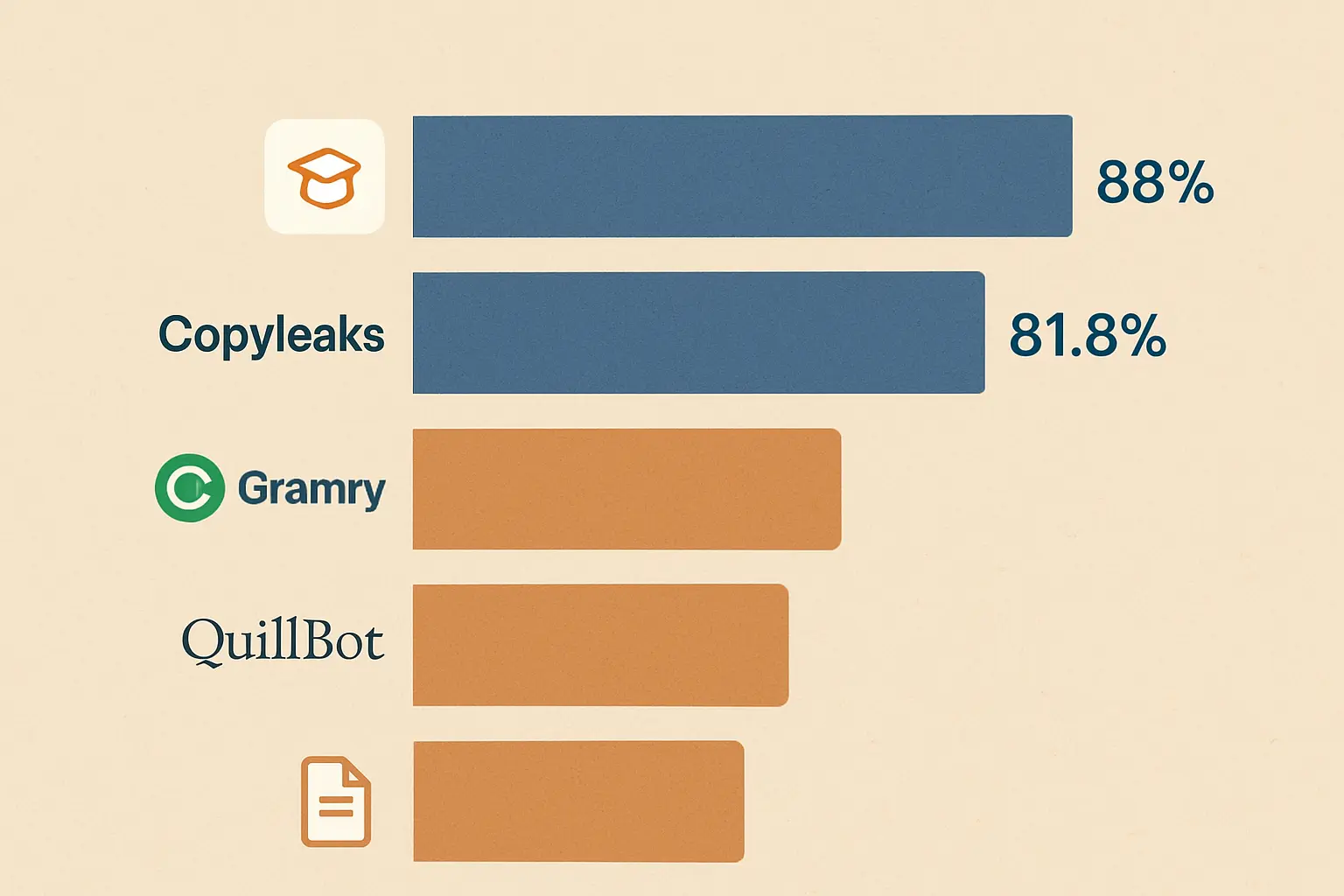
Scribbr is the closest you can get to a Turnitin check without a university login. It is powered directly by Turnitin’s infrastructure, meaning the database coverage — including paywalled academic journals — is the same. Independent comparative testing found Scribbr detected 88% of plagiarised content in test documents, compared to an average of 43% across free tools. In a separate head-to-head test, Scribbr identified 14 out of 20 deliberately plagiarised paragraphs (70%) while QuillBot found only 11 (55%).
The reports are designed for students to understand: they highlight matched passages, link back to sources, and provide guidance on whether each match is a genuine concern or a standard citation. This is meaningfully more useful than a raw similarity number.
Pricing: Scribbr charges per check rather than a subscription — pricing runs from $19.95 for shorter documents up to $39.95 for longer submissions (the exact threshold varies by word count). There is no free tier and no subscription option. For a single dissertation final-submission check, the one-time cost is reasonable. For students who want to run multiple chapter drafts throughout the year, the per-check model adds up.
Copyleaks — Best for AI Detection + Plagiarism in One Scan
Copyleaks is the only tool on this list that was designed from the ground up to treat traditional plagiarism detection and AI-content detection as co-equal priorities rather than bolting one onto the other. Most plagiarism checkers added AI detection as an afterthought in response to ChatGPT; Copyleaks built it into the core detection model from the start.
In independent testing, Copyleaks achieved an 81.8% detection rate for plagiarised content — behind Scribbr but ahead of Grammarly and QuillBot for academic text. On AI detection, it claims up to 99.1% accuracy for unedited AI-generated content, though independent testing shows performance that is strong for fully AI-generated passages but more variable for lightly edited or paraphrased AI text. It also identifies paraphrasing plagiarism, code similarities, and image-based text — useful for technical dissertations and computer science theses.
Pricing: Copyleaks offers a free tier with a 500-word limit per scan — useful for checking individual paragraphs or short passages. Premium plans start at around $11 per month on a subscription basis, or $9–$12 per individual scan. For students who need regular checks across multiple drafts, the subscription model is more economical than Scribbr’s per-check pricing.
Grammarly — Best All-in-One Writing and Originality Tool
Grammarly’s plagiarism detection is included in its Premium plan and scans against billions of web pages. It provides an originality score, highlights matching passages, and links to the sources where the match was found. It also categorises text to distinguish human-written content from AI-generated content when the Premium AI-detection feature is active.
The core limitation for academic use is database scope. Grammarly searches the open web thoroughly — it will reliably catch copied blog posts, Wikipedia passages, and publicly available texts — but it does not have access to paywalled journal databases. A dissertation that lifts a passage from a journal article behind an Elsevier or Springer paywall may not be flagged by Grammarly even though it would be caught by Turnitin or Scribbr. This makes Grammarly genuinely useful as a first-pass check early in the writing process, but not sufficient as a pre-submission originality check for postgraduate work.
Where Grammarly genuinely earns its place is in combining originality checking with grammar, clarity, tone, and style feedback in a single interface. For students who would pay for Grammarly Premium anyway for the writing assistance, the plagiarism checker is a solid bonus rather than a reason to buy on its own. Premium runs at approximately $12 per month on an annual plan, with student discounts periodically available. Grammarly also integrates directly into Word, Google Docs, and most browsers, making it the most frictionless option in daily writing workflow. Researchers writing in English as a second language may also want to compare it against other ESL-focused tools — see the tesify.app guide to the best AI editors for non-native English researchers for a parallel comparison of writing-focused academic tools.
QuillBot — Free Tier with Real Limitations
QuillBot’s plagiarism checker is bundled into its Premium plan, giving subscribers 20 checks per month. It scans the open web for exact and near-exact matches and produces a report with matched passages and source links. Independent testing puts QuillBot’s direct plagiarism detection rate at 79% and its mosaic or paraphrasing plagiarism detection rate at 41% — the lowest figures among the tools on this list.
The 41% mosaic detection rate is the figure that matters most for academic writing. Students who paraphrase source material rather than lifting it verbatim are exactly the cases QuillBot misses at a rate that should give you pause before relying on it for a pre-submission check. QuillBot also explicitly does not scan paywalled academic databases — its coverage is web-only, which mirrors Grammarly’s limitation at a lower accuracy ceiling.
QuillBot’s real strength is its paraphrasing tool, which is a separate feature from the plagiarism checker. If you are using QuillBot to rewrite passages, running the plagiarism check on the rewritten output is a sensible practice. But the plagiarism checker should not be your primary defence against accidental similarity in a formal academic submission. For a broader look at how QuillBot fits into the student writing toolkit, the ranked guide to the best AI writing tools for students covers it alongside Grammarly, Tesify, and other tools in context.
Tesify Originality Self-Check: Where It Fits in the Workflow
Tesify is an AI thesis and dissertation assistant — its primary function is helping you structure, draft, and properly reference your academic work. As part of that workflow, it includes an originality self-check that runs on text you generate with it. This is an integrity-first feature: the goal is to help you understand and maintain the originality of your work during the writing process, not to simulate what Turnitin will report after submission.
That distinction matters. Tesify’s originality self-check is most useful at the drafting stage — it flags passages where the AI-assisted output has stayed too close to source material and prompts you to rework those sections before they ever reach a formal plagiarism checker. Think of it as a real-time integrity guardrail rather than a replacement for a Scribbr or Copyleaks scan before you submit.
Used in sequence — Tesify for originality-conscious drafting, then a Scribbr or institutional Turnitin check before final submission — you have covered both ends of the process. The Tesify approach also connects naturally to the practices covered in our guide to proven, integrity-first strategies for avoiding plagiarism, where the emphasis is on building originality into the writing process rather than patching similarity scores after the fact.
Tesify helps you structure and draft your thesis with proper citations in APA, MLA, Chicago, or Vancouver — and its built-in originality self-check means you catch similarity issues during writing, before they reach a formal submission check.
How to Choose the Right Plagiarism Checker for Your Situation
| Your situation | Best tool |
|---|---|
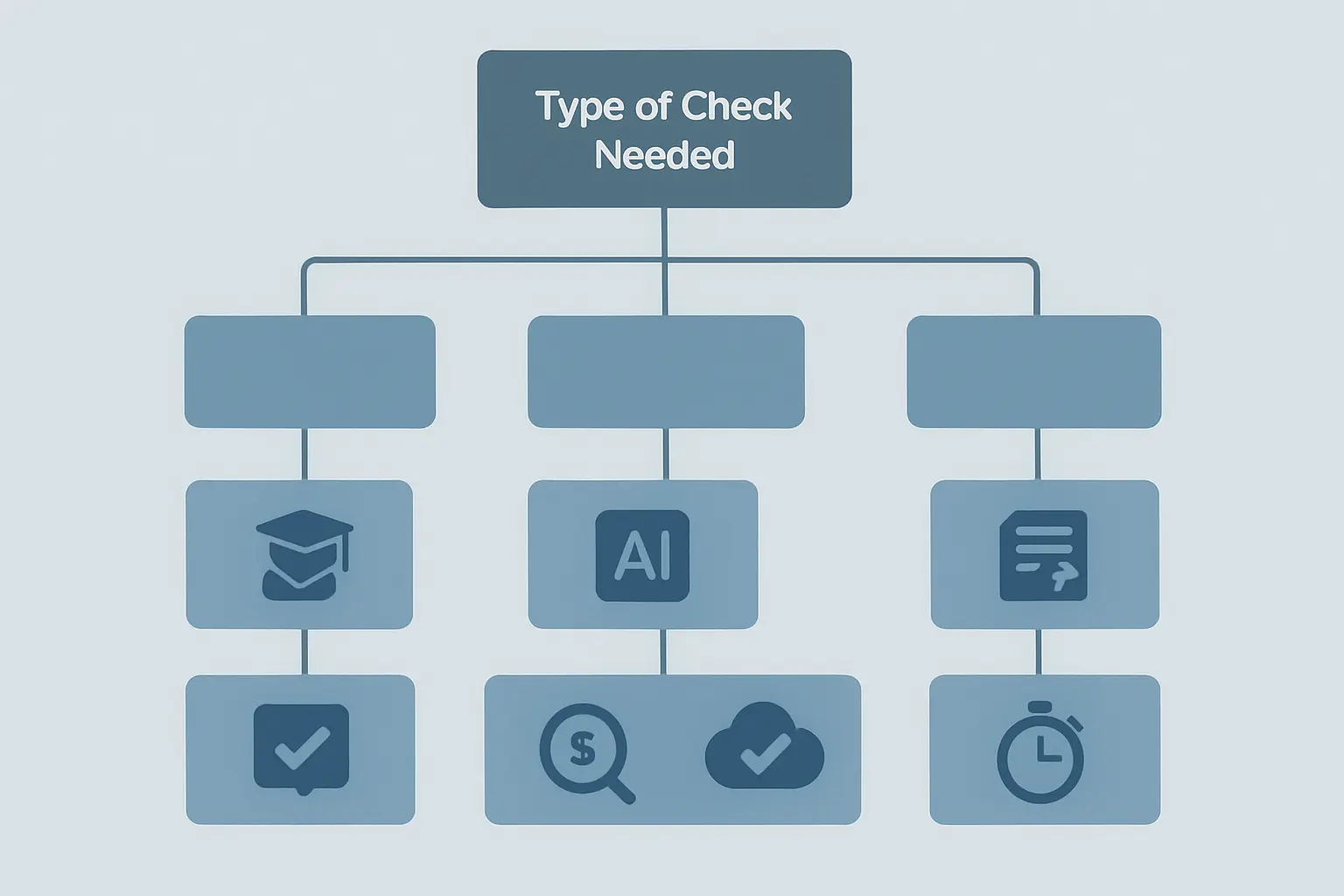
| Final pre-submission check for a thesis or dissertation | Scribbr — Turnitin database, highest accuracy for academic content |
| You need AI-content detection and plagiarism in one tool | Copyleaks — built-in AI detection with strong plagiarism coverage |
| You want grammar + originality feedback throughout writing | Grammarly Premium — best all-in-one writing + web-based originality check |
| Quick free check on a short draft passage | Copyleaks free tier (500 words) or QuillBot free — with accuracy caveats |
| Institutional check — university-submitted work | Turnitin via your university’s LMS — the only option with full paywalled journal access |
| Writing thesis chapters with AI assistance and want real-time integrity check | Tesify — originality self-check built into the drafting workflow |
| Regular citation management to prevent accidental plagiarism | A reference manager — see our Zotero vs Mendeley comparison to choose the right one |
One final note: if you are building your academic writing toolkit from scratch, plagiarism checking is just one layer. A reference manager (Zotero or Mendeley) handles the citation side; the plagiarism checking process itself is a separate skill worth understanding before you sit in front of any tool.
Frequently Asked Questions
Which plagiarism checker is most accurate for academic writing in 2026?
Scribbr is the most accurate plagiarism checker available to individual students in 2026, achieving 88% detection accuracy in independent comparative testing versus an average of 43% for free tools. This advantage comes from its use of the Turnitin database, which includes paywalled academic journals that free web-based tools cannot access. Turnitin itself is more comprehensive but is only available through institutional subscriptions.
Can students access Turnitin directly without a university account?
No. Turnitin sells licences only to educational institutions and does not offer individual student subscriptions. Students who want Turnitin-level database coverage can use Scribbr, which runs on Turnitin’s infrastructure and is available to individuals on a per-check basis ($19.95–$39.95 per document). Some universities also provide students with access to Turnitin Draft Coach inside Google Docs — check your library or writing centre for details.
Does Grammarly’s plagiarism checker work for academic papers?
Grammarly’s plagiarism checker (included in Premium, around $12/month annually) scans billions of web pages and is effective at catching content that matches publicly available online sources. However, it does not access paywalled academic databases — if a paper borrows from journal articles behind a paywall, Grammarly will not flag it. For coursework and early drafts, Grammarly’s check provides a useful baseline. For a thesis or dissertation pre-submission check, supplement it with Scribbr or your institution’s Turnitin access.
Is QuillBot’s plagiarism checker reliable for students?
QuillBot’s plagiarism checker is included with Premium and is adequate for a rough first-pass check on web-visible content. Independent testing found a 79% direct plagiarism detection rate and a 41% mosaic (paraphrasing) detection rate — significantly lower than Scribbr or Copyleaks. It also does not scan paywalled academic journals. It is not recommended as the primary check before a formal academic submission, but it is useful for quick self-checks during drafting, particularly after using QuillBot’s paraphrasing tool.
Should I use a plagiarism checker or a reference manager to avoid academic misconduct?
Both, at different stages. A reference manager like Zotero or Mendeley prevents accidental plagiarism by keeping every source tracked and ensuring every citation is correctly formatted — it is the preventive layer. A plagiarism checker is the verification layer: you run it on a finished or near-finished draft to confirm that your citations and paraphrasing are clean. Using only a plagiarism checker without proper citation management is like checking your seatbelt after the crash. See our guide to integrity-first plagiarism avoidance strategies for the full workflow.
Does Copyleaks detect AI-generated content as well as plagiarism?
Yes. Copyleaks is one of the few tools designed to handle both traditional plagiarism detection and AI-content detection within the same scan. It claims up to 99.1% accuracy for detecting unedited AI-generated text, though accuracy decreases for content that has been significantly edited or paraphrased after AI generation. For students who need to demonstrate that AI was used responsibly — or avoid false positives from AI detection — Copyleaks provides more granular reporting than most alternatives.