
How to Email a Potential PhD Supervisor in 2026: Templates That Get a Reply
The difference between a promising PhD application and a missed opportunity often comes down to a single cold email. Professors at research-intensive universities receive dozens — sometimes hundreds — of unsolicited enquiries each term, and most are deleted within ten seconds. The ones that survive share a recognisable pattern: they are specific, concise, and demonstrate that the applicant has done genuine intellectual homework. Knowing how to email a potential PhD supervisor effectively is therefore one of the highest-leverage skills you can develop before your application cycle opens.
This guide walks through every stage of the process: when to reach out, how to research a supervisor’s current work, what to put in each paragraph, three copy-paste templates you can adapt today, and the follow-up etiquette that keeps you on a professor’s radar without becoming an annoyance. Practical email templates appear in formatted blocks below — ready to personalise and send.
Why the First Email Matters More Than You Think
In many PhD systems — particularly in the UK, Australia, Canada, and increasingly the US — a professor’s willingness to supervise you is a prerequisite for admission, not an afterthought. Admissions committees routinely ask applicants whether a faculty member is prepared to work with them. A warm response from a supervisor can strengthen an otherwise borderline application; sustained silence can sink a strong one.
The email also functions as a writing sample in miniature. A supervisor reading your message is simultaneously evaluating your clarity of thought, your familiarity with their field, and your professional communication — qualities they will be living with for three to five years if they agree to take you on. A review published in PLOS Computational Biology, Ten Simple Rules for Choosing a PhD Supervisor, notes that the supervisor relationship is one of the most consequential decisions a doctoral student makes — the initial impression formed during outreach is already part of that dynamic.
Timing is equally important. Reaching out 6–8 weeks before your target programme’s application deadline gives the professor time to respond, have a brief conversation, and confirm their availability — without the pressure of a looming close date. Emailing the week before a deadline signals poor planning.
Research the Supervisor Before You Write a Word
Generic emails fail because supervisors recognise them instantly. Before you open a new draft, spend at least one hour doing the following:
- Read their two or three most recent papers (published within the last two years). Google Scholar, ResearchGate, and the supervisor’s departmental profile all surface recent output. You do not need to master every statistical method — but you do need a genuine, specific reaction to what you read.
- Check their current PhD student roster. Most faculty pages list active and completed doctoral students. If a supervisor already has five ongoing students, they may not be taking new ones. A short roster signals available capacity.
- Look for active grants. UK Research Councils (UKRI), the Australian Research Council (ARC), the Natural Sciences and Engineering Research Council (NSERC) in Canada, and US federal agencies publish award data online. An active grant often means a funded PhD position exists or will materialise soon — see our round-up of fully funded PhD programs in 2026 for the main sources to monitor.
- Identify one specific methodological or conceptual point from their recent work that connects to your own background or research interests. This one sentence is what separates your email from every other one in their inbox.
This preparation takes time, but it is what allows five personalised emails to outperform fifty identical ones. For a broader checklist of what to evaluate in a potential supervisor, DiscoverPhDs offers a useful decision framework alongside email guidance.
Anatomy of an Effective PhD Outreach Email
Subject line
Keep the subject line under 60 characters. Avoid vague openers like “Enquiry” or “PhD Interest.” The most reliable formats are:
- Prospective PhD Student — [Your Specific Research Area]
- PhD Enquiry: [Their Paper Topic / Research Area]
- Doctoral Research Enquiry — [Your Name], [Your University]
Opening greeting
Always use “Dear Professor [Surname]” or “Dear Dr [Surname].” Check their departmental page for the correct title — addressing a full professor as “Dr” or a postdoc as “Professor” signals carelessness. When in doubt, “Dear Professor [Surname]” is universally appropriate.
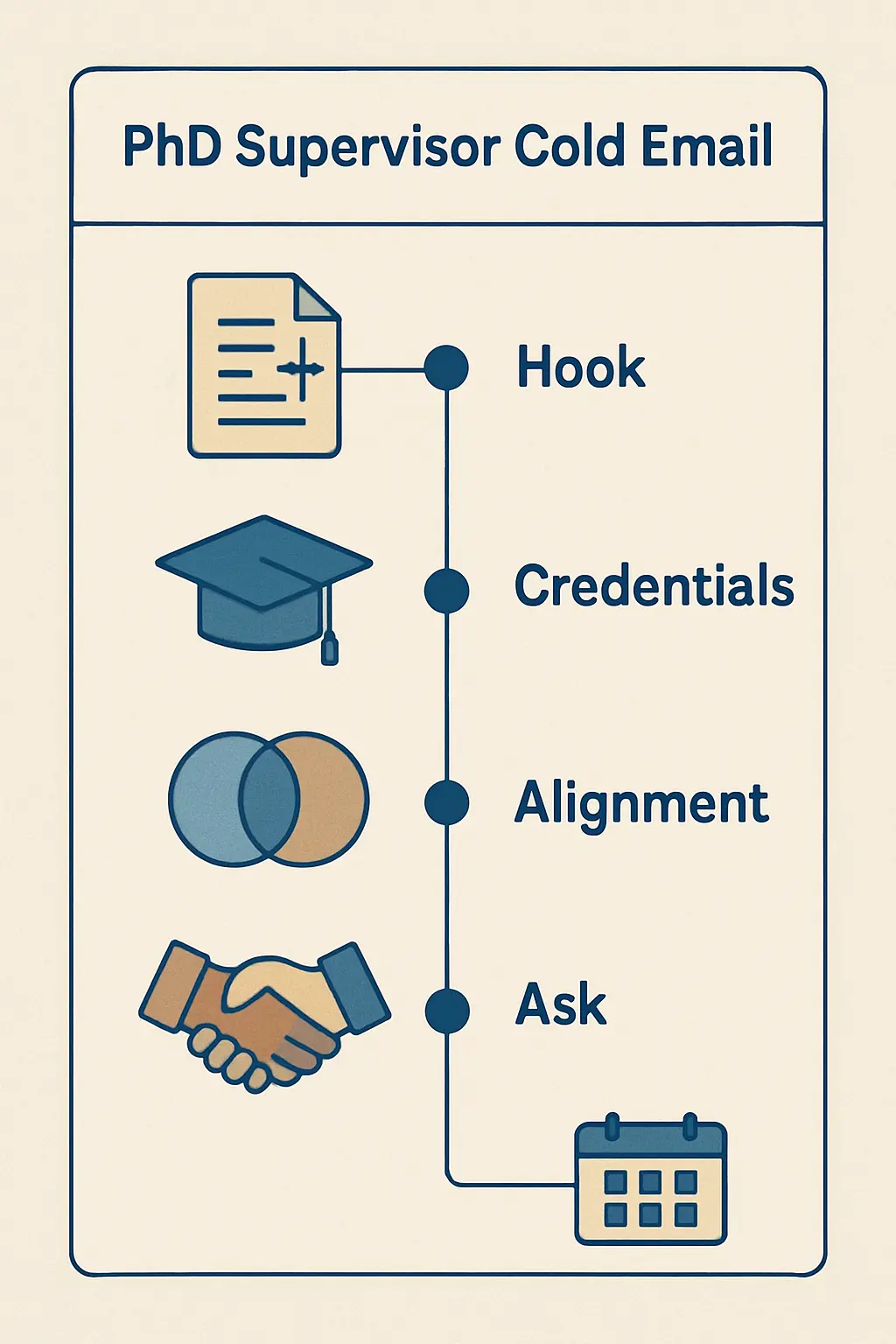
The four-paragraph body structure
- Paragraph 1 — The hook (2–3 sentences): Reference a specific paper or project of theirs. State one concrete thing you found insightful or that connects to a gap you have identified. Do not open with “My name is…” — the supervisor can read that in the sender field.
- Paragraph 2 — Who you are (2–3 sentences): Your degree, institution, and one or two research experiences (thesis topic, published paper, lab placement, fieldwork) directly relevant to their work. Quantify where you honestly can.
- Paragraph 3 — The alignment (2–3 sentences): Connect your background explicitly to their current research agenda. Propose a broad research direction you would want to pursue under their supervision. Be specific enough to be credible, open enough to invite dialogue.
- Paragraph 4 — The ask (1–2 sentences): Make a small, concrete, easy-to-say-yes-to request: a 20-minute video call, confirmation of PhD availability for the upcoming cycle, or feedback on your emerging research idea. Do not ask them to read your CV as a standalone request — attach it and reference it briefly.
Attachments
Attach a one-page CV and, if available, a one-to-two-page research outline. Do not embed lengthy documents in the email body. Name your files clearly: YourName_CV.pdf and YourName_ResearchOutline.pdf.
Three Copy-Paste Email Templates
Each template follows the four-paragraph structure above. Replace everything in brackets with accurate, personalised information — do not send any template verbatim.
Template 1 — Standard first contact (no specific funded position)
Subject: Prospective PhD Student — [Your Research Area], [Your Name]

Dear Professor [Surname],

I read your recent paper "[Full Paper Title]" ([Year], [Journal]) with genuine
interest, particularly your argument that [one specific claim or finding]. This
connects directly to a question I encountered in my own research: [one-sentence
description of the gap or follow-on question].

I am currently completing a [degree type] in [discipline] at [university], where
my thesis investigates [brief thesis description]. Previously, I spent [X months]
as a [research assistant / intern / fieldworker] with [organisation or lab],
where I [specific relevant task or finding].

My planned doctoral research would explore [broad research question], which I
believe aligns closely with your work on [their specific agenda]. I would welcome
the opportunity to develop this direction under your supervision.

Are you currently taking on new PhD students for the [year] intake? I have
attached my CV and a brief research outline, and I would be grateful for a short
call at your convenience.

Yours sincerely,
[Your Full Name]
[Degree & Institution] | [Email] | [LinkedIn or personal website, optional]
Template 2 — Applying for a specific funded position or scholarship
Subject: PhD Application — [Funded Project Title / Scholarship Name], [Your Name]

Dear Professor [Surname],

I came across the [funded PhD position / scholarship] in [research area] listed
on [platform or website] and wanted to reach out before submitting a formal
application. Your project on [project title or topic] addresses a question I have
been approaching from my own angle: [your specific angle in one sentence].

I hold a [degree] in [field] from [institution], graduating [month/year]
[with distinction / with a GPA of X, if strong]. My final-year thesis on [topic]
used [methods] to examine [brief finding], and I believe this methodological
background maps directly onto the proposed project.

The [scholarship/position] aligns with my goal of [your research goal], and I am
particularly drawn to [one specific aspect of their project] as a doctoral focus.
I have reviewed the funding body's eligibility requirements and believe I meet
the criteria.

I have attached my CV and a two-page research proposal for your review. Would
you be willing to discuss whether my profile is a strong fit for this opportunity?

Kind regards,
[Your Full Name]
[Degree & Institution] | [Email]
Template 3 — Email after reading a specific paper (paper-first approach)
Subject: PhD Enquiry: Your Work on [Paper Topic], [Your Name]

Dear Dr [Surname],

Your [Year] paper "[Full Title]" shifted how I think about [concept]. The way
you [specific method or argument] opened a question I have been working towards:
[your follow-on research question in one sentence]. I would like to pursue this
as a doctoral project, and I am writing to ask whether you have capacity to
supervise.

My background: I completed a [degree] in [field] at [institution] ([year]),
with a thesis on [topic] using [method]. I also have [relevant experience:
internship, publication, dataset access, fieldwork] that connects directly to
the direction I am proposing.

I am envisioning a project that [two-sentence research sketch connecting your
question to their existing agenda]. I believe the question sits squarely within
your current research programme and would benefit from the methodological
approach your group has developed.

I have attached a brief research outline (2 pages) and my CV. If you are open
to supervising in this area, I would be grateful for a short conversation to
explore whether there is a fit.

With best regards,
[Your Full Name]
[Degree & Institution] | [Email]
Attach a Polished Research Proposal
A brief research proposal attached to your email significantly increases the quality of responses you receive. It signals seriousness, gives the supervisor something concrete to assess, and makes any follow-on conversation far more productive. Your outline should include a working title, a clearly stated research question, a brief literature context placing the question in the field, a preliminary methodology, and a note on why this supervisor’s expertise is relevant to your proposed approach.
Many applicants struggle to pitch this document at the right level — too broad and it reads as unfocused; too narrow and it fails to interest a supervisor who wants intellectual headroom. If you are drafting your proposal alongside other application documents, Tesify can help you structure your arguments and ensure the outline reads as a coherent, well-organised document before it lands in a professor’s inbox. For a section-by-section walkthrough of what belongs where, see our guide to writing a research proposal step by step.
Follow-Up Etiquette
Professors are busy. Not receiving a reply within the first week does not mean a rejection — it usually means a crowded inbox. The appropriate follow-up sequence is straightforward:
- Wait 10–14 days after your initial email before sending any follow-up.
- Send one follow-up only, forwarding the original email with a brief two-sentence note: something like “I wanted to follow up on my message below in case it was missed. I remain very interested in the possibility of doctoral research under your supervision and would welcome any response at your convenience.”
- Do not send a third message. If you have followed up once and heard nothing, move to the next supervisor on your list. A non-response after two emails is a clear signal that this professor cannot take a new student, is on sabbatical, or the research direction is not a match.
If you receive a reply that is warm but non-committal (“interesting, but I don’t have funding right now”), treat it as a soft open door. Ask whether they would be willing to discuss your application for the following intake cycle, or whether they could recommend a colleague working in an adjacent area who might have capacity. A gracious, low-pressure follow-up to a partial positive is often what secures the relationship.
Seven Mistakes That Get Your Email Ignored
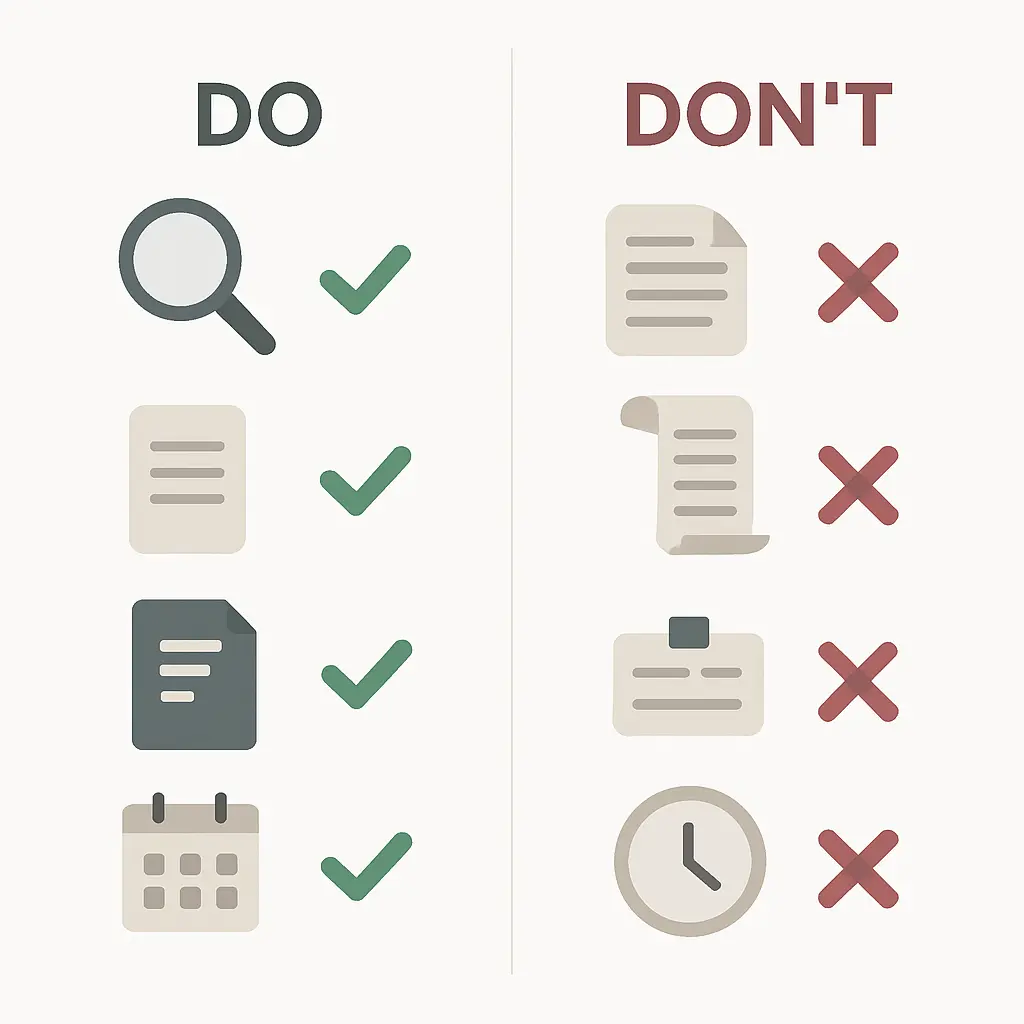
- Sending a mass-template. Professors recognise copy-paste emails immediately. If your message could be sent to any faculty member in the department without changing a single word, it will be deleted.
- Making it too long. An email that requires scrolling from an unknown sender will rarely be read in full. Aim for under 250 words in the body — put the detail in your attached CV and proposal.
- Getting the title wrong. Calling a professor “Dr” when they hold a chair, or “Professor” when they are a postdoctoral researcher, signals a failure to do even basic fact-checking.
- Opening with “My name is…” Your name appears in the sender field. Open instead with something that gives the professor a concrete reason to keep reading — a specific, accurate reference to their own work.
- Making an oversized ask in the first email. “Could you read my 15-page writing sample and tell me if you would supervise me?” is enormous for a stranger. A 20-minute call is not. Scale the ask to the relationship.
- Contacting supervisors too late. Reaching out two weeks before a programme deadline forces a quick decision without adequate time to assess your profile — and signals poor planning.
- Failing to proofread. A typo in the professor’s name, their paper title, or your own institution’s name is an immediate signal — and not a positive one. Read the email aloud before sending.
Frequently Asked Questions
How long should an email to a potential PhD supervisor be?
Aim for 150–250 words in the email body. This is long enough to demonstrate genuine knowledge of the supervisor’s work and your own credentials, but short enough to read in under 60 seconds. Attach a CV and research outline for the detail — do not embed everything in the body.
When is the best time to email a potential PhD supervisor?
Contact a potential supervisor 6–8 weeks before the admissions deadline for your target programme. This gives time for a response, a brief conversation, and confirmation of their willingness to supervise before you submit your formal application. Avoid August and the first two weeks of January, when many academics are on leave or catching up after breaks.
Do I need to contact a supervisor before applying for a PhD?
It depends on the institution and country. In the UK, Australia, New Zealand, and Canada, pre-application contact is strongly recommended — many programmes will ask whether you have identified a willing supervisor. In the US, formal pre-contact is less common for departmental PhD programmes, but reaching out to faculty whose work aligns with yours is still widely practised and beneficial. Always check individual programme guidance.
What should I attach to my first email to a PhD supervisor?
Attach a concise academic CV (one to two pages) and a brief research outline or proposal (one to two pages). Do not attach your full master’s thesis at this stage — if the supervisor is interested, they will ask for more. Name files clearly: YourName_CV.pdf and YourName_ResearchOutline.pdf.
How many PhD supervisors should I contact?
Five to ten highly personalised emails to carefully selected supervisors consistently outperforms blasting fifty generic messages. Focus on professors whose recent publications directly overlap with your proposed research direction. Quality of targeting matters far more than volume.
Is it acceptable to email a PhD supervisor in another country?
Yes. International applications to PhD programmes in the US, UK, Canada, Australia, and Europe are extremely common, and supervisors expect to receive enquiries from applicants worldwide. Mention your intended funding source — whether a scholarship, self-funding, or a government scheme — to address the most immediate practical question they will have. Our guide to PhD scholarships in 2026 covers the main international funding sources worth mentioning.
Ready to strengthen your full application?
A well-crafted email opens the door — a polished statement of purpose closes it. Whether you are targeting programmes with fully funded PhD positions or exploring the broader landscape of PhD scholarships, your writing quality is the single most controllable variable in the admissions process. Start with Tesify free →