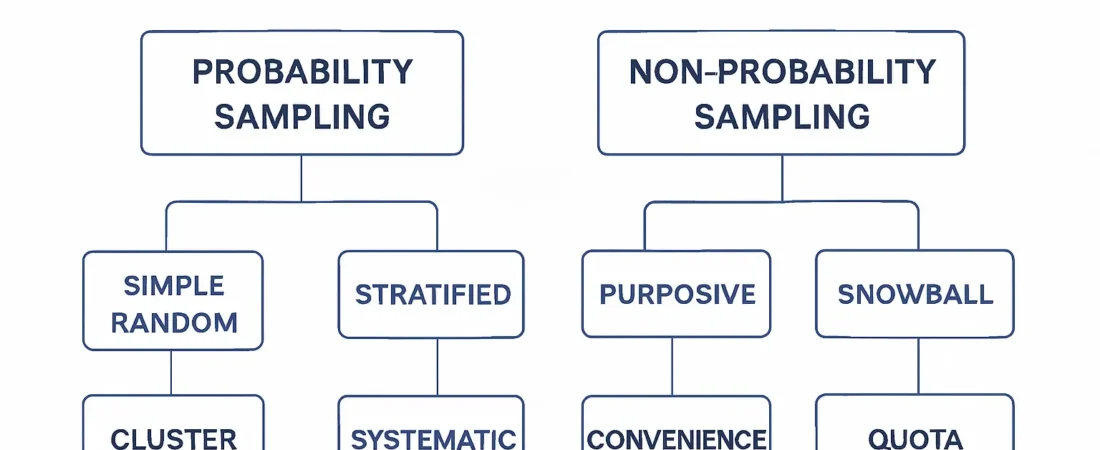
Sampling Methods in Research (2026): Probability vs Non-Probability Explained with Examples
Choosing the wrong sampling methods in research can unravel an otherwise sound study before a single data point is collected. Supervisors flag it, examiners question it, and peer reviewers reject manuscripts on it — yet the sampling decision is often treated as an afterthought. Whether you are recruiting twenty interview participants for a phenomenological inquiry or drawing a nationally representative survey panel, your sampling strategy must be driven by your research questions and epistemological position, not by convenience or convention.
This guide works through every major probability and non-probability technique with concrete examples, lays out the logic behind sample size decisions, and shows you exactly how to write and justify your sampling approach in a methodology chapter so that examiners cannot fault it.
What Is Sampling and Why It Matters
A population in research terms is every element you want to draw conclusions about — every undergraduate student in the UK, every small business in Lagos, every GP surgery in Ontario. Because studying the entire population is rarely feasible, researchers select a sample: a manageable subset from which findings can, under the right conditions, be extended back to the whole.
The mechanism of selection — the sampling method — determines what kind of claims you can legitimately make. Use a probability method correctly and you can apply inferential statistics and speak to representativeness. Use a non-probability method and you may still produce deeply valuable knowledge, but your conclusions are bounded by the logic of purposeful selection rather than statistical generalisation. Conflating the two is one of the most common methodology-chapter weaknesses that examiners cite in viva reports.
A useful framing comes from the distinction between a target population (all elements you intend to generalise to) and a sampling frame (the list or mechanism from which you actually draw your sample). The gap between these two — known as coverage error — should be acknowledged in every methodology chapter, regardless of the method chosen. For a rigorous discussion of how sampling sits within the broader design decision, see our guide to research methodology types and how to choose between them.
Probability Sampling Methods
Probability sampling methods share a defining feature: every element in the sampling frame has a known, non-zero probability of selection. That property is what permits estimation of sampling error and construction of confidence intervals — the bedrock of design-based statistical inference.
Simple Random Sampling
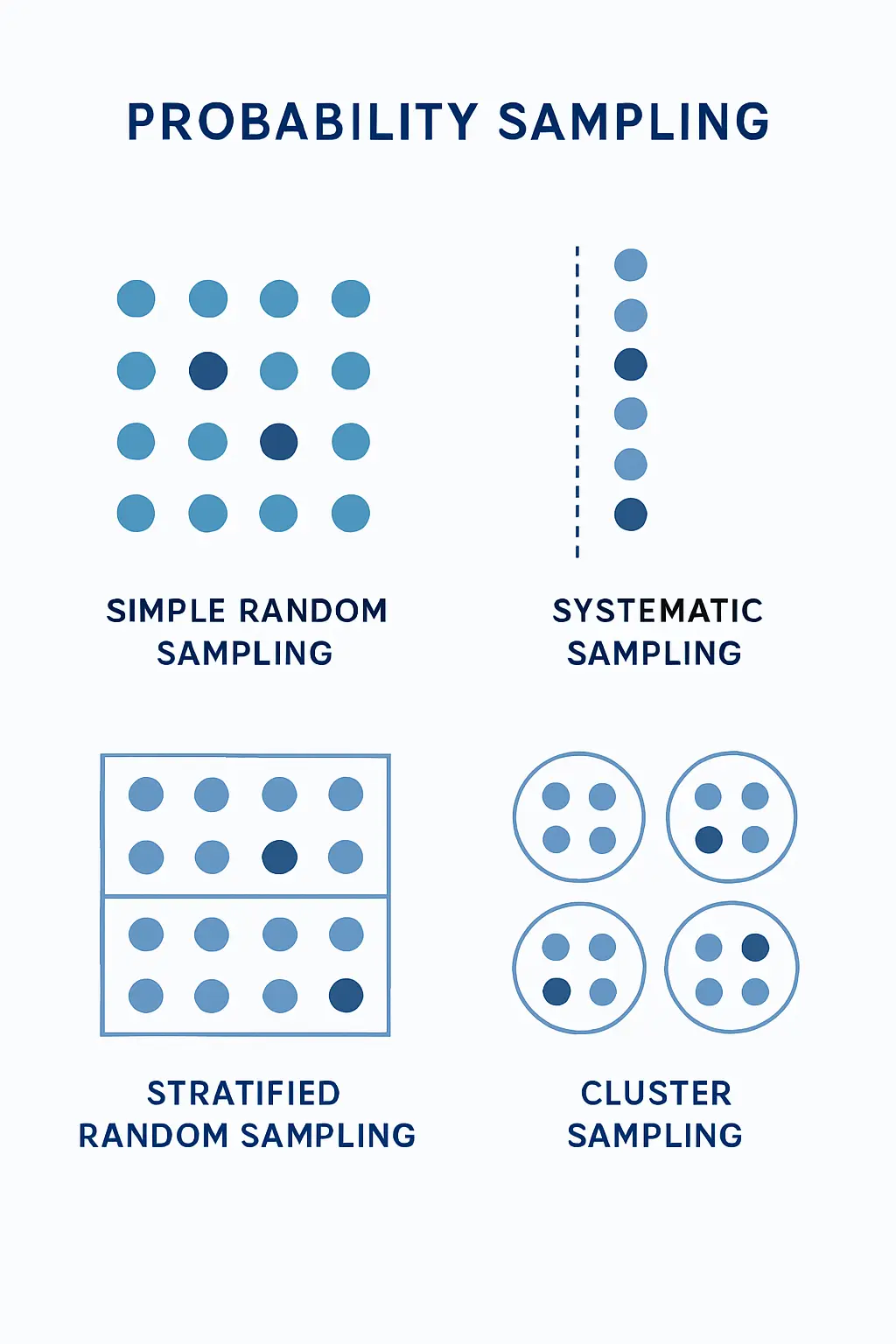
Each unit in the sampling frame is assigned a unique identifier, and selections are made using a random number generator or randomisation table. It is the conceptual benchmark against which all other methods are measured, because it minimises selection bias and ensures an unbiased estimator of the population parameter.
Worked example: A study of student satisfaction at a university with 12,000 enrolees randomly selects 370 student IDs from the institutional database. Every student had an equal chance of selection. The sample size of 370 is derived from Cochran’s formula at a 95% confidence level and ±5% margin of error (see below).
When to use it: When you have a complete, accessible sampling frame and the population is relatively homogeneous. Its main limitation is logistical: in large, geographically dispersed populations, reaching randomly selected individuals becomes prohibitively expensive.
Systematic Sampling
Select a random starting point between 1 and k, then select every k-th element thereafter, where k = population size ÷ desired sample size. It produces properties similar to simple random sampling and is considerably faster when working from a physical or ordered list.
Worked example: An audit of 2,000 hospital admission records targets 200 records. The researcher randomly picks a starting record between 1 and 10, then selects every 10th record. The key check: does a weekly cycle in admission patterns mean every 7th record is systematically different? Periodicity of that kind introduces bias — an issue to address in the methodology chapter.
Stratified Random Sampling
The population is divided into mutually exclusive subgroups (strata) based on a variable relevant to the research question — gender, income band, academic year, geographic region. A random sample is then drawn independently from each stratum.
With proportional allocation, each stratum contributes to the sample in proportion to its size in the population. With disproportional (or optimal) allocation, smaller or higher-variance strata are deliberately over-sampled to ensure adequate cell sizes for subgroup analysis.
Worked example: A study of doctoral completion across three discipline clusters — STEM, Social Sciences, and Humanities — stratifies the population by discipline and draws 120 participants per stratum, even though Humanities doctoral students constitute only 18% of the total population. The disproportional design enables robust subgroup comparisons that proportional allocation would prevent.
Cluster Sampling
Rather than sampling individuals directly, the researcher randomly selects naturally occurring groups (clusters) — schools, wards, firms, districts — and then either surveys all members of each selected cluster (single-stage) or draws a random sub-sample from each cluster (multi-stage or two-stage sampling).
Worked example: A national literacy study randomly selects 40 primary schools from a master list of 800 (the cluster stage), then randomly samples 15 classrooms per school (the second stage). Instead of constructing and managing a list of 200,000 pupils, the researcher only needs class lists for the 40 selected schools — a dramatic logistical saving.
The cost is statistical efficiency. Because pupils within the same school are more similar to each other than to pupils in other schools, cluster samples carry a design effect — a multiplier that inflates the required sample size compared to a simple random sample of equal size. This intra-cluster correlation must be accounted for in both the sample size calculation and the analysis. Guidance on design effects in cluster designs is discussed in detail by Donner and Klar (International Journal of Epidemiology).
Non-Probability Sampling Methods
Non-probability sampling does not assign known selection probabilities to population elements. That does not make these methods weak — it makes them appropriate for different epistemological purposes, particularly when your interest is in meaning, experience, or access rather than statistical representativeness.
Purposive (Judgmental) Sampling
The researcher deliberately selects participants who possess characteristics central to the research question. As Creswell (2013) frames it, purposive sampling is guided by the principle of information richness — you seek the cases most likely to illuminate the phenomenon under study, not the most typical or randomly drawn cases.
Worked example: A study of how first-generation doctoral students navigate supervision relationships purposively recruits only students who are the first in their immediate family to attend university and are currently enrolled in a doctoral programme. Volunteers who do not meet both criteria are excluded regardless of willingness to participate. The boundaries are explicit and pre-specified — a marker of methodological rigour in qualitative work.
Convenience Sampling
Participants are selected because they are readily available — students in the researcher’s own classes, colleagues who respond to a departmental email, social media users who click a survey link. It is fast and inexpensive, but its limitations must be addressed transparently in the methodology chapter.
Convenience sampling is widely accepted in pilot studies, experimental psychology, and exploratory qualitative work where the priority is testing an instrument or procedure, not generating a representative estimate. The key obligation is honesty: name it, justify it, and specify the boundary it places on your conclusions.
Snowball Sampling
Initial participants nominate further participants from their networks. Each recruitment wave expands outward. The technique is particularly valuable for hard-to-reach or hidden populations — undocumented migrants, survivors of specific traumas, practitioners of niche professional roles — where no sampling frame exists and cold recruitment would be ineffective.
Worked example: A study of informal peer-support networks among newly arrived refugees begins with three participants identified through a community organisation. Each refers two further contacts; across four recruitment waves the researcher reaches 27 participants with lived experience of the phenomenon under study. A key limitation acknowledged in the methodology: homophily (people tend to refer others similar to themselves) may narrow the range of perspectives captured.
Quota Sampling
The researcher defines demographic or characteristic quotas that mirror the population — 50% women, 30% postgraduate students, 20% part-time enrolees — then fills those quotas using any available means, typically convenience or purposive selection within each cell. It is a deliberate attempt to add compositional structure to a non-probability design without the cost of full random selection. The distinction from stratified random sampling is critical: within each quota cell, selection remains non-random.
Probability vs Non-Probability Sampling Methods in Research: At a Glance
| Feature | Probability Sampling | Non-Probability Sampling |
|---|---|---|
| Selection basis | Random, known probabilities | Judgment, availability, criteria |
| Generalisation | Statistical generalisation supported | Analytic or transferable generalisation |
| Typical paradigm | Post-positivist, quantitative | Interpretivist, qualitative |
| Requires sampling frame? | Yes | No |
| Sample size logic | Power analysis or Cochran’s formula | Saturation or purposive adequacy |
| Typical sample size | Hundreds to thousands | Tens (qualitative: 6–30 common) |
| Key strength | Representativeness, low selection bias | Flexibility, depth, access |
| Common methods | SRS, systematic, stratified, cluster | Purposive, convenience, snowball, quota |
How to Choose the Right Sampling Method
The choice should flow from four questions answered in sequence:
- What is your research question asking? A question about prevalence or causal effect across a population calls for probability sampling. A question about lived experience or meaning-making calls for purposive non-probability sampling. See the full decision framework in our guide to qualitative vs quantitative research.
- Does a complete sampling frame exist? If there is no reliable list of your population, probability sampling is not achievable — not a fallback, but a genuine constraint. Non-probability methods are then the only option and a legitimate one, provided the rationale is made explicit.
- What are your access and resource constraints? Cluster sampling dramatically reduces travel costs in geographically dispersed populations; convenience sampling is honest when time and access are genuinely limited, provided limitations are disclosed.
- What does your epistemological position commit you to? If you are working within a post-positivist framework aiming for statistical inference, probability sampling is not optional. If you are working within an interpretive framework, forcing randomness onto participant selection may actually reduce the information richness of your data. As explored in our research methodology overview, the consistency between epistemology, design, and sampling is precisely what examiners look for when assessing methodology chapters.
If your study involves a survey questionnaire, the step-by-step guide on how to design a survey, including sampling strategy, questionnaire structure, and piloting procedures, walks through the full instrument-design process alongside the sampling decision — a useful companion to the framework above.
Sample Size Logic
Sample size decisions differ radically between probability and non-probability designs.
For probability samples: Cochran’s formula
The standard starting point for estimating a proportion in a large population is Cochran’s formula:
n₀ = (Z² × p × q) / e²
Where Z is the z-score for your desired confidence level (1.96 for 95%), p is the estimated proportion of the attribute in the population (use 0.5 if unknown, as it maximises the required sample size and is therefore the most conservative estimate), q = 1 − p, and e is the desired margin of error.
At a 95% confidence level with a ±5% margin of error and unknown proportion: n₀ = (1.96² × 0.5 × 0.5) / 0.05² = 384. If your population is small — below roughly 10,000 — apply the finite population correction formula to reduce that figure: n = n₀ / (1 + (n₀ − 1)/N), where N is the population size.
For cluster sampling, multiply by the design effect (typically 1.5–2.5 depending on the intra-cluster correlation) to compensate for the reduced statistical efficiency. A practical guide to these adjustments is provided by Naing et al. in their simplified sampling technique selection guide (ScienceDirect, 2024).
For non-probability samples: saturation and purposive adequacy
In qualitative research, sample size is governed by informational saturation — the point at which new participants no longer introduce substantively new themes or perspectives. There is no formula. Instead, you justify your sample size by referencing published norms for your specific methodology. Guest, Bunce, and Johnson (2006) found thematic saturation commonly occurring between 6 and 12 interviews in homogeneous populations; larger or more heterogeneous samples typically require 20–30.
For thematic analysis specifically, 6 to 10 rich, in-depth interviews often suffice when the phenomenon is well-bounded. Some researchers adopt a procedural rule: continue recruiting until no new codes emerge across two consecutive interviews, then stop. Whichever approach you use, document the decision rule in your methodology chapter before data collection begins.
How to Write Sampling in Your Methodology Chapter
A well-written sampling section addresses four elements in order:
- Population and sampling frame: Define your target population precisely. Describe the sampling frame — the actual list, database, or access route from which participants were drawn. Name any gap between the two (coverage error) and its potential effect on your conclusions.
- Sampling method and rationale: Name the method and justify it with explicit reference to your research question, paradigm, and the methodology literature. “Convenience sampling was used” is insufficient. “Purposive sampling was adopted to ensure participants possessed the specific professional experience required to address Research Question 2, in line with Creswell’s (2013) principle of information richness” is defensible.
- Sample size and determination: State how many participants you recruited and how you determined that number — Cochran’s formula with parameters shown, a power analysis with effect size and alpha level specified, or a reference-grounded saturation argument. Supervisors and examiners want to see the arithmetic or the logic, not just the final number.
- Inclusion and exclusion criteria: List the criteria explicitly, in a table if space allows. Pre-specified criteria signal precision and reduce the suspicion that participants were cherry-picked to support a predetermined conclusion.
If you find it difficult to maintain consistency across the methodology chapter as you draft other sections alongside it, Tesify’s AI dissertation assistant can help you structure and cross-check your choices — keeping your design logic coherent from research question to analysis plan.
For a step-by-step walkthrough of how sampling fits into the full research proposal before your study begins, see our guide to writing a research proposal, which covers how to present sampling in the proposal stage before it is fully implemented.
Frequently Asked Questions
What is the difference between probability and non-probability sampling?
Probability sampling gives every member of the population a known, non-zero chance of selection and enables statistical generalisation to the population. Non-probability sampling selects participants based on judgment, criteria, or availability; it does not support design-based statistical inference but is appropriate for qualitative and exploratory research where depth and access matter more than representativeness.
Which sampling method is best for a dissertation?
There is no universally best method. Quantitative dissertations seeking to generalise findings typically require stratified or simple random sampling. Qualitative dissertations exploring experiences or processes are better served by purposive or snowball sampling. Mixed-methods designs often combine both, using probability sampling for the survey component and purposive sampling for interviews. The best method is always the one most consistent with your research question and epistemological stance.
How do I justify my sampling method in a methodology chapter?
State the method, connect it explicitly to your research question and paradigm, and cite methodological authority — Creswell for qualitative purposive designs, Cochran for quantitative sample size calculations. Then specify your inclusion and exclusion criteria, report your achieved sample size and how it was determined, and acknowledge any limitations of your chosen approach, such as coverage gaps, potential selection bias, or restricted transferability.
How many participants do I need for a qualitative study?
There is no single rule. Most qualitative methodologists advise sampling until informational saturation — the point where new participants add no new themes or perspectives. In homogeneous populations with a focused phenomenon, saturation often occurs between 6 and 15 interviews. More heterogeneous populations or complex phenomena typically require larger samples. Always justify your sample size with reference to published saturation norms for your specific methodology.
What is cluster sampling and when should I use it?
Cluster sampling randomly selects naturally occurring groups — schools, hospitals, districts — rather than individuals, then surveys members of those groups. Use it when no individual-level sampling frame exists or when geographical dispersion makes individual random selection prohibitively expensive. Always account for the design effect in your sample size calculation, as cluster samples are statistically less efficient than simple random samples of the same size.
Can I use convenience sampling in a dissertation?
Yes, with appropriate justification and honest acknowledgement of limitations. Convenience sampling is widely accepted in pilot studies, experimental psychology, and exploratory qualitative work where the aim is not population-level generalisation. The key is transparency: state clearly why convenience sampling was the most practical option, note the limits it places on your conclusions, and avoid overclaiming generalisability in your discussion chapter.
Ready to Write Your Methodology Chapter?
Sampling decisions are one piece of a well-structured methodology. Tesify helps you draft, align, and refine every section — from research design and sampling justification to data analysis and discussion — with guidance grounded in academic best practice.