Thematic Analysis in 2026: A Step-by-Step Guide (Braun & Clarke)
Thematic analysis is consistently one of the most-searched qualitative methods among dissertation students — and consistently one of the most misapplied. Students describe doing thematic analysis and then produce a list of topics pulled from a surface reading of interviews. They cite Braun and Clarke, yet follow a process Braun and Clarke would not recognise. The result is a methodology chapter that examiners mark down not because the student chose the wrong method, but because they never fully understood the one they chose. This guide walks through every phase of Braun and Clarke’s approach with the rigour it deserves, so you can conduct and write up a thematic analysis that holds up under examination.
What Is Thematic Analysis?
Thematic analysis (TA) is a qualitative method for identifying, analysing, and interpreting patterns of meaning across a dataset. Unlike grounded theory, which aims to generate substantive theory, or interpretative phenomenological analysis (IPA), which focuses tightly on lived experience for small samples, TA makes no strong theoretical commitments. It can be applied to interview transcripts, focus group data, open survey responses, social media posts, policy documents, or field notes. That theoretical flexibility is both its greatest strength and the source of its most common misuse.
Braun and Clarke introduced their systematic six-phase approach in a 2006 paper in Qualitative Research in Psychology. By 2021 that paper had accumulated close to 300,000 Google Scholar citations — making it one of the most-cited methodological papers in social science history. In 2021 they published a full treatment in Thematic Analysis: A Practical Guide (SAGE), extending and clarifying their framework in response to two decades of observed misapplication. A core correction in their later work: TA is not a generic or theory-free method. Their own version — reflexive thematic analysis — is explicitly constructivist in its epistemology. It treats researcher subjectivity as an analytical resource, not a confound to be eliminated.
Understanding the broader research methodology landscape helps you position thematic analysis correctly in your methodology chapter. TA sits within the qualitative tradition, alongside but distinct from grounded theory, IPA, and narrative analysis.
Reflexive TA vs Codebook TA: The Distinction That Matters
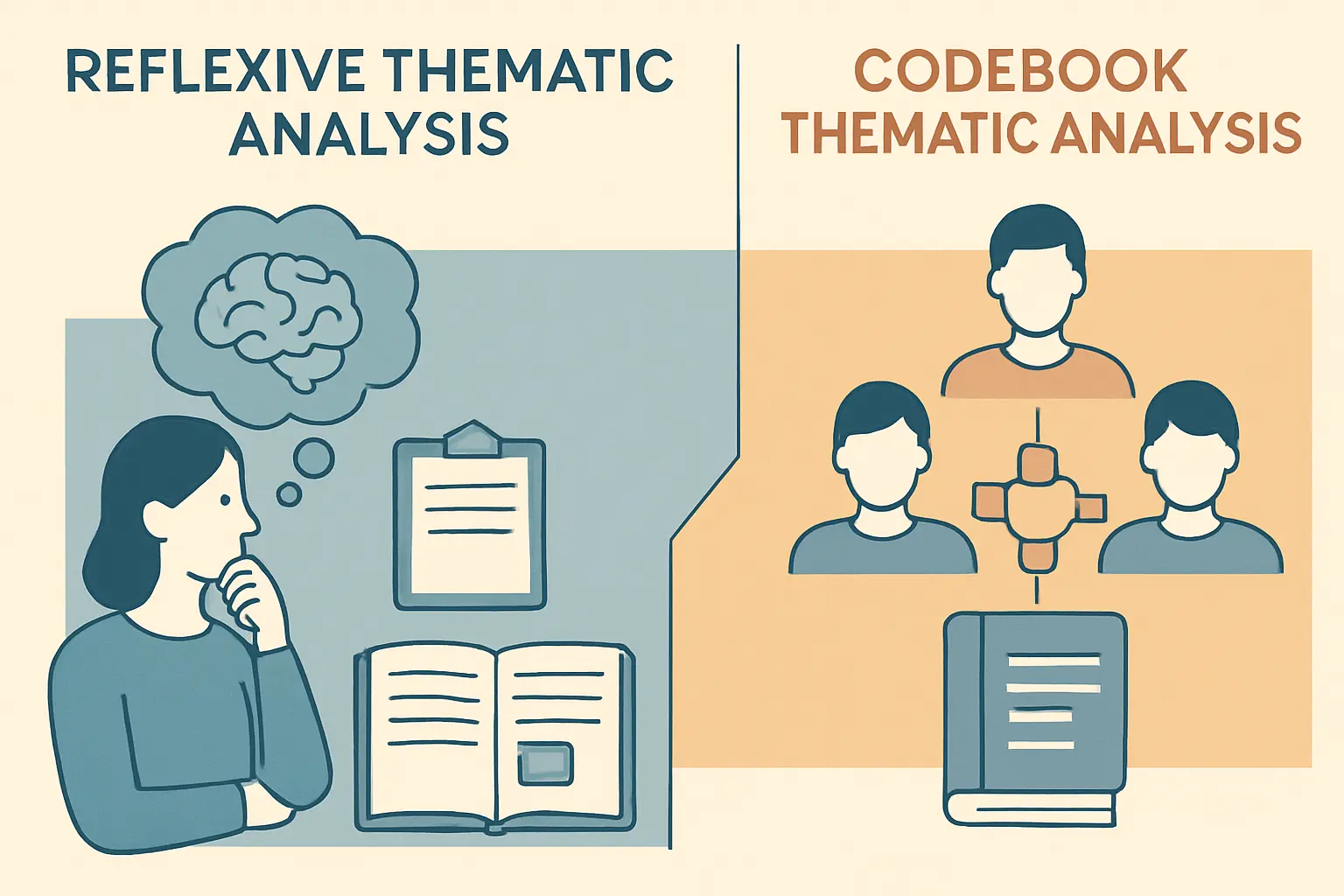
Braun and Clarke categorise the many variants of thematic analysis into three broad families: coding reliability approaches, codebook approaches, and reflexive approaches. The distinction matters enormously for your methodology chapter, because each family rests on incompatible assumptions about what data analysis is and what “quality” looks like.
Codebook TA (and coding reliability approaches)
Codebook TA — which includes framework analysis, template analysis, and matrix analysis — uses a predetermined or collaboratively developed codebook. Multiple researchers apply the same codes to the same data, and inter-coder reliability (ICR) measures such as Cohen’s kappa are used to establish agreement. The underlying assumption is broadly positivist: that the codes represent real features of the data that different trained observers should identify consistently, and that disagreement indicates error rather than legitimate interpretive difference. These approaches are appropriate when you need replicability, when working in a team, or when your epistemology is critical realist or post-positivist.
Reflexive TA
Braun and Clarke’s own approach is explicitly not a codebook approach. Reflexive TA treats the researcher’s interpretive lens — shaped by theory, experience, and positionality — as an inherent part of the analysis rather than a source of bias to be controlled away. Themes are not waiting in the data to be discovered; they are actively constructed through sustained, reflective engagement with the dataset. Braun and Clarke are emphatic: applying inter-coder reliability measures to reflexive TA is a category error. ICR assumes a ground truth that reflexive TA explicitly rejects.
Choosing between reflexive and codebook TA should follow from your epistemological position — the same logic that drives the choice between qualitative and quantitative approaches more broadly. Constructivist? Reflexive TA. Post-positivist team-based project? Codebook TA with explicit ICR.
When Thematic Analysis Is the Right Choice
Thematic analysis is well-suited when:
- Your research questions ask what, how, or why people experience, understand, or make sense of something.
- You have a moderately sized dataset (typically 6–30 interviews for reflexive TA; larger for codebook approaches) and sufficient depth per participant.
- Your epistemological position is constructivist, interpretivist, or critical realist, and you are not seeking to generate formal theory.
- You need methodological flexibility — TA works across disciplines from psychology and education to health sciences and management.
TA is not the best choice when you need to build substantive theory from data (use grounded theory), when your sample is very small and you want to explore lived experience in granular detail (use IPA), or when you need quantifiable agreement across coders on a large corpus (use content analysis or framework analysis).
If you are still deciding on your overall methodology, a thorough literature review can reveal which analytical approaches your field’s key papers use — a reliable signal for your own choice.
The 6 Phases of Braun & Clarke’s Thematic Analysis

Braun and Clarke’s six phases are iterative, not linear. You will move back and forth between phases as your analysis develops. Treating them as a checklist to tick off in sequence is itself a misapplication of the framework.
Phase 1: Familiarise Yourself with the Data
Before touching your analytical software or writing a single code, read the entire dataset multiple times. For interview data, this means reading every transcript in full — not skimming, not searching. Take initial notes about anything that seems significant, surprising, or that recurs across participants. If you have conducted the interviews yourself, this phase also means bracketing (or in reflexive TA, examining) your expectations and preconceptions. What were you anticipating you would find? Where have those expectations already shaped what you noticed in the field?
Familiarisation is not just preliminary housekeeping. It is the phase in which you build the interpretive understanding of your data that will drive everything that follows. Rushing this phase produces shallow coding.
Phase 2: Generate Initial Codes
Coding is the process of labelling data segments that are relevant to your research question. A code is a short phrase — not a single word and not a long sentence — that captures something analytically interesting about a data extract. Codes should be descriptive enough to anchor the extract but open enough to allow for later reinterpretation.
Work systematically through your entire dataset. Code every extract that is relevant; do not cherry-pick. At this stage, generate more codes than you expect to use — you will collapse and restructure them in later phases. Keep a coding log noting when and why you assigned each code. That log becomes evidence of your analytical rigour and can be included as an appendix.
| Data extract (example) | Initial codes |
|---|---|
| “I kept waiting for someone to tell me I’d done it wrong. Even after I passed, I thought they’d call me back.” | Impostor syndrome; post-defence anxiety; legitimacy doubt; waiting for authority validation |
| “My supervisor never told me outright it wasn’t good enough, but I could read it in the pauses.” | Implicit feedback; supervisor communication gap; reading non-verbal cues; uncertainty about quality |
| “I rewrote the whole introduction four times. I think I was avoiding the data.” | Avoidance behaviour; procrastination; data anxiety; perfectionism in writing |
Phase 3: Search for Themes
Once you have coded the entire dataset, gather all codes and their associated data extracts and begin looking for patterns across them. Which codes cluster together? Which codes share an underlying idea, concern, or experience? A theme is not a code — it is a pattern across codes that captures something meaningful about the dataset in relation to your research question.
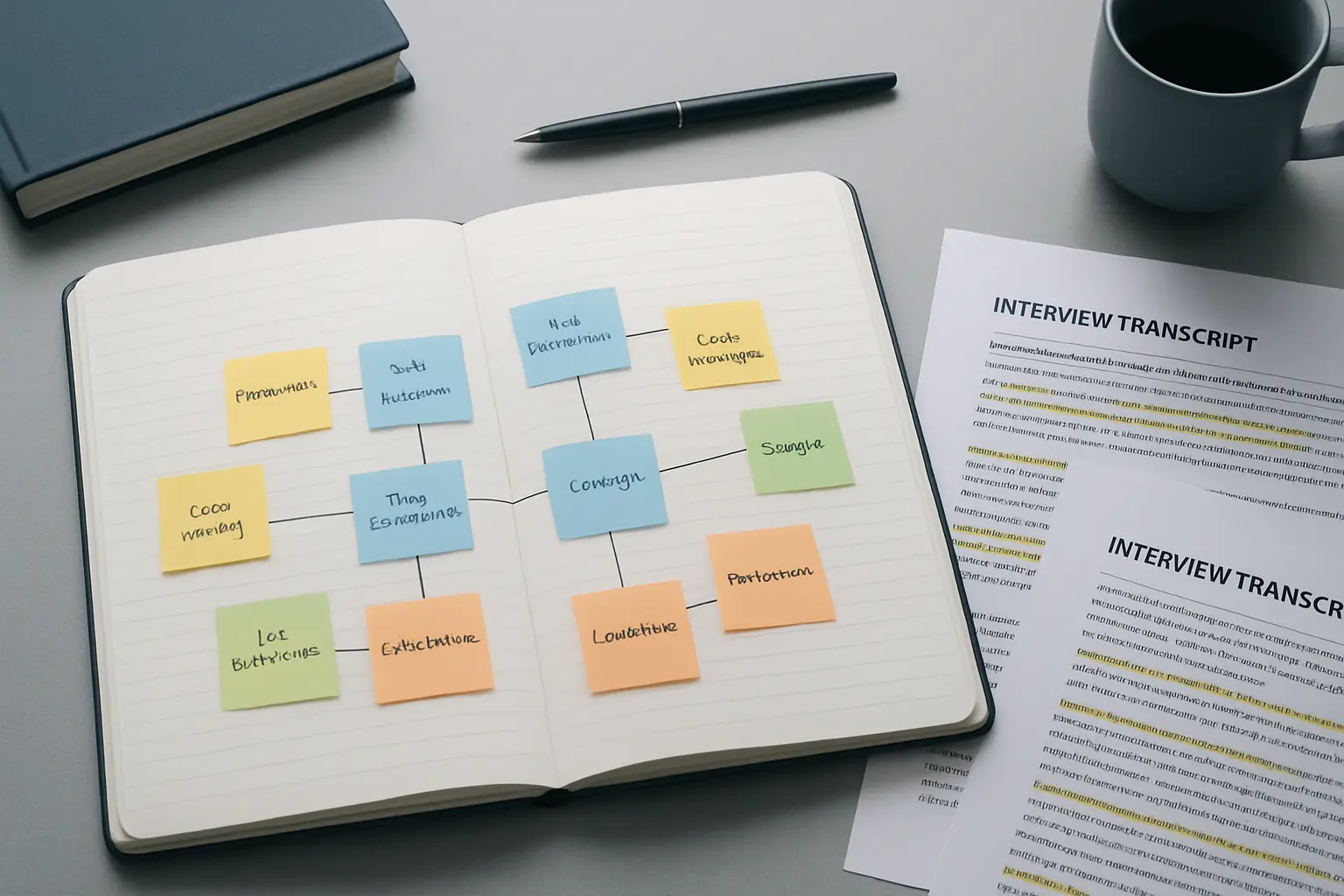
At this stage, many students create a theme map: a visual representation of how codes group into candidate themes and sub-themes. This is an analytical working document, not a figure for your final chapter. The map will change — sometimes dramatically — as your analysis progresses.
Do not equate prevalence with importance. A theme does not need to appear in every data item to be analytically significant. A theme that appears in a minority of your data but captures a sharp, theoretically important pattern can be more valuable than a diffuse, high-frequency theme that tells you little you did not already know.
Phase 4: Review Themes
Phase 4 is where many student analyses stall or collapse. Having generated candidate themes, you now need to test them against two criteria: (a) do the coded extracts within each theme cohere — do they tell a consistent, interpretively meaningful story? and (b) does each theme tell a distinct story that differs from the other themes?
Return to your full dataset — not just the coded extracts — and re-read it with your candidate themes in mind. Are there data points you coded but that do not fit any theme? That might indicate a theme you have missed, or that a candidate theme is over-broad. Are two themes so similar that they are essentially the same theme? Merge them. Is one theme doing so much work that it is really two or three distinct themes? Split it.
By the end of Phase 4 you should have a set of well-defined themes that are internally coherent and mutually distinct. This phase typically requires multiple iterations and is the most intellectually demanding part of the analysis.
Phase 5: Define and Name Themes
Each theme needs a clear definition — a description of what the theme captures, what it does not capture, and what its central organising concept is. The name of the theme should communicate its essence, not just its topic. Compare:
- Weak name: “Supervisor relationship” — this is a topic, not a theme.
- Strong name: “The silence of implied inadequacy” — this captures what participants experienced in supervisor interactions, the interpretive layer that elevates the theme above description.
Write a detailed theme definition for each theme. These definitions will form the skeleton of your findings chapter and should demonstrate that you can distinguish your themes clearly.
Phase 6: Produce the Report
The final phase is writing. In thematic analysis, the write-up is not a summary of what participants said — it is an analytical narrative that builds an argument using data as evidence. Each theme section should move between interpretation (your analytical claim) and data extracts (the evidence), weaving them into a coherent argument rather than alternating them mechanically.
A common structural error is the “quote dump” — strings of participant quotes with minimal interpretation between them. If you have three quotes in a row with only transitional phrases connecting them, you are summarising rather than analysing. The analytical voice must drive every paragraph, with quotes serving as evidence for claims you have already made, not as the claims themselves.
Semantic vs Latent Themes
Braun and Clarke distinguish between two levels of analysis that can be applied at any phase of TA.
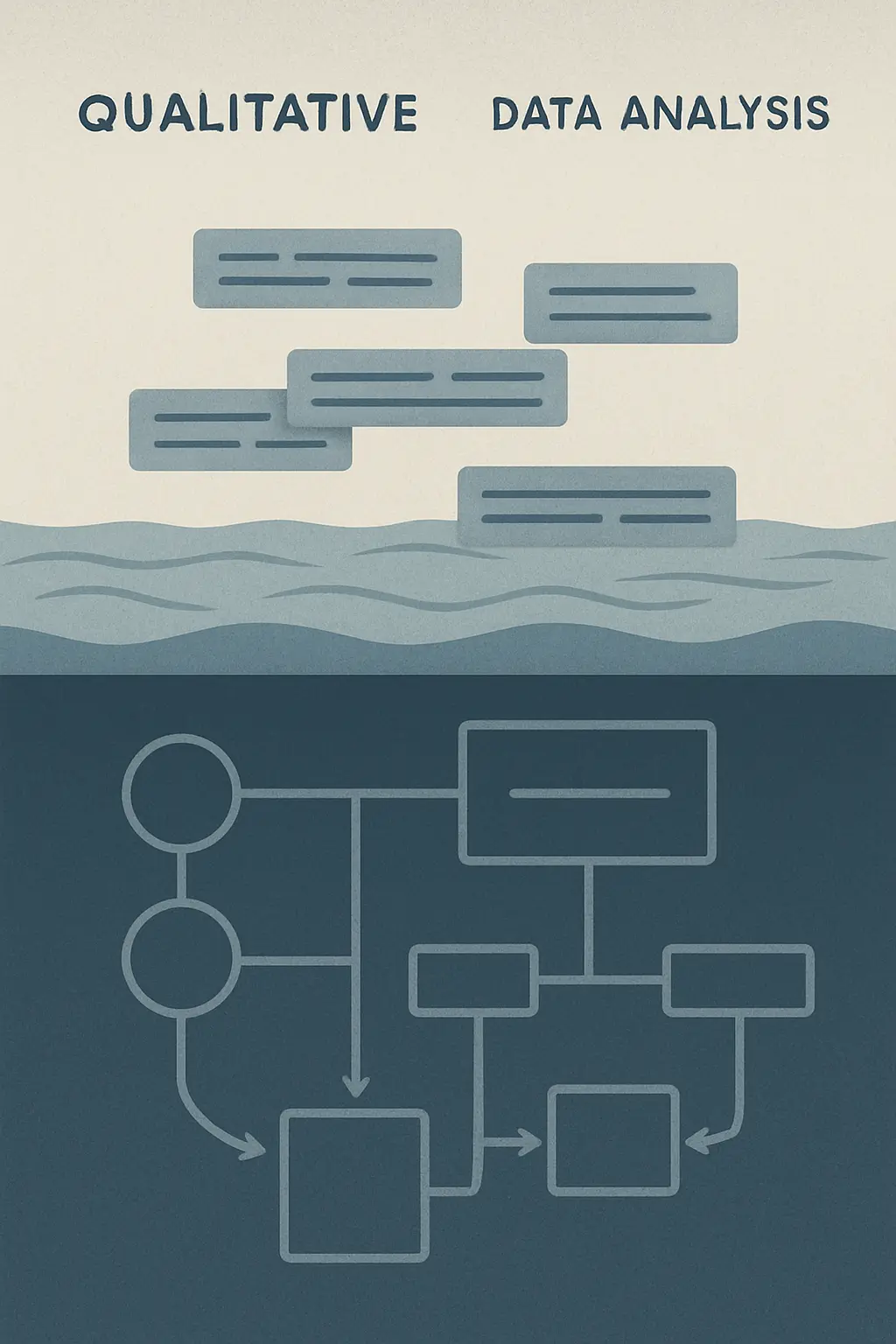
Semantic themes are generated from the explicit, manifest content of the data — what participants said, in roughly the terms they used. Semantic analysis stays close to the surface of the data. It is appropriate for descriptive research questions and for studies in which participants’ own language and framing is analytically significant.
Latent themes involve a deeper interpretive move, examining the underlying ideas, assumptions, structures, or ideologies that shape what participants said and how they said it. Latent analysis asks: what does this discourse presuppose? What is this person not saying, and why? What cultural or social logics are operating beneath the surface of these accounts?
Worked Example: Doctoral Student Wellbeing
The following illustrates how phases 2–5 might unfold in a small-scale study on doctoral student wellbeing, using three interview transcripts as an illustrative (not empirical) dataset.
Research question: How do doctoral students make sense of their experience of self-doubt during the dissertation process?
Phase 2 — Sample codes generated: impostor syndrome language; minimising achievement; comparison with peers; seeking external validation; reinterpreting praise as conditional; catastrophising assessment outcomes.
Phase 3 — Candidate themes identified: (i) Disbelief in earned success — codes around impostor syndrome, minimising achievement, reinterpreting praise; (ii) The tribunal of peers — codes around peer comparison, social visibility of struggle; (iii) Examiners as arbiters of identity — codes around catastrophising assessment, legitimacy seeking.
Phase 4 — Review finding: Candidate themes (i) and (iii) overlap significantly. Both involve a refusal to internalise positive evaluation. After returning to the full dataset, they are merged into a single theme: The conditional self — capturing how participants experienced their doctoral identity as perpetually provisional, contingent on an external verdict that had not yet arrived.
Phase 5 — Theme definition: “The conditional self” describes participants’ experience of their academic identity as permanently on trial — in which completed work, positive supervisor feedback, and even formal progression milestones failed to constitute proof of belonging. The theme operates at the latent level, revealing an internalised model of academic merit as infinitely deferrable.
This is a latent-level theme. It does not just describe what participants said about self-doubt; it interprets the structure of that experience in terms that the participants themselves may not have used. That interpretive move is what distinguishes reflexive thematic analysis from a thematic summary.
If you are writing up qualitative data analysis for a thesis, the complete dissertation guide on this site walks through how findings chapters relate to methodology chapters at every degree level.
Writing Thematic Analysis in Your Methodology Chapter
Your methodology chapter must do three things for your analytical approach: identify it precisely, justify it epistemologically, and describe it procedurally. Here is a structure that works for most dissertations using reflexive TA.
1. Name and cite the approach precisely
Do not write “thematic analysis was used.” Write: “This study employs reflexive thematic analysis as developed by Braun and Clarke (2006, revised 2021/2022), a constructivist approach in which themes are actively constructed by the researcher through iterative engagement with the dataset.”
The key references are: Braun, V. & Clarke, V. (2006). Using thematic analysis in psychology. Qualitative Research in Psychology, 3(2), 77–101; and Braun, V. & Clarke, V. (2021). Thematic Analysis: A Practical Guide. SAGE.
2. State your epistemological position
Reflexive TA assumes a constructivist or interpretivist epistemology. Your methodology chapter should state this explicitly and explain what it means for your analysis: that reality is socially constructed, that your interpretations are one valid reading rather than the reading, and that your positionality as researcher shapes what you notice and how you make sense of it.
For the relationship between epistemological stance and method choice, your research methodology chapter should connect these decisions into a coherent methodological argument.
3. Describe the analytical process phase by phase
Walk through Braun and Clarke’s six phases in your own words, applied to your specific study. Do not just list the phases — show what each phase looked like in your research. How many times did you read the data? What coding software did you use (NVivo, Atlas.ti, or manual)? How did you move from codes to themes? How many iterations of Phase 4 did you go through? Did you use a theme map, and if so, can you include it in an appendix?
4. Address reflexivity
In reflexive TA, you are expected to comment on your own positionality. Who are you in relation to this topic? What prior beliefs or experiences do you bring? How might these have shaped your coding and interpretation? This is not a confession of bias — it is an analytic statement about how your perspective informed a legitimate interpretation of the data.
5. Do not claim inter-coder reliability unless you used codebook TA
As noted above, reporting ICR for a reflexive TA study is a methodological contradiction. If peer-checking or member-checking was part of your quality assurance, describe it accurately — as a check on plausibility or transparency, not as evidence of reliability.
For qualitative dissertation students working through the full write-up, the complete guide to qualitative research methods at Tesify covers how thematic analysis fits alongside grounded theory, IPA, and ethnography — useful context for positioning your approach in a literature review.
Writing your methodology chapter with AI support
If you are working through your methodology chapter and want structured support organising your analysis, Tesify helps you plan, draft, and reference each chapter — including methodology — with integrity-first AI assistance. It does not write your analysis for you; it helps you structure your own thinking and keeps your citations accurate. Free sign-up, no credit card.
FAQ
What is thematic analysis in qualitative research?
Thematic analysis is a qualitative method for identifying, analysing, and interpreting patterns of meaning — called themes — across a dataset. Braun and Clarke’s reflexive approach, introduced in 2006, is the most widely used version. It works with any data type (interviews, focus groups, documents) and is not tied to a single theoretical framework.
What are the 6 phases of Braun and Clarke’s thematic analysis?
The six phases are: (1) Familiarising yourself with the data, (2) Generating initial codes, (3) Searching for themes, (4) Reviewing themes, (5) Defining and naming themes, and (6) Producing the report. These phases are iterative — researchers move back and forth between them rather than following a linear sequence.
What is the difference between reflexive TA and codebook TA?
Reflexive thematic analysis (Braun and Clarke’s own approach) treats researcher subjectivity as an analytical resource. Themes are actively constructed through deep engagement with data, and inter-coder reliability is not required. Codebook TA, by contrast, uses a shared codebook and requires agreement between multiple coders, prioritising reliability and replicability over interpretive depth.
What is the difference between semantic and latent themes?
Semantic themes are identified at the surface level of what participants explicitly said — the manifest content. Latent themes go deeper, interpreting the underlying ideas, assumptions, or ideologies that shape what participants said and how they said it. Doctoral work and higher-stakes qualitative projects typically demand latent-level analysis.
Do I need inter-coder reliability for thematic analysis?
Not in reflexive thematic analysis. Braun and Clarke explicitly argue that inter-coder reliability (measuring agreement between two coders) is misaligned with the reflexive approach, where researcher interpretation is the analytical engine rather than a source of bias to be controlled. Codebook TA and framework analysis do require it.
How do I write thematic analysis in my methodology chapter?
Identify and cite your approach (Braun and Clarke’s reflexive TA, 2006 and 2021), state your epistemological position (constructivist or interpretivist), describe your data corpus and how you familiarised yourself with it, explain your coding process (inductive or deductive, semantic or latent), and describe how you moved from codes to themes. Show, don’t just tell — include a short extract from your codebook or theme map as an appendix.