
How to Write a Literature Review in 2026: Step-by-Step Guide with Examples
Few tasks in academic writing produce as much anxiety as the literature review — and the reason is almost always the same: students treat it as a reading task when it is really an argument task. Knowing how to write a literature review means knowing how to transform a pile of papers into a coherent, critical account of what your field currently knows, where it disagrees, and why your own research needs to exist. This guide walks you through every stage, from scoping your question to submitting a polished chapter, drawing on guidance from leading university writing centres and current academic practice in 2026.
What Is a Literature Review?
A literature review is an evaluative critique of scholarly literature on a defined topic. As Trinity College Dublin’s Library guides make clear, it is not a summary — it analyses, critically evaluates, and synthesises sources to give a clear picture of the current knowledge base of a subject. That distinction matters enormously. A summary tells you what each paper says; a literature review tells you what the body of papers, taken together, reveals — and where the knowledge still falls short.
Literature reviews serve several purposes depending on context:
- As a dissertation chapter — it situates your own research within existing scholarship and justifies why the gap you are filling is worth filling. If you are working on your full dissertation, the literature review is normally Chapter 2, appearing after your introduction.
- As a standalone submission — common in health sciences, education, and policy research where systematic synthesis of evidence is itself the scholarly contribution.
- As part of a research proposal — to demonstrate that you know the field before you begin. See our guide to writing a research proposal step by step for how this fits into the broader document.
It is also worth knowing what a literature review is not. An annotated bibliography lists sources with brief descriptions but does not weave them together. A book review evaluates a single work. A literature review argues across sources — comparing, contrasting, tracing intellectual progression, and identifying contradictions — to produce a new interpretive account.
Types of Literature Reviews
Before you start searching, establish which type of review you are writing. The type determines your methodology, your reporting conventions, and how you select sources.
| Type | Purpose | Protocol required? | Common in |
|---|---|---|---|
| Narrative (traditional) | Synthesise literature thematically; explore a broad question | No | Humanities, social sciences, most thesis chapters |
| Systematic | Answer a specific question with reproducible, bias-minimised methods | Yes (PRISMA) | Health sciences, clinical research, policy |
| Scoping | Map the extent and nature of evidence; identify gaps for future research | Yes (PRISMA-ScR) | Emerging topics; interdisciplinary fields |
| Meta-analysis | Statistically pool quantitative results from multiple studies | Yes | Medicine, psychology, economics |
Most dissertation students write a narrative literature review. If your supervisor requires a systematic review, register your protocol on PROSPERO (for health topics) before you begin searching — registration cannot be done retrospectively.
Step 1: Define Your Scope and Research Question
The most common reason literature reviews fail is that the student searched too broadly and became overwhelmed. A well-scoped review answers one focused question — or a tightly related cluster of questions — not an entire field. Invest real time here before opening a single database.
Spend time with your supervisor refining the scope. Two useful tools:
- PICO (Population, Intervention, Comparison, Outcome) — the standard framework for clinical and health-science reviews.
- Spider (Sample, Phenomenon of Interest, Design, Evaluation, Research type) — better suited to qualitative and social science topics.
Write your research question down as a single sentence. If you cannot do this, your scope is still too large. The research question also links directly to your choice of research methodology: a question about lived experience calls for qualitative literature; a question about treatment efficacy calls for randomised controlled trials.
Too broad: “What is the relationship between social media and mental health?”
Well scoped: “What effect does passive Instagram use have on self-reported body image satisfaction in female undergraduates?”
Step 2: Search Databases Systematically
Ad hoc Googling produces an unrepresentative sample of the literature. A systematic search uses multiple databases, pre-defined search strings, and Boolean operators to ensure comprehensive coverage.
Choose your databases
Use at least two databases to reduce the risk of missing key studies:
- Scopus and Web of Science — broad multidisciplinary coverage with citation metrics
- PubMed / MEDLINE — health and biomedical sciences
- PsycINFO — psychology and mental health
- ERIC — education research
- Google Scholar — useful for finding grey literature and theses, but poor for systematic filtering
Build your search string
Use Boolean operators to control what you retrieve:
- AND narrows results:
social media AND body image AND undergraduates - OR broadens results by capturing synonyms:
Instagram OR TikTok OR "social networking sites" - NOT excludes irrelevant terms:
NOT "eating disorders"(if that is out of scope) - Quotation marks search exact phrases:
"passive use" - Truncation (*) captures word variants:
adolescen*finds adolescent, adolescents, adolescence
Record every search — database, date, search string, and number of results returned. This documentation is essential for systematic and scoping reviews and good practice for all types.
Step 3: Screen and Select Your Sources
Once you have retrieved your results, apply inclusion and exclusion criteria to filter them. Define these criteria before you start screening, not as you go.
Typical criteria include:
- Publication date — e.g., 2015–2026 to capture recent evidence
- Language — e.g., English only (or specified languages)
- Study design — e.g., peer-reviewed empirical studies only (excluding opinion pieces)
- Population — e.g., adult participants aged 18+
- Relevance — does the study directly address your research question?
Screening happens in two stages. First, screen titles and abstracts to remove obviously irrelevant results. Then read the full texts of remaining papers and apply your criteria rigorously. For systematic reviews, this process is visualised in a PRISMA flow diagram showing how many records were identified, screened, assessed for eligibility, and ultimately included.

Manage your sources in a reference manager. Zotero and Mendeley are the two most popular free options; both support browser import, PDF annotation, and automatic citation generation.
Step 4: Read Critically and Map the Terrain
Reading for a literature review is not the same as reading for understanding. You are reading to build a comparative map of the field. For each source, record:
- Core argument or finding
- Methodology and sample
- Theoretical framework or lens
- Limitations acknowledged by the authors
- How this source agrees, disagrees, or builds on others you have already read
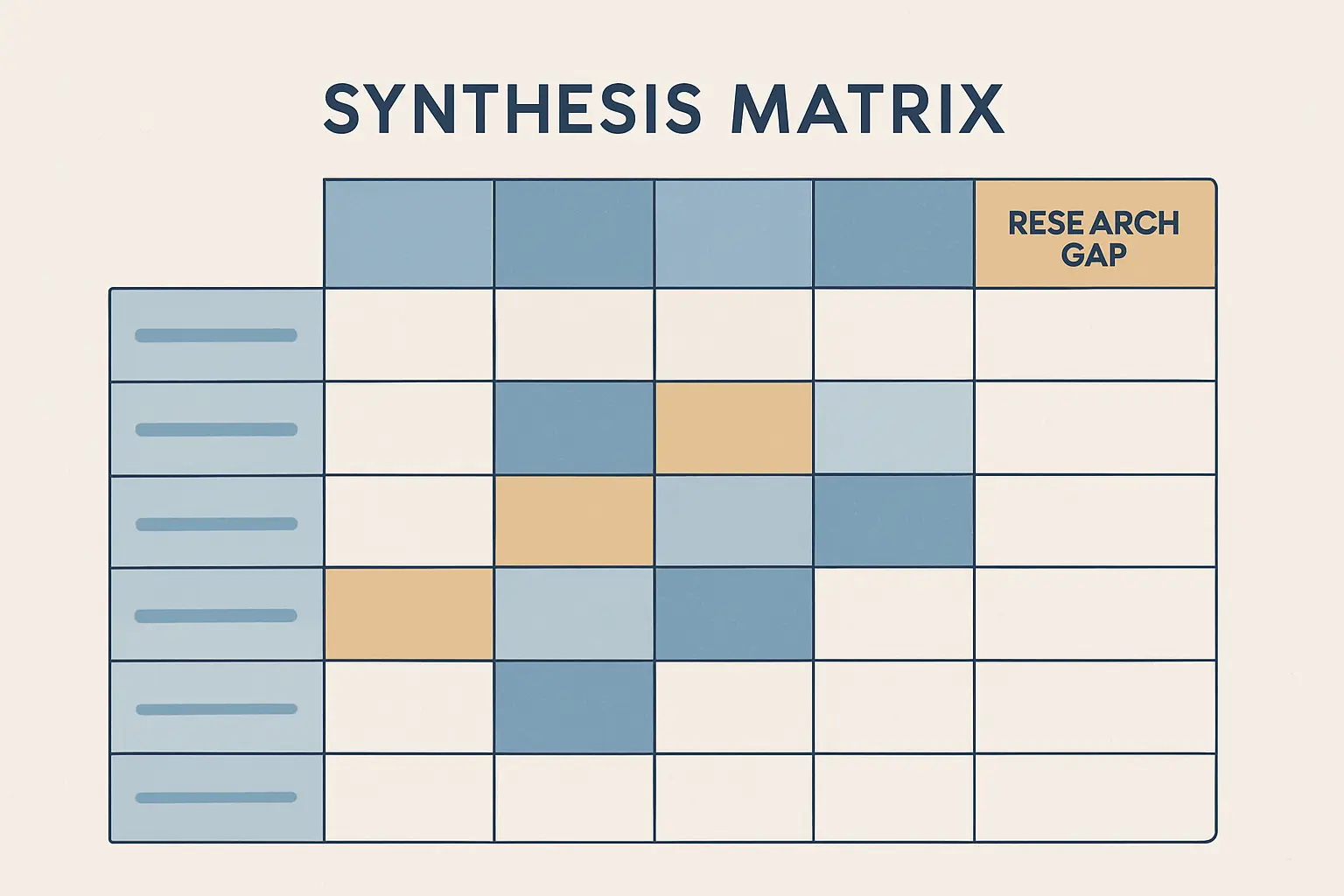
Use a synthesis matrix — a spreadsheet with sources as rows and themes as columns. Filling it in forces you to compare sources directly rather than reading them in isolation. When you spot a cell that is consistently empty across multiple sources, you have found a research gap.
As you read, note:
- Consensus — where multiple independent studies reach the same conclusion
- Contradiction — where studies reach opposing conclusions (and why: different samples, methods, contexts?)
- Influential theories — the foundational frameworks your field keeps returning to
- Methodological trends — shifts in how the field studies the question over time
Step 5: Synthesise — Move Beyond Summary
Synthesis is the skill that separates a strong literature review from a weak one. Summarising lists what each author said; synthesising builds an argument across authors. As the UCSB Library guide puts it: “Do not over-quote. If you only quote from every single author you found, then you are not showing any original thinking or analysis.”
Three synthesis moves to master:
Thematic synthesis
Group sources by the theme or concept they address, then compare how different researchers have approached that theme. This is the most common structure for narrative reviews. If your subsequent data analysis will use thematic analysis — identifying, analysing, and reporting patterns within data — read our companion guide on thematic analysis step by step to see how these two skills connect.
Conceptual synthesis
Trace the development of a theoretical concept across the literature — showing how it was originally defined, how subsequent researchers refined or challenged it, and where the concept stands today. Common in philosophy, education, and sociology.
Methodological synthesis
Compare how different studies have operationalised and measured the same construct. Useful for identifying why conflicting findings exist (e.g., different measures of “engagement,” different age ranges, cross-sectional vs. longitudinal designs).
Summary: “Smith (2022) found X. Jones (2023) found Y.”
Synthesis: “While Smith (2022) and Jones (2023) both examined X, they reached opposing conclusions, arguably because Smith used a cross-sectional design with undergraduate samples while Jones followed participants over 18 months.”
Step 6: Structure and Write Your Review
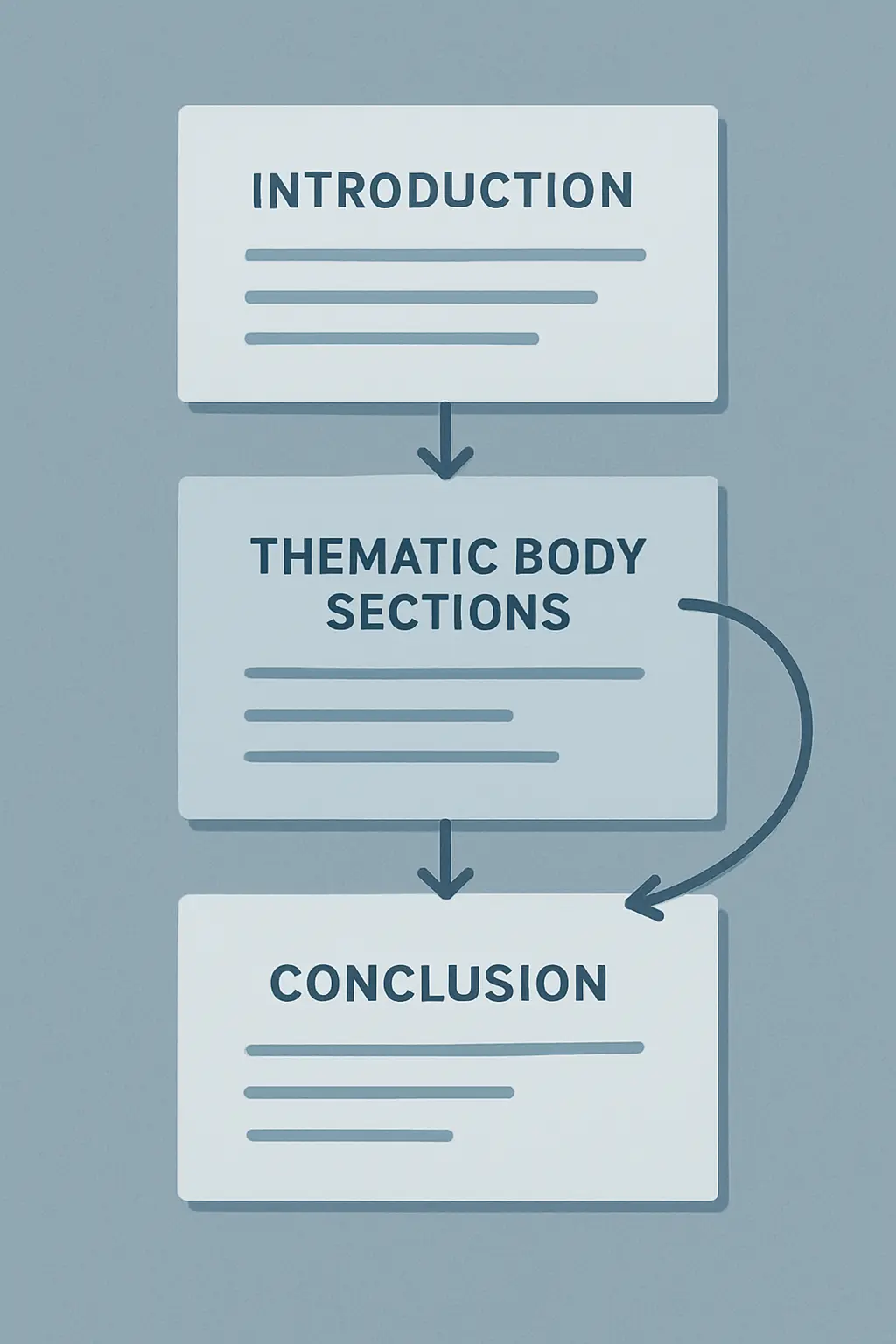
Most literature reviews share a three-part architecture: an introduction, a body, and a conclusion. The body is where the variation lies.
Introduction
Open by introducing the topic and explaining why reviewing the literature matters for your specific research question. State the scope (what the review covers and what it deliberately excludes) and, for systematic reviews, briefly describe your search methodology.
Body: choose your organising principle
The body of a narrative literature review can be organised in several ways:
- Thematically — the most common and usually most effective approach. Organise by concept, argument, or finding rather than by author.
- Chronologically — useful when tracing the historical development of a concept or when showing how scholarly understanding has evolved over time.
- Methodologically — organise by research design (experimental, observational, qualitative) to highlight how different methods produce different insights.
Within each section of the body, apply the synthesis moves from Step 5. Every paragraph should make an argument about the literature — not merely describe it.
Conclusion
The conclusion of your literature review should do three things: (1) summarise the main themes and findings you have identified, (2) highlight the key gaps and contradictions in the literature, and (3) explain how your own research addresses one of those gaps. The conclusion is a direct bridge to your methodology chapter.
A note on voice and citation
Use reporting verbs that signal your evaluative stance: argues, contends, demonstrates, suggests, acknowledges, overlooks, conflates. These verbs carry much more information than the generic “states” or “says.” Integrate citations throughout — do not leave long paragraphs uncited and then tag all sources onto the final sentence.
A Worked Example
Suppose you are writing a literature review on the effectiveness of mindfulness-based interventions (MBIs) for reducing academic burnout in university students. Here is how the six steps map onto practice:
- Scope: Research question — “To what extent do mindfulness-based interventions reduce academic burnout in undergraduate students, and what programme characteristics predict effectiveness?”
- Search: Databases — PsycINFO, Web of Science, ERIC. Search string —
mindfulness AND ("academic burnout" OR "student burnout") AND undergraduate*. Date range — 2014–2026. - Screen: Inclusion criteria — peer-reviewed, empirical studies, English language, undergraduate participants, pre/post burnout measure. Exclusion — purely qualitative studies (because the sub-question asks about effectiveness). After screening: 42 studies included.
- Read critically: Synthesis matrix across columns: intervention type (MBSR, MBCT, app-based), duration, outcome measure (MBI, BAT, ABQ), control condition, effect size, sample size.
- Synthesise: Three themes emerge: (a) in-person MBIs show consistent short-term reductions in burnout; (b) app-based delivery shows mixed results, possibly mediated by user adherence; (c) the majority of studies rely on self-report measures with no follow-up beyond 8 weeks — a methodological gap.
- Structure: Three body sections, one per theme, each comparing across multiple studies rather than reviewing them in sequence.
Notice how the worked example never says “Study A found X, then study B found Y.” It groups, compares, and identifies what is known and what is still missing.
Common Mistakes to Avoid
These are the errors that reviewers, supervisors, and examiners flag most often:
- Annotated-bibliography syndrome. Paragraphs are structured source-by-source instead of argument-by-argument. Fix: reorganise around themes, not authors.
- No critical voice. The review reads as purely descriptive — all sources accepted at face value, no discussion of limitations, methodology, or contradictions. Fix: use evaluative reporting verbs and explicitly note limitations and conflicting evidence.
- Outdated sources only. Leaning heavily on textbooks and older studies while ignoring recent empirical work. Fix: set a date range in your search criteria and include recent peer-reviewed literature.
- Missing seminal works. The opposite problem — focusing only on recent studies while ignoring the foundational papers that the field keeps citing. Fix: use forward citation searches (who has cited the classic papers?) to identify the canonical literature.
- No clear research gap. The review describes what is known but fails to articulate what is missing and why your research addresses it. Fix: end the review with an explicit statement of the gap and its significance.
- Poor paragraph integration. Citations dumped at the end of paragraphs rather than woven into the argument. Fix: embed citations as you make claims, not after them.
- Scope drift. Starting with a focused question but expanding the review until it covers tangentially related topics. Fix: return to your research question after every section and ask whether this content serves it directly.
If you are concerned about properly attributing sources and paraphrasing correctly throughout your review, our guide to avoiding plagiarism in academic writing covers the practical techniques in detail.
For students who want to accelerate the drafting stage without compromising analytical integrity, this guide on writing your literature review faster with AI (on tesify.app) walks through a four-phase workflow for using AI tools to organise themes and draft paragraphs while keeping every interpretive decision in your own hands.
Frequently Asked Questions
How long should a literature review be?
Length depends on your level and discipline. A standalone undergraduate literature review typically runs 1,000–3,000 words. A master’s thesis literature review is usually 4,000–8,000 words, and a doctoral dissertation literature review commonly spans 8,000–12,000 words or more. Always verify your institution’s requirements first — some departments specify minimum word counts or chapter proportions.
What is the difference between a literature review and an annotated bibliography?
An annotated bibliography lists sources with a brief description or evaluation of each, source by source. A literature review synthesises those sources — comparing, contrasting, and connecting them to construct an argument about the current state of knowledge in your field. The literature review demonstrates analytical thinking across the body of evidence; the annotated bibliography demonstrates coverage of individual sources.
How many sources do I need for a literature review?
Source count varies by level. Undergraduate reviews commonly draw on 10–20 sources; master’s theses 30–60; doctoral dissertations 80–150 or more. Quality and relevance matter more than raw numbers. Prioritise peer-reviewed, recent publications and seminal works in your field. Always check your departmental guidelines — some specify a minimum number of sources.
Can I use first person in a literature review?
Most academic disciplines discourage first person in literature reviews. Prefer passive constructions (“the evidence suggests”) or third person (“scholars have argued”). Some fields — including education, nursing, and qualitative social science — now permit first person in certain contexts. Check your department’s style guide and, if in doubt, ask your supervisor directly.
What databases should I use for a literature review?
Start with field-appropriate databases: Scopus and Web of Science for broad multidisciplinary coverage, PubMed/MEDLINE for health sciences, PsycINFO for psychology, ERIC for education, and Google Scholar for general accessibility and grey literature. Using at least two databases reduces the risk of missing key studies. Your university library subject guide will usually list the recommended databases for your discipline.
What is the difference between a narrative and a systematic literature review?
A narrative (traditional) review synthesises literature thematically without a pre-registered protocol, making it well suited to humanities and social sciences. A systematic review follows a rigorous, reproducible search-and-selection process with explicit inclusion and exclusion criteria, typically reported using the PRISMA framework. Systematic reviews are the standard in health, clinical, and policy research. A scoping review maps the available evidence on a topic without assessing its quality — useful for emerging or poorly understood fields.
Structure Your Literature Review with AI Support
A literature review is analytically demanding but structurally predictable — and that predictability is where AI can help without compromising your intellectual contribution. Tesify helps you map your themes, draft synthesis paragraphs in your own academic voice, and generate properly formatted citations in APA, MLA, Chicago, or Vancouver — so you spend your time on the critical thinking, not the formatting. Sign up free, no credit card required, and use Tesify as your thinking partner from the first source to the final draft.