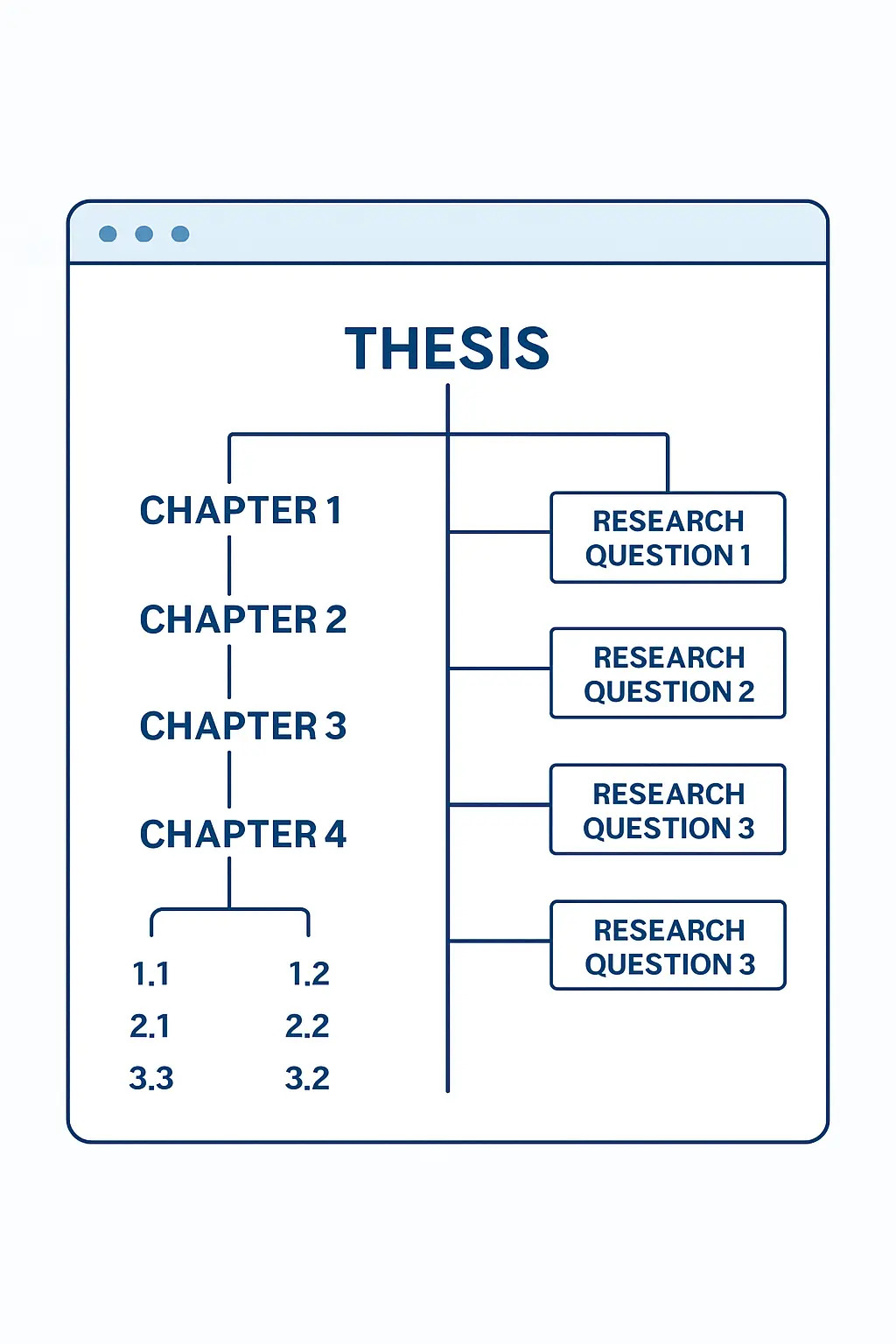
AI Thesis Outline Generator in 2026: Structure Every Chapter Before You Draft (with Tesify)
Most students who stall on a thesis do not stall because they cannot write — they stall because they have no map. Opening a blank document for Chapter 3 while uncertain whether the theoretical framework precedes or follows the methodology is not a writing problem; it is a planning problem. An AI thesis outline generator solves exactly that: feed it your topic, your research questions, and a handful of key sources and it returns a chapter-by-chapter skeleton with section-level bullets you can pressure-test against your supervisor’s expectations before you write a single sentence.
This guide walks through how to build a defensible chapter skeleton at the planning stage — moving from research questions to chapter map to section bullets — and where Tesify fits as the integrity-first tool that keeps you in the author’s seat from the first outline to the final submission.
Why Outlining Before Drafting Saves Weeks
Writing chapters without a skeleton is expensive in revision time. You produce prose that gets cut, discover mid-draft that your literature review does not connect to your methods chapter, or realize your research questions do not map cleanly onto your findings structure. Structural revision — moving chapters, reordering arguments, collapsing underpowered sections — costs far more time than building the structure upfront during a focused two-hour planning session.
A solid outline accomplishes three specific things that blind drafting cannot:
- Aligns chapter functions with research questions — every chapter either builds toward answering your central question or contextualizes why answering it matters. A chapter without a research-question anchor is almost always scope creep.
- Surfaces sourcing gaps before you draft — if you cannot fill a section bullet with at least one source, you have a research gap to fix now, not in Week 8 when your submission deadline is visible on the calendar.
- Gives your supervisor something concrete to critique early — a two-page skeleton reviewed and annotated before drafting eliminates the most common cause of late-stage structural redirections. Structural feedback at the outline stage takes an afternoon to address; the same feedback after drafting takes weeks.
The role of an AI thesis outline generator is to accelerate this planning work — not to replace your judgment about what your thesis needs to argue. Garbage in, scaffold out.
The Three-Layer Outline Method
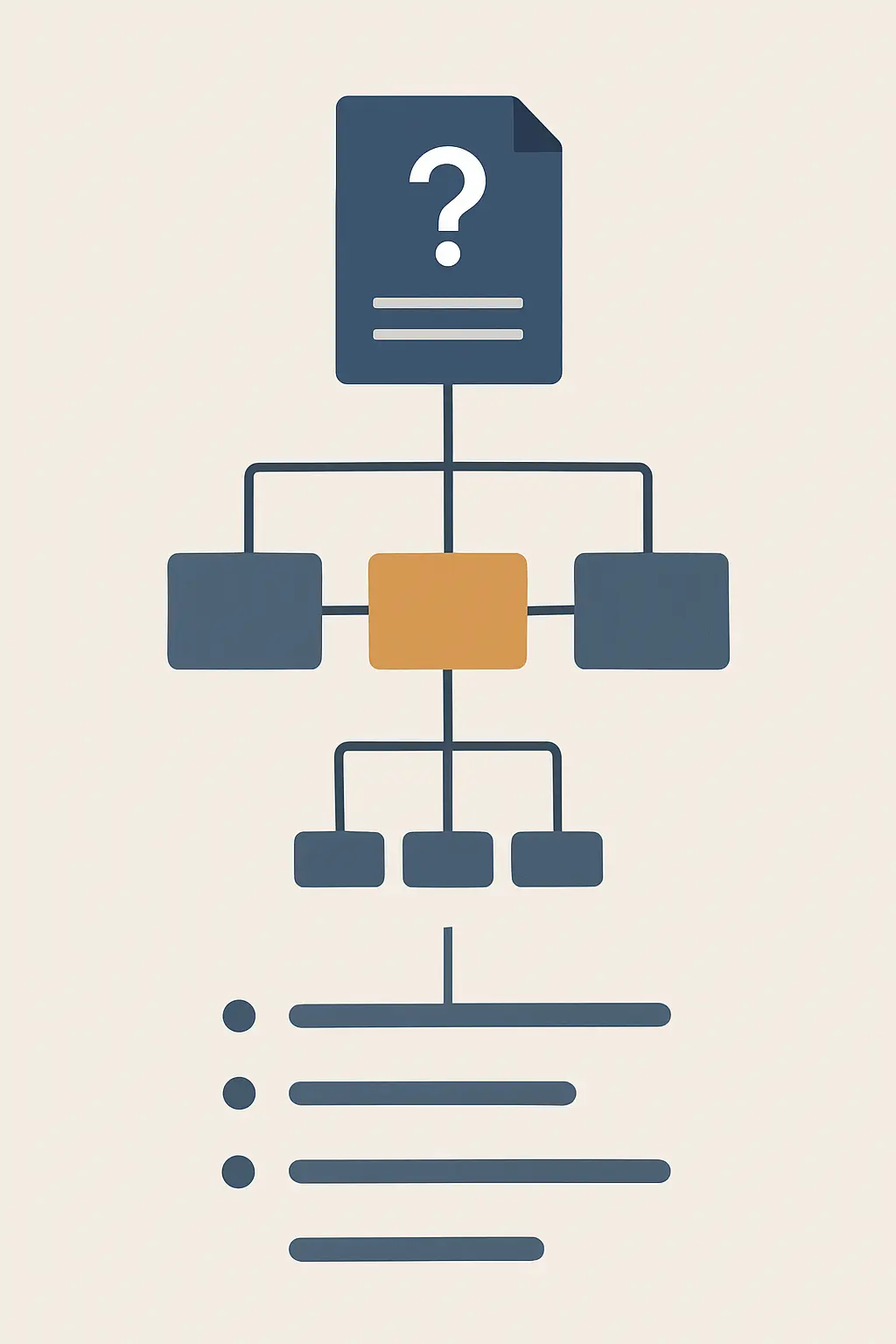
The most defensible thesis outlines are built in three passes, each layer more specific than the last. AI tools are most useful at layers two and three.
Layer 1: Research question alignment (you write this)
Before opening any tool, write your central research question and sub-questions on paper or in a notes document. These are the load-bearing walls of your entire thesis. Every chapter must either advance the argument or contextualize the question.
A management dissertation, for example, might have:
- Central RQ: How do remote-first organizational structures affect knowledge transfer in early-stage fintech firms?
- Sub-RQ 1: What mechanisms do these firms use to transfer tacit knowledge?
- Sub-RQ 2: How do these mechanisms differ from those used in co-located equivalents?
Writing these out before you involve AI is non-negotiable. If you cannot state your research questions clearly, no outline generator will save you — it will simply produce a plausible-looking skeleton with no intellectual core.
Layer 2: Chapter map (AI + you)
Feed your research questions and a brief topic description to an AI thesis outline generator. Ask for a chapter map that includes a title and a one-sentence function statement for each chapter. Review the output against your research questions: does each chapter have a clear purpose? Does the sequence build a logical argument arc from background through findings to conclusion? Reorder or rename chapters at this stage — it costs nothing.
Layer 3: Section bullets (AI + you verify)
Within each chapter, generate H3-level section bullets — the sub-sections you will actually write. This is where an AI thesis outline generator saves the most planning time. Your job at this layer is to delete any bullet that does not serve your argument and flag every bullet where you do not yet have sources. An empty bullet is a research gap; a bullet you cannot justify intellectually is scope creep. Both are far cheaper to catch now than during the drafting phase.
How to Use an AI Thesis Outline Generator: Step by Step
Step 1: Prepare your input document
Good AI output requires structured input. Before opening any tool, compile the following in a short notes document:
- Your working title (even a rough one)
- Your central research question and 2–4 sub-questions
- Your methodology type (e.g., qualitative case study, systematic review, mixed-methods survey)
- A list of 5–10 key sources or authors you already know you will cite
- Your required chapter count and target word count (check your faculty handbook)
This input document doubles as your prompt to Tesify and as the planning brief you can share with your supervisor.
Step 2: Generate the chapter map
Paste your input into Tesify and prompt it to produce a chapter-by-chapter outline with chapter titles, one-sentence chapter functions, and H3-level section bullets. Specify your referencing style — APA 7, MLA 9, or Chicago 17 — so the tool calibrates to the conventions your discipline expects. For a full walkthrough of the dissertation process from proposal to submission, the complete guide to writing your dissertation in 2026 covers every stage.
Step 3: Evaluate the architecture
Apply a single test to each chapter in the generated map: can you draw a straight line from that chapter’s stated function back to one of your research questions? If a chapter exists without a research-question anchor, it is either necessary framing (background, theoretical context) or noise. Prune ruthlessly — cutting a bullet at the outline stage costs nothing; cutting a drafted 1,500-word section costs hours of work and confidence.
Step 4: Anchor each section bullet to a source
For every H3 bullet, note beside it one or two sources you know can support that section. If a bullet is empty — no source comes to mind and a quick database search returns nothing useful — you have a genuine sourcing gap. Either find a source within the next 48 hours or consolidate the bullet into a broader section. This source-anchoring step transforms your outline into a de facto annotated bibliography structure, which accelerates the literature review phase considerably.
Step 5: Submit the skeleton to your supervisor before you draft
Share your structured outline as a PDF and ask one specific question: Does this outline answer my research questions in a defensible and logical order? Any structural feedback at the outline stage takes an afternoon to address. The same feedback after drafting takes weeks — and carries a morale cost that slows everything else down. Submitting an outline before drafting is not a sign of unreadiness; it is the most professional move you can make at the start of a thesis.
Where Tesify Fits: Integrity-First Structuring
Tesify is not a ghostwriter. It does not produce text you submit as your own intellectual work. It functions as an integrity-first AI dissertation writing assistant — you set the intellectual direction, it handles the structural scaffolding and referencing architecture, and you verify every decision before it becomes part of your thesis.
At the outline stage specifically, Tesify offers three advantages over generic AI tools:
- Discipline-aware structure: A social-science thesis has a different methods chapter than an engineering dissertation. Tesify’s chapter maps reflect the conventions of your field, not a one-size-fits-all template that confuses a literature review with a conceptual framework.
- Research-question threading: Paste your RQs directly into the outline prompt and Tesify labels each chapter with the specific question it addresses, making the alignment explicit and supervisor-ready from the first draft of the outline.
- Citation-type tagging: Section bullets come pre-tagged with the category of source each requires — empirical study, theoretical framework, policy document, meta-analysis — so you know what to search for in your databases before you write a word of body text.
The best AI thesis writer workflow starts at the outline, not at the first sentence of Chapter 1. Once your skeleton is approved, Tesify’s drafting environment lets you move from bullet to paragraph without losing the structural logic you built at the planning stage — and its built-in originality self-check ensures every section you produce is fully yours.
Chapter Skeleton Reference (Standard 5-Chapter Format)
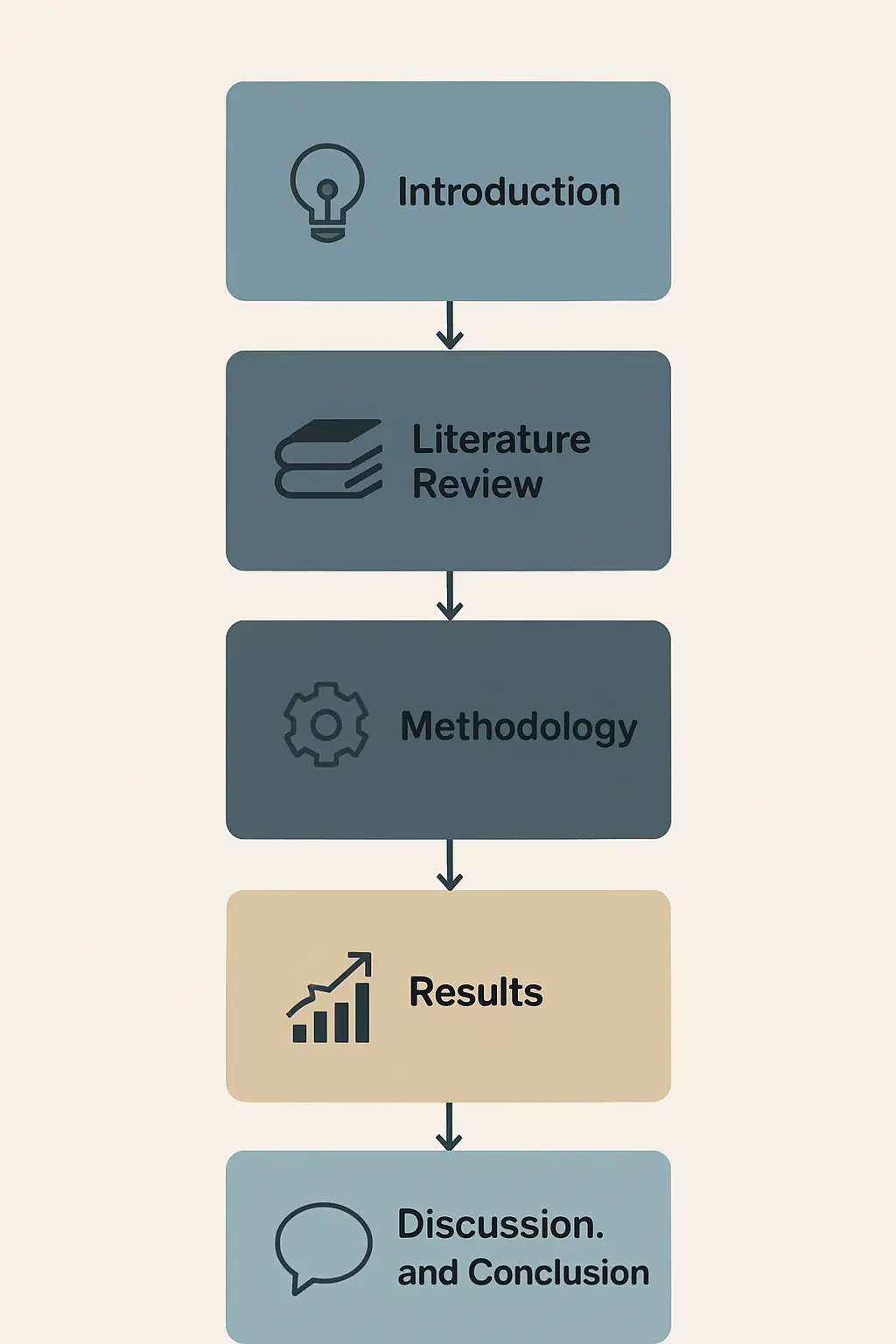
Use this table as a starting framework. Your institution may require variations — always cross-reference your faculty handbook and any department-specific guidelines.
| Chapter | Function | Key Sections |
|---|---|---|
| 1 — Introduction | Establishes the problem, rationale, and scope | Background, problem statement, research questions, significance of the study, chapter overview |
| 2 — Literature Review | Contextualizes the problem within existing knowledge | Thematic clusters, theoretical framework, identification of the research gap |
| 3 — Methodology | Justifies the research design and explains data collection | Research philosophy, design type, sample and sampling strategy, data collection instruments, analysis method, ethical considerations |
| 4 — Findings / Results | Presents data without interpretation | Structured by sub-question or theme; tables, figures, and verbatim extracts (if qualitative) |
| 5 — Discussion & Conclusion | Interprets findings, addresses limitations, suggests future research | Answer to each research question, theoretical contributions, practical implications, limitations, recommendations, conclusion |
For PhD-level work, Chapters 2 and 3 frequently expand or split. A separate conceptual framework chapter is common in some disciplines, and methodology chapters often divide into design and analysis. The complete chapter-by-chapter breakdown for doctoral dissertations — including the differences between a traditional five-chapter structure and a publication-based format — is covered in the PhD Thesis Structure: Complete Chapter Guide at Tesify.app.
Once your outline is finalized and supervisor-approved, the next planning move is building your literature review structure. Tesify’s AI literature review generator follows the same integrity-first model: you supply the sources and the thematic clusters from your outline, it produces the synthesis structure and section-level argument map you need before writing a word of Chapter 2.
Frequently Asked Questions
What is an AI thesis outline generator?
An AI thesis outline generator is a tool that takes your research topic, research questions, and available sources as input and produces a structured chapter map with section-level headings and bullet points. It is a planning tool, not a drafting tool — it organizes your architectural decisions before you write any substantive text, so every sentence you write in the draft stage has a structural home.
Does using an AI outline generator count as academic misconduct?
An outline is a planning document, not submitted work. Using AI to generate a chapter skeleton is analogous to using a mind-mapping tool or discussing structure with a librarian — you are organizing your own intellectual decisions, not generating text for submission. That said, always check your institution’s specific AI policy, particularly if you are in a program with strict disclosure requirements for any AI tool use.
How detailed should a thesis outline be before I start drafting?
Your outline should reach the H3 (sub-section) level with at least one source noted beside each bullet. This means you can see, before drafting begins, whether each section has evidential support. A chapter-level outline — just titles and one-sentence functions — is too thin to catch sourcing gaps. A sentence-by-sentence outline is overkill that delays you without adding proportionate value.
Can Tesify generate an outline for any academic discipline?
Yes. Tesify handles outlines for humanities, social sciences, STEM, business, law, and health disciplines. You specify your field and methodology type in the prompt, and the tool adjusts chapter structure to match those conventions. A qualitative grounded-theory study will generate a different methods chapter structure than a randomized controlled trial or a systematic review.
How long does it take to build a thesis outline with AI?
The AI generation step takes minutes. The full planning session — preparing your input document, generating the chapter map, evaluating the architecture, anchoring each bullet to a source, and refining the structure based on your supervisor’s feedback — typically takes two to four hours for a master’s thesis and a full working day for a doctoral dissertation. That investment consistently prevents weeks of structural revision during the drafting phase.
Build Your Chapter Skeleton Tonight
Stop staring at a blank chapter document. Paste your research questions into Tesify, generate your chapter map in minutes, and start every section knowing exactly what you need to argue — and which sources you need to find first.