
AI Literature Review Generator in 2026: Synthesise Sources Faster with Tesify (Without Ghostwriting)
The literature review chapter defeats more students than any other section of a thesis or dissertation. You have collected 60, 80, sometimes 120 sources. You know what the research says — but turning that reading into a coherent, argument-driven synthesis feels like trying to build a mosaic in the dark. An AI literature review generator changes that equation without changing who does the intellectual work: you do.
In 2026, the best of these tools do not write your literature review for you. They help you organise themes, draft synthesis paragraphs from your selected sources, and format references in the style your university requires — while you direct the argument, judge the sources, and reach your own conclusions. That distinction matters enormously for academic integrity, and it is the principle Tesify is built around.
What Is an AI Literature Review Generator?
Scholarly publishing has accelerated to a point where staying current with a field is genuinely difficult. More than five million peer-reviewed articles are published each year, and the total volume of academic literature has been doubling roughly every decade. For a postgraduate student, that means a literature base that grows faster than any researcher can manually synthesise — and a literature review chapter that can consume months of a dissertation timeline before a single argument is made.
An AI literature review generator is a tool that uses large language models — trained on or connected to academic databases — to help researchers move from a stack of PDFs and citations to a structured, referenced draft. The best tools in 2026 work in one of two ways:
- Retrieval-based generation: The tool searches verified academic databases such as Semantic Scholar, PubMed, or arXiv and surfaces relevant papers, then drafts synthesis paragraphs with real, verifiable citations. Every reference traces to a confirmed source.
- Document-upload synthesis: You upload your own curated papers. The AI reads them, groups them by theme, and drafts a structured review from your selection — keeping you in control of which sources appear.
Tesify uses the document-upload approach, meaning the synthesis is built entirely from sources you have chosen, reviewed, and approved. You are the researcher. Tesify is the synthesis engine.
How Tesify Synthesises Your Literature Review
Tesify is purpose-built for thesis and dissertation work. When you reach the literature review stage — whether you are writing a full chapter or a focused review section — here is precisely what the platform does with your sources:
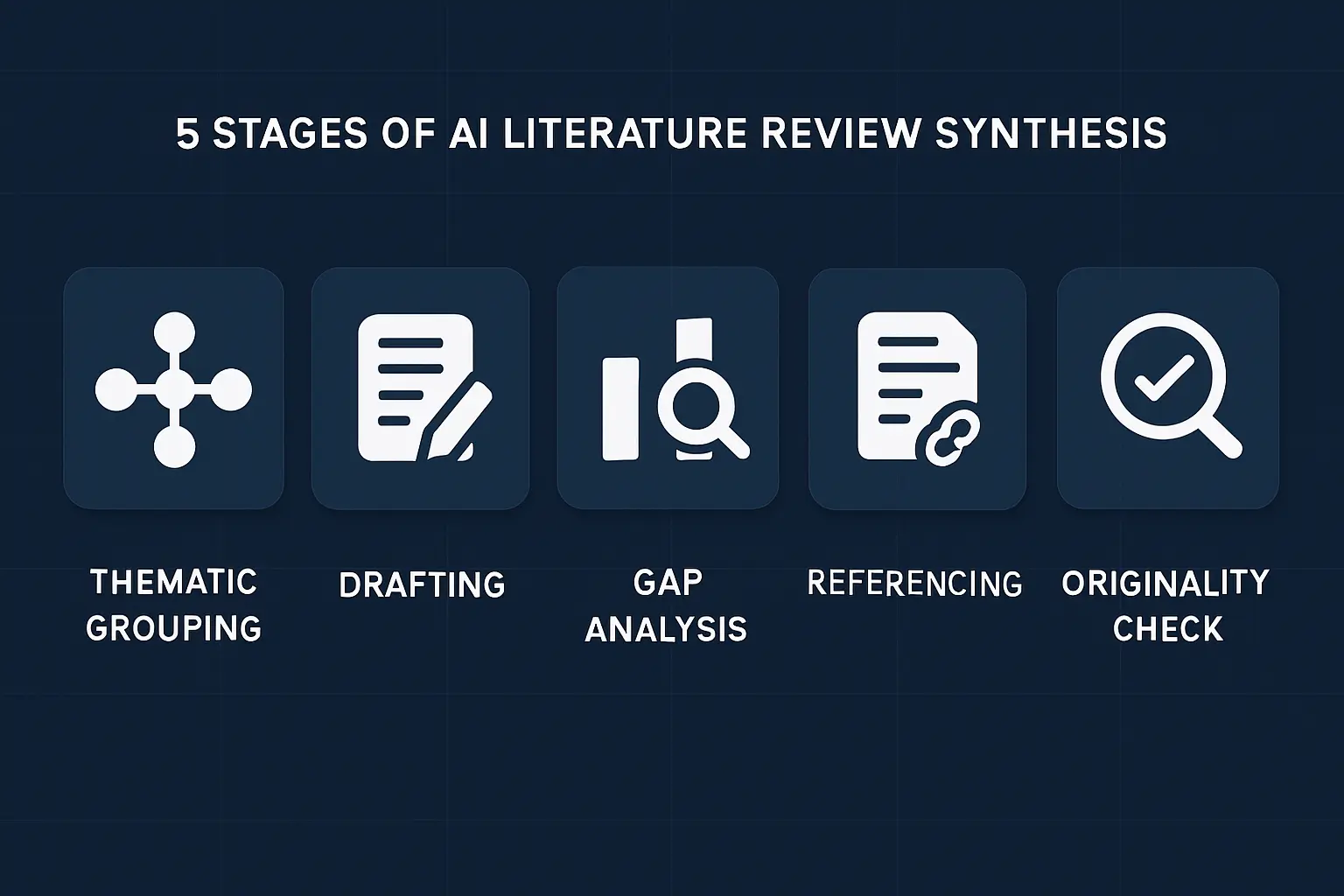
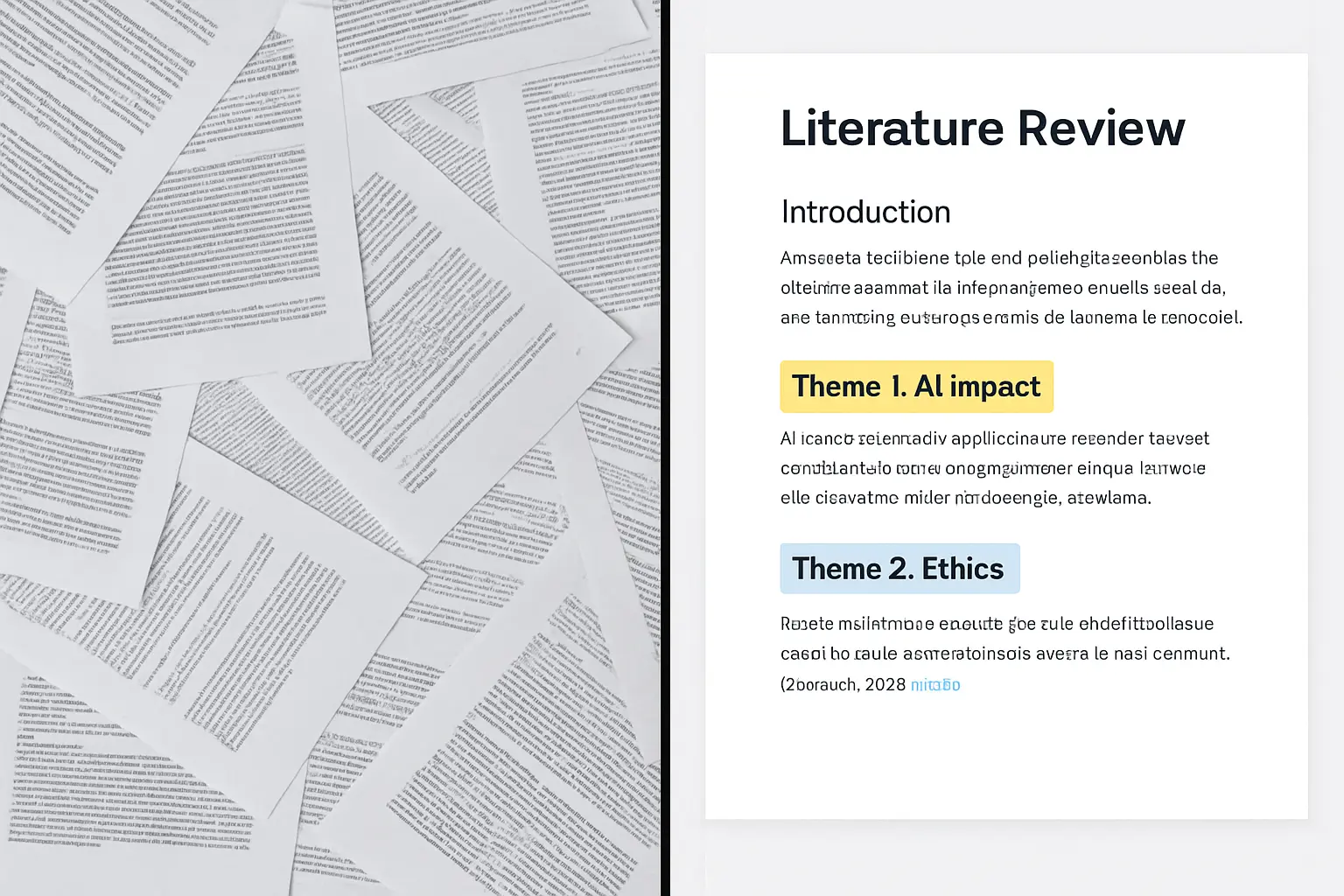
- Thematic grouping. Tesify reads your uploaded sources and clusters them by shared arguments, methodologies, and findings — revealing the thematic structure of your field without you manually colour-coding 80 PDFs.
- Synthesis drafting. For each theme cluster, Tesify drafts synthesis paragraphs that compare and contrast the studies, noting agreements, contradictions, and methodological differences. The prose is a starting point, not a finished submission.
- Gap identification. The tool flags where your sources reveal under-researched questions, methodological limitations, or contradictory findings that your thesis could address — giving you material to justify your own research contribution.
- Auto-referencing. Every synthesised paragraph includes correctly formatted in-text citations in APA 7th, MLA 9th, Chicago 17th or Vancouver, plus a full reference list generated from your source metadata.
- Originality self-check. Before you submit, Tesify’s built-in originality check compares your draft against its reference corpus to flag passages that need stronger paraphrasing or clearer attribution.
If you are still in the earlier stages of your project, Tesify’s full AI dissertation writing assistant workflow covers planning, chapter structuring, and referencing in a single environment — so you are not switching between five different tools as your dissertation grows.
For a grounded understanding of how the literature review fits into a complete dissertation, the guide on how to write a literature review covers both narrative and systematic review types step by step.
For hands-on tips on how to write your literature review faster with AI — including worked examples and time-saving templates for each synthesis stage — the extended guide on Tesify’s platform covers the full process end to end.
The Integrity Question: What Stays Yours
Using an AI literature review generator is not ghostwriting. Ghostwriting means having someone else produce your intellectual work and submitting it as your own. What Tesify does is structurally different: it drafts from your selected sources, under your direction, producing prose that you then revise, deepen, and argue through. The intellectual judgements — which sources matter, how they relate to your research question, what the gaps mean for your study — remain yours at every stage.
Universities across the UK, US, Australia, and Canada moved rapidly to clarify AI-use policies in 2025–2026. The consistent thread in guidance from institutions including Edinburgh, Melbourne, and Toronto is: AI as a writing scaffold, disclosed and revised, is generally permitted. AI-generated text submitted unchanged and undisclosed is academic misconduct.
Tesify is designed around that boundary. The platform generates a first draft built to be revised, not submitted. The originality self-check highlights passages that read as formulaic or under-paraphrased. If you want to understand exactly where your institution draws the line, our guide on what is allowed when using AI for your thesis maps the policy landscape by country and institution type.
Step-by-Step: From Sources to Synthesised Draft
Here is how a complete literature review workflow looks in Tesify, from a blank source list to a structured draft chapter ready for critical revision.
| Stage | What you do | What Tesify does |
|---|---|---|
| 1. Source curation | Select 20–80 papers from Google Scholar, Scopus, or your institution’s databases; upload PDFs or paste DOIs | Extracts metadata and full text; builds a source index |
| 2. Theme mapping | Review the proposed thematic clusters; add, remove, or relabel themes to match your argument | Groups sources by shared concepts, methods, and findings |
| 3. Synthesis draft | Prompt with your research question; review, revise, and expand each paragraph critically | Drafts synthesis paragraphs per theme with in-text citations |
| 4. Gap analysis | Evaluate flagged gaps against your thesis argument; select gaps that justify your contribution | Identifies under-researched areas and contradictory findings |
| 5. Reference generation | Choose citation style; verify auto-generated references against original source papers | Outputs full reference list in APA, MLA, Chicago, or Vancouver |
| 6. Originality check | Run self-check; revise flagged passages; add your own critical commentary throughout | Flags high-similarity passages and formulaic AI phrasing |
For a broader view of how each dissertation chapter connects — including how your literature review sets up the methodology — the complete dissertation writing guide walks through every section from proposal to submission.
Common Mistakes to Avoid with AI Literature Review Tools
Used carelessly, any AI writing tool creates problems that cost marks and credibility. Here are the mistakes that matter most — and how Tesify is designed to prevent them.
- Accepting AI-generated citations without checking. General-purpose AI models frequently produce plausible-sounding references with real authors but non-existent DOIs or wrong publication years. Tesify generates citations only from files you have uploaded — if a paper is not in your source library, it cannot appear in the reference list. Even so, always verify auto-formatted citations against the original source before submitting.
- Submitting the first draft. The synthesis paragraphs Tesify produces are scaffolding. They give you structure and a starting voice. They are not the finished argument. Plan at least one full revision pass where you deepen the critical analysis, add your own evaluative voice, and ensure every paragraph advances your specific research question rather than summarising sources generically.
- Skipping the thematic structure step. Prompting an AI tool for a single continuous literature review often produces a chronological summary of sources — competent but weak analytically. Tesify’s thematic-clustering step structures your review around dimensions of your research problem, producing an argument rather than an annotated bibliography in prose form.
- Skipping disclosure. Submitting AI-assisted work without disclosing it in your methodology notes or appendix is the line most universities define as misconduct, regardless of how thoroughly you revised the draft. Disclose the tool, document what it produced, and note what you wrote or substantially revised.
Start Synthesising Tonight — Free
Upload your sources, let Tesify group them by theme and draft your first synthesis paragraphs — then revise until the argument is unmistakably yours. No credit card. No subscription wall on your first chapter.
Frequently Asked Questions
Is using an AI literature review generator considered cheating?
Not when used as a writing scaffold rather than a ghostwriter. Most universities in 2026 permit AI assistance for drafting and structuring, provided the student directs the intellectual work, revises the output, and discloses which tools were used. Submitting an AI draft unchanged and undisclosed is academic misconduct. Using Tesify to synthesise your own curated sources — then critically revising the output — sits clearly in the permitted category. Always check your institution’s specific AI policy before submitting.
Will an AI literature review generator make up sources?
General-purpose AI tools such as ChatGPT or Gemini can hallucinate fictional citations — plausible author names, journal titles, and publication years attached to papers that do not exist. Tesify avoids this by generating references only from sources you have uploaded. It cannot invent a paper that is not in your source library. That said, always verify auto-formatted citations against the original paper before submitting, since metadata errors in source files can produce formatting mistakes even with real sources.
How long does it take to generate a literature review with Tesify?
Tesify can produce a structured synthesis draft from 30–50 uploaded papers in a matter of minutes. The time-intensive part is the work you do before and after: curating and reading your sources beforehand, and revising the draft to deepen the critical argument afterwards. Most students complete the full literature review chapter — from source upload to polished draft — in a single focused session of three to five hours, compared to days or weeks for the same work done manually.
Which citation styles does Tesify support for literature reviews?
Tesify supports APA 7th edition, MLA 9th edition, Chicago 17th edition, and Vancouver. You select your preferred style and the platform formats both in-text citations and the full reference list automatically. If your department uses a specialist style not on that list, you can export your references to Zotero or Mendeley for final formatting adjustments.
Can Tesify identify research gaps in my literature review?
Yes. After clustering your sources by theme, Tesify surfaces areas where the literature shows contradictory findings, limited methodological diversity, or under-studied populations and contexts. These gap flags are prompts for your own critical judgement — the AI identifies the pattern; you decide whether the gap is significant enough to position your thesis around it and how to frame it in relation to your research questions.
Does Tesify work for systematic literature reviews?
Tesify works well for narrative and thematic literature reviews — the formats most common in humanities, social science, and education dissertations. For full systematic reviews following PRISMA protocols (database search logs, PICOS criteria, GRADE assessment), it can accelerate synthesis and writing but should be paired with dedicated systematic review software such as Covidence or Rayyan for the screening and extraction stages. For a guide covering both review types, see the step-by-step literature review guide.