
How to Write a Problem Statement Step by Step in 2026 (Template + Worked Examples)
Your committee reads the problem statement before they read anything else. If it does not immediately answer “what is wrong, where is the gap, and why does fixing it matter?” — they stop trusting the rest of your proposal. Most students bury the actual problem under three paragraphs of broad background, or confuse it with the purpose statement, or jump straight to methodology before the reader understands what needs solving. This guide gives you five numbered steps for writing a problem statement, a fill-in template, and three worked examples across different disciplines so you can match the pattern to your own research.
A well-built problem statement is not a complaint about the world. It is a precise, evidence-backed argument that a specific problem exists, that current knowledge does not fully address it, and that your proposed study is a justified response. Getting this right early also makes the rest of the proposal easier — your research questions, objectives, and conceptual framework all flow from it.
What a Problem Statement Is (and Is Not)
A problem statement is a 150–250 word passage that justifies why a study needs to exist. It lives at the opening of your introduction chapter, research proposal, or grant application. It is not:
- A purpose statement (“This study aims to…” — that comes after).
- A research question (“To what extent does…?” — that follows from the problem).
- A hypothesis — which belongs in your methodology section.
- A background paragraph with no argument — broad context is only the first move, not the whole statement.
Think of it as a three-move argument: here is what is known → here is what is still broken or missing → here is why someone must fix it now. Your study is the proposed fix.
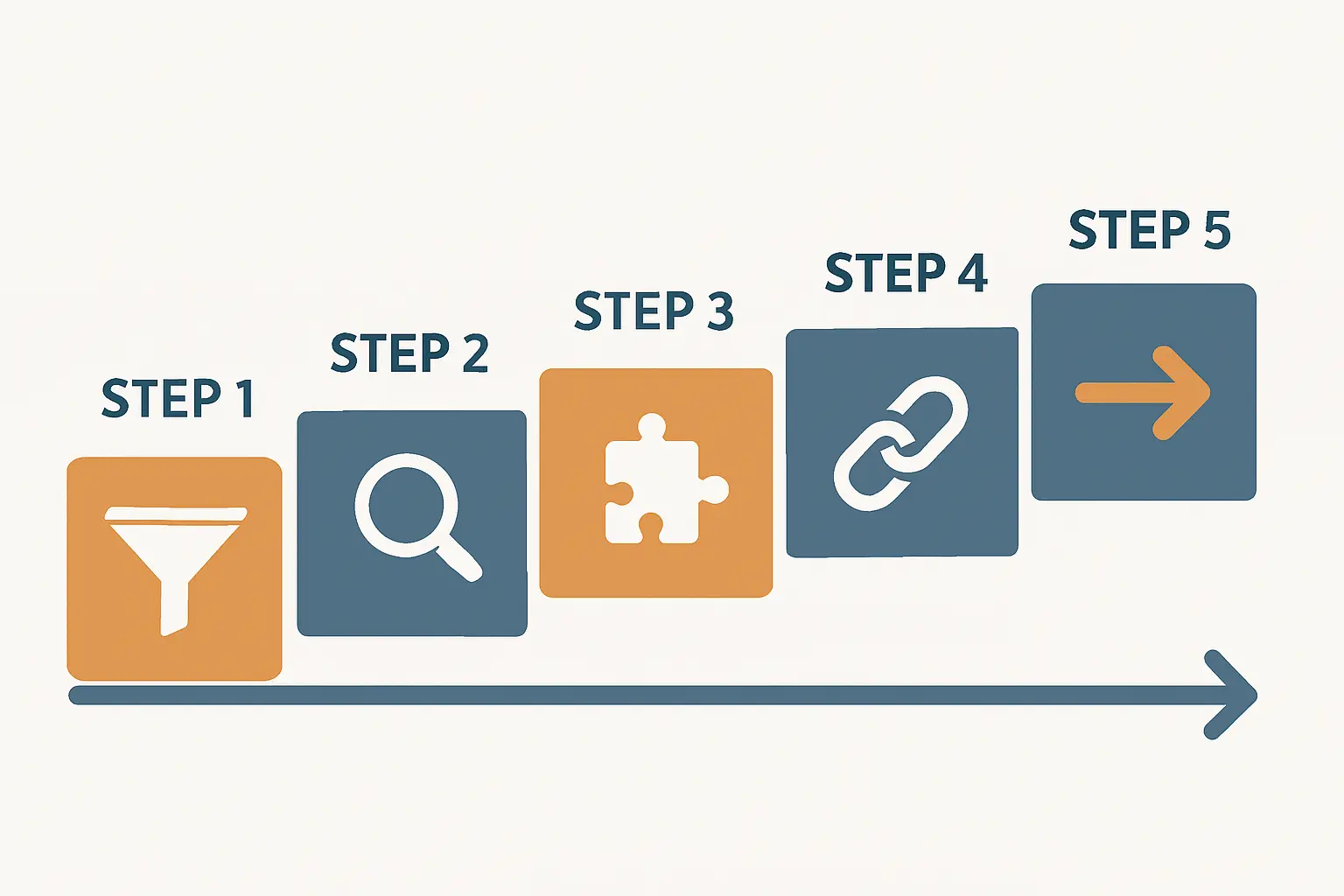
Step 1: Set the Broader Context (2–4 Sentences)
Open with the field, population, or phenomenon your work is situated in. Establish the stakes without over-generalising. Cite one or two published sources to anchor the reader in real evidence, not assumption.
Include: the domain (secondary education in urban schools; antibiotic prescribing in primary care; distributed cloud systems); the general situation that makes your topic relevant; the scale or significance at a high level.
Avoid: “Since the dawn of time…”, “In today’s rapidly evolving landscape…”, or any opener that could appear in any paper in any discipline. Be specific from sentence one.
Step 2: Name the Specific Problem (2–3 Sentences)
Narrow from the context to the precise issue your study addresses. This is the move most writers rush or miss entirely. The problem must be:
- Specific — not “students struggle with maths” but “Year 9 students in under-resourced urban schools show a measurable decline in algebraic procedural fluency following the 2021 curriculum revision.”
- Evidenced — backed by published data, inspection reports, or systematic observation, not personal experience alone.
- Researchable — something a study can investigate through data collection, not a value judgement.
Name the problem in active, declarative language. Passive constructions (“it has been noted that…”) weaken the statement and waste your word budget.
Step 3: Point to the Knowledge Gap (2–3 Sentences)
A problem exists in the world; a knowledge gap is what existing research has not yet answered about that problem. This pivot is what justifies academic inquiry specifically. Even when practitioners are aware of a problem, there may be no peer-reviewed evidence on its causes, mechanisms, or effective interventions.
Signal the gap with phrases like: “however, few studies have examined…”, “existing research has not addressed X in the context of Y”, or “no large-scale investigation has compared…”. You should be able to substantiate this claim from your literature review — confirming the gap is one of the primary reasons you conduct a systematic search of the literature before writing the problem statement, not after.
“Despite its prevalence, no controlled study has examined X in the context of Y.”
“Existing interventions were designed for Z populations and have not been evaluated with A populations.”
“The mechanism by which B affects C in low-resource settings remains poorly understood.”
Step 4: State the Relevance and Consequences (1–2 Sentences)
What happens if this gap remains unfilled? Articulate the practical, policy, or theoretical consequences. This is not scaremongering — it is demonstrating that the research has value beyond academic credit. Link the consequences to real stakeholders: patients, educators, policymakers, engineers, or the discipline itself.
Keep this concise. One strong consequence sentence is more persuasive than three vague ones. Examiners and funders respond to clarity here, not volume.
Step 5: Pivot to Your Objective (1–2 Sentences)
Close the problem statement by gesturing toward your study’s purpose — without yet writing the full purpose statement. This transitional sentence connects the gap to what you will do about it and creates momentum into the next section of your proposal or introduction.
Formula: “To address this gap, the present study [investigates / examines / compares / develops] [what] in [context or population] using [brief methodological hint, optional].”
This sentence then expands naturally into your formal research questions in the following section of your proposal.
The Fill-In Template
Copy this template and replace each bracketed field with your own content. Do not pad — keep every sentence load-bearing.
This template is intentionally tight — five sentences, no filler. You can expand each sentence into two where the evidence demands it, but resist exceeding 250 words before you have earned every word.
Three Worked Examples by Discipline
Example 1 — Learning Sciences (Education)
“Secondary schools in sub-Saharan Africa have expanded enrolment substantially since 2015, yet student retention in STEM subjects remains a persistent concern for education ministries across the region. In many under-resourced schools, Year 10 and 11 students show pronounced disengagement from physics and chemistry by mid-year, a pattern linked to limited laboratory access and low teacher subject-specialisation. However, most intervention studies to date have focused on curriculum redesign at primary level or on elite-school contexts; few have examined low-cost pedagogical adaptations — such as simulation-based learning — at secondary level in resource-constrained settings. Without evidence on what works in these specific conditions, teachers and policymakers lack actionable guidance. The present study investigates whether guided simulation activities improve student engagement and procedural understanding in physics among Year 11 learners in three district schools in Kenya.”
Why it works: Context is established (SSA secondary expansion), the specific problem is named (STEM disengagement in under-resourced schools), the gap is precise (no evidence on low-cost secondary-level interventions in resource-constrained settings), the consequence is actionable (teachers lack guidance), and the objective is immediately clear.
Example 2 — Public Health
“The global rise of antimicrobial resistance is driven in part by inappropriate antibiotic prescribing in outpatient settings. In urban primary care clinics across South-East Asia, patients frequently request antibiotics for self-limiting viral illnesses, and clinicians report difficulty declining due to patient-pressure and short consultation times. Behaviour-change interventions targeting prescribers have been evaluated in high-income contexts with mixed results, but peer-reviewed evidence on their effectiveness in middle-income urban clinic settings — where patient expectations and consultation norms differ substantially — remains limited. If prescribing patterns remain unchecked, treatment options for common infections risk becoming ineffective within a generation. This study therefore evaluates the effect of a brief, structured decision-support tool on antibiotic prescribing rates among general practitioners in three urban primary care clinics in Vietnam.”
Why it works: The gap is geographically and contextually specific (middle-income urban clinics, not replicated from high-income settings), and the consequence is concrete and time-bounded without fabricating a specific statistic.
Example 3 — Computer Science / Information Systems
“Federated learning has emerged as a privacy-preserving approach to training machine-learning models across distributed edge devices without centralising raw data. Organisations deploying federated systems at scale report significant variance in model convergence when participating devices have heterogeneous data distributions — a condition known as statistical heterogeneity. While recent studies have proposed aggregation algorithms to mitigate this, most have been validated only in controlled laboratory simulations with uniform device configurations. No large-scale empirical evaluation has tested these algorithms under real-world heterogeneous conditions across a mix of mobile and IoT devices. Without this validation, practitioners cannot confidently select or tune aggregation strategies for production environments. The present study benchmarks five leading aggregation algorithms against real-world heterogeneous device fleets to identify performance boundaries and provide practitioner-ready selection guidance.”
Why it works: It assumes a technically literate reader without overloading on jargon, and the gap — lab-only validation versus real-world heterogeneous conditions — is precise and verifiable during examination.
From Problem Statement to Research Questions
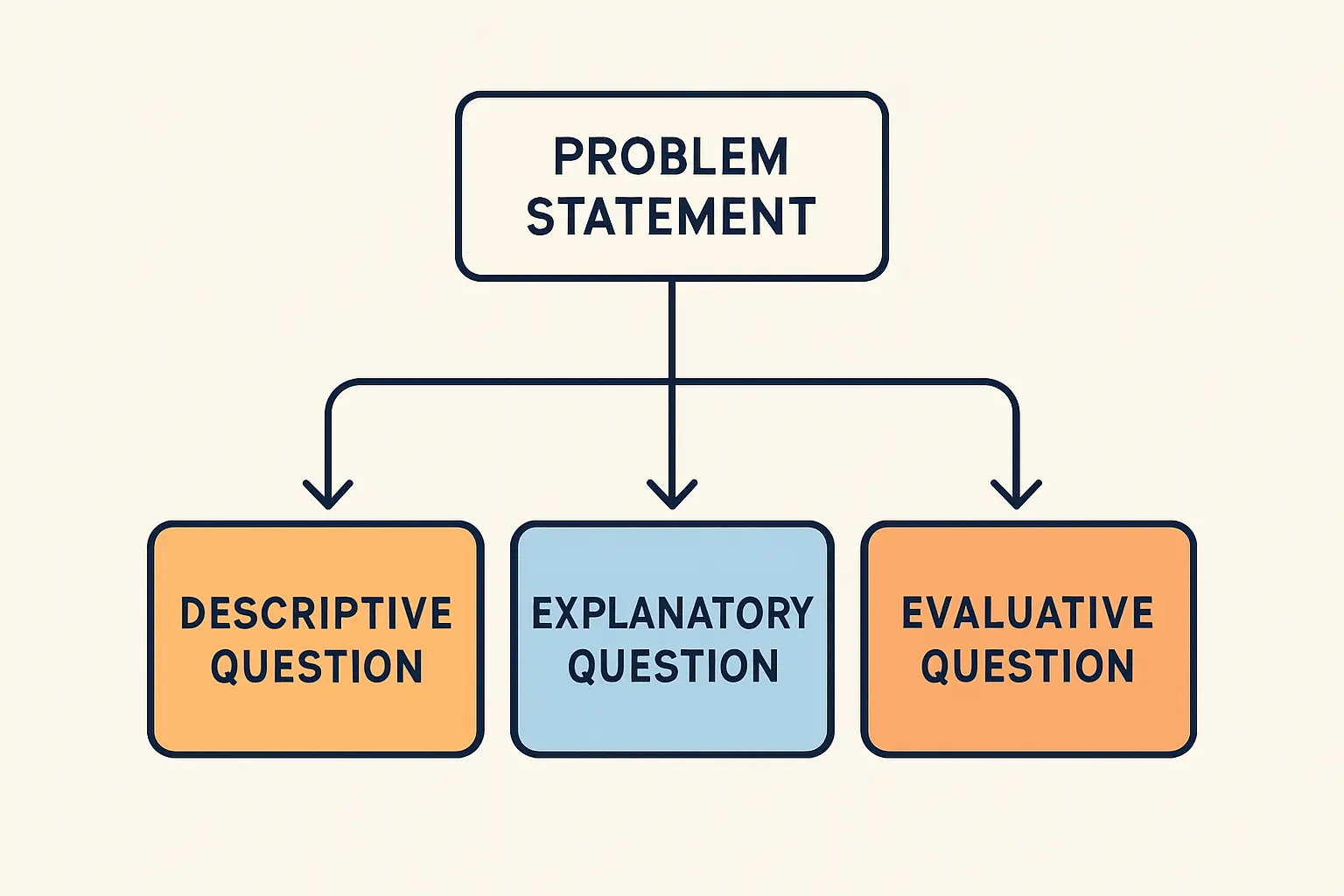
Once your problem statement is stable, deriving research questions becomes almost mechanical. Each component of the statement maps to a different type of question:
| Problem Statement Component | Type of Research Question Generated |
|---|---|
| The specific problem (Step 2) | Descriptive: “To what extent does X occur among Y?” |
| The knowledge gap (Step 3) | Explanatory or comparative: “What is the relationship between A and B in context C?” |
| The objective pivot (Step 5) | Evaluative or interventional: “To what extent does [intervention] improve [outcome] in [setting]?” |
For a detailed walkthrough of question types, the FINER criteria, and PICO framing, see the guide to writing research questions step by step. Once your questions are finalised, your problem statement becomes the anchor of the introduction section in your full research proposal. For a complete section-by-section template covering every component of a research proposal — problem statement through methodology and timeline — the research proposal template and writing guide on Tesify provides annotated examples across multiple disciplines.
Common Mistakes to Avoid
- Writing a topic, not a problem. “This study examines social media use in teenagers” is a topic description. The problem is that heavy social media use in adolescents is associated with disrupted sleep, yet no school-based programme has demonstrated sustained behaviour change. Identify the specific harm or gap, not just the subject area.
- Conflating the problem with the purpose. The problem is what is wrong; the purpose is what you will do about it. Keep them in separate, sequential sentences. Mixing the two confuses the reader and weakens both statements.
- Claiming an absolute gap without evidence. “No study has ever examined X” is almost always inaccurate and will embarrass you at the viva. Write “few peer-reviewed studies have examined X in the context of Y” and be ready to show the search strategy that confirms this.
- Exceeding 250 words. Length signals uncertainty. If you cannot state the problem concisely, you have not yet understood it clearly enough to begin designing the study.
- Skipping the consequence. Without Step 4, the reader has no reason to care whether the gap gets filled. The consequence sentence is the persuasive linchpin — do not treat it as optional.
Frequently Asked Questions
How long should a problem statement be?
A problem statement in a dissertation or research proposal should be 150–250 words. For a journal article, it is compressed into the opening paragraph of the introduction — often 50–100 words without a dedicated heading. In a business or project context, it can be as brief as two or three sentences. Longer does not mean stronger: a concise, well-argued problem statement signals that you understand the research territory.
What is the difference between a problem statement and a purpose statement?
A problem statement explains what is wrong and why it matters. A purpose statement explains what your study will do in response. They are sequential, not interchangeable. The problem statement ends with a gap and its consequences; the purpose statement begins with your proposed study. In APA-style dissertations, both appear in Chapter 1, usually within a few paragraphs of each other.
Do I need citations in a problem statement?
Yes. The context (Step 1) and the specific problem (Step 2) should each be supported by at least one citation. The gap claim (Step 3) does not always require a direct citation, but you must be able to substantiate it at the viva — typically by showing that your literature search returned no studies meeting your precise criteria. Unsupported claims in a problem statement raise immediate red flags for examiners and grant reviewers.
Can a problem statement change after I start the research?
Yes, and it is normal for it to be refined as your literature review deepens and your methodology crystallises. The version you write first is a working draft. Most supervisors expect to see it sharpen between the proposal and the final thesis submission. Track your revisions so you can explain the evolution of your framing if asked during examination.
Where does the problem statement appear in a dissertation?
In a dissertation or thesis, the problem statement appears near the beginning of Chapter 1 (Introduction), typically after one or two paragraphs of broad background and before the purpose statement and research questions. In a research proposal, it is usually the second section after the title and abstract. In a journal article, it is embedded in the opening introduction without a dedicated heading.