
How to Write Research Questions Step by Step in 2026 (FINER, PICO & Examples)
Your topic is approved. Your supervisor has nodded. Now comes the question that stops most students cold: how do you turn a broad subject into a precise, answerable research question? The research question is the load-bearing wall of your thesis — every methodology choice, every data source, and every chapter of your dissertation flows directly from it. Get it wrong and you spend months collecting data that answers the wrong thing. Get it right and your whole study snaps into place.
This guide walks you through six concrete steps — from spotting a genuine research gap to stress-testing your final wording — using the FINER criteria and the PICO/PEO frameworks that examiners expect. At each step you will find worked examples drawn from business, health sciences, education, and social work so you can adapt the process to your own discipline.
A strong research question is specific, feasible within your constraints, and leads to a clear methodology. Start by identifying a gap in the literature, apply the FINER criteria (Feasible, Interesting, Novel, Ethical, Relevant), then use PICO or PEO to structure the wording. Finish by writing one primary question and two to four sub-questions that each map to a distinct section of your data collection.
What Makes a Research Question “Good”?
A research question is not a topic (“climate change and agriculture”) or a hypothesis (“organic farming increases yield”). It is a focused, interrogative sentence that your study is specifically designed to answer. Three qualities define a good one:
- Specificity. It names the population, phenomenon, or variable under investigation and the context or setting where the study takes place.
- Answerability. You can collect data — empirical, documentary, or observational — that directly responds to it within a realistic timeframe.
- Significance. Answering it advances knowledge, informs professional practice, or fills a stated gap in the existing literature.
These three qualities map directly onto the FINER criteria, which you will apply in Step 2.
Step 1 – Identify Your Research Gap
Before you can write a question, you need to know what remains unanswered. Conduct a targeted literature review and ask four diagnostic questions as you read:
- What conclusions do existing studies agree on?
- Where do findings conflict, and what explains that conflict?
- Which populations, contexts, or time periods have been ignored?
- What methodology limitations do authors themselves flag in their discussion sections?
Record every gap in a plain list. You only need one that you can realistically address with your resources and timeline — that single gap becomes the seed of your primary research question.
Step 2 – Apply the FINER Criteria
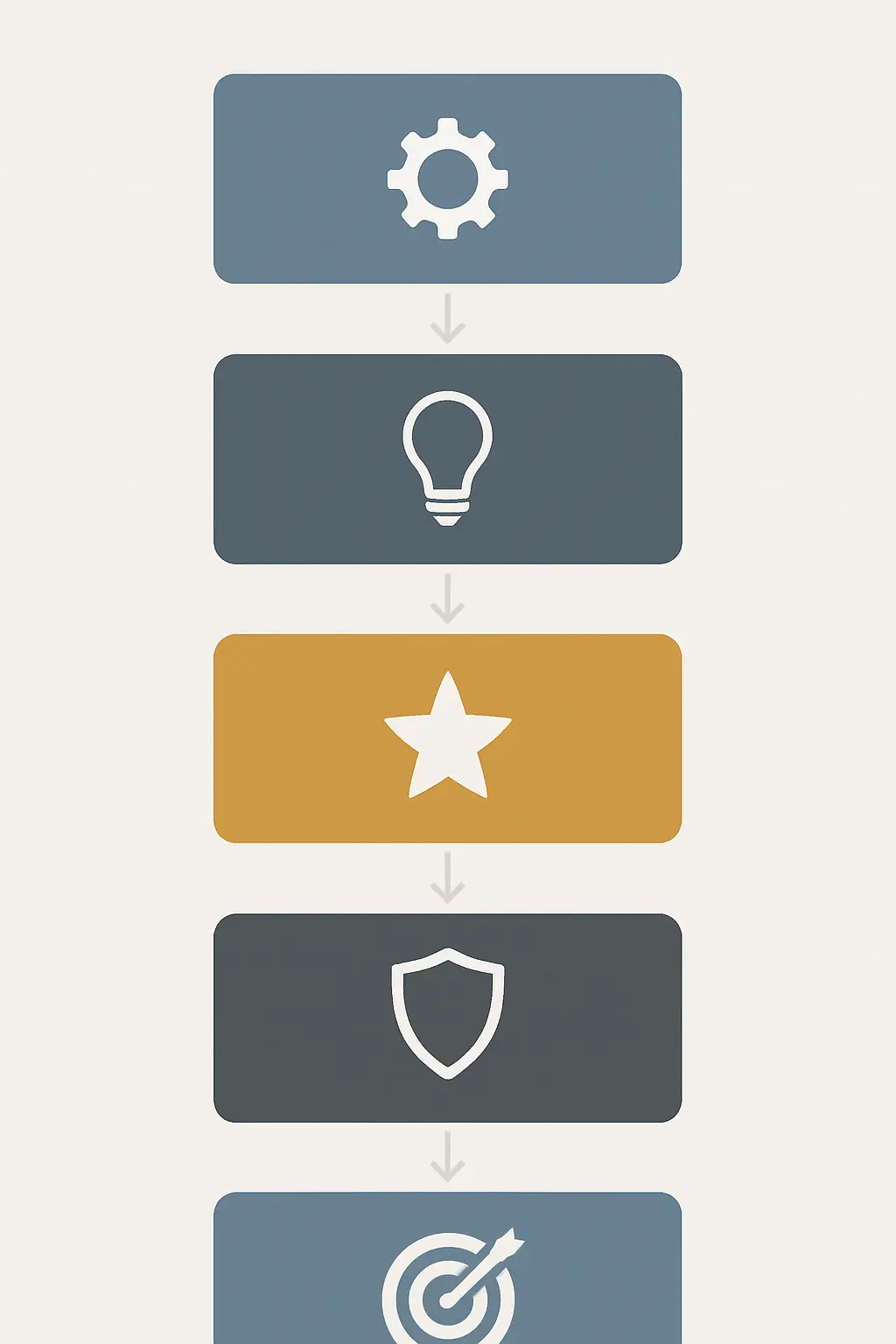
The FINER criteria give you a structured checklist to audit a candidate question before you commit to it. Run every draft question through all five filters. A question that fails even one criterion needs revision — not polished prose, revision.
| Criterion | What it means | Self-check question |
|---|---|---|
| Feasible | Achievable with your time, budget, sample size, and existing skills | Can I recruit enough participants and collect this data before my submission deadline? |
| Interesting | Motivating for you and relevant to your field’s current debates | Will I still care about this question nine months from now? |
| Novel | Adds new knowledge — it does not replicate a published study without extending it | Does this question already have a published answer? If so, what do I add? |
| Ethical | Can be answered without causing harm to participants, communities, or data subjects | Would an institutional ethics board approve my proposed data collection plan? |
| Relevant | Matters to theory, professional practice, or public policy | Who needs this answer, and how will they use it? |
A question that scores weak on Feasible or Ethical will be flagged at your viva regardless of how well-executed the rest of your study is. Fix the question first.
Step 3 – Choose Your Framework: PICO vs PEO
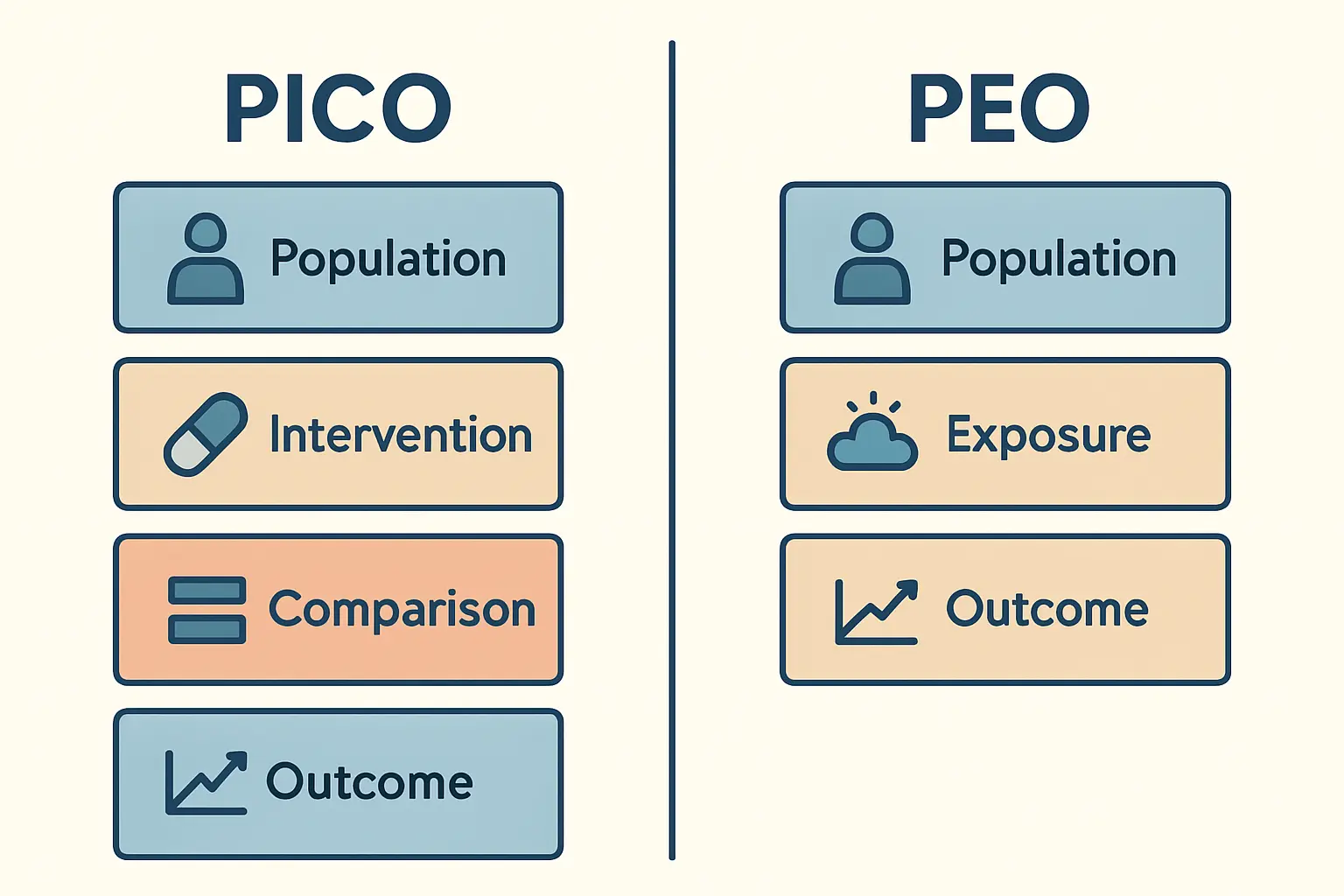
Frameworks give your question a replicable internal structure so that another researcher can understand exactly what you are comparing and measuring. The two most widely used are PICO (quantitative and clinical studies) and PEO (qualitative studies).
| Element | PICO | PEO |
|---|---|---|
| P | Population | Population |
| I / E | Intervention — what you do to or with the group | Exposure or Experience — what the group lives through |
| C | Comparison — control group or alternative treatment | — (not applicable) |
| O | Outcome — the measured result | Outcome — the theme or phenomenon of interest |
- Use PICO for: randomised controlled trials, quasi-experiments, comparative surveys, and systematic reviews with measurable outcomes.
- Use PEO for: interviews, focus groups, ethnography, phenomenology — any study that explores lived experience rather than testing a measured effect.
For cross-over or mixed-methods designs, consult your research methodology chapter for the framework that fits your primary strand. The framework you choose should match your underlying epistemology, not just your convenience.
Step 4 – Write Your Primary Research Question
Slot your PICO or PEO elements into a complete sentence. Two reliable templates:
- Quantitative (PICO): “To what extent does [Intervention] affect [Outcome] in [Population] compared with [Comparison]?”
- Qualitative (PEO): “How do [Population] experience [Exposure or Phenomenon] in relation to [Outcome or Theme]?”
Write the question in full, then read it aloud. If you need to pause mid-sentence to interpret what it means, it is still too vague. The standard to aim for: any colleague in your faculty can understand the question without further explanation.
Step 5 – Draft Your Sub-Questions
Your primary question sets the destination; sub-questions map the route. Each sub-question should:
- Address one distinct aspect of the primary question — no overlap between sub-questions.
- Be answerable by a specific section of your data collection instrument.
- Follow a logical sequence, typically conceptual → empirical → interpretive.
Two to four sub-questions is the accepted range across most disciplines. Fewer than two and your study may lack analytical depth; more than four and you risk scope creep that stretches your methodology across too many directions.
Worked example — education, qualitative:
- Primary: How do first-generation university students experience academic writing feedback during their first year?
- Sub-Q1: What types of written feedback do first-generation students receive on assessed work?
- Sub-Q2: How do students interpret and act on written feedback from tutors?
- Sub-Q3: What institutional factors shape students’ engagement with feedback practices?
Each sub-question maps to one block of semi-structured interview questions. Together they build the complete answer to the primary question.
Step 6 – Match Phrasing to Your Method
The language of your research question signals your design before any reader reaches your methods chapter. Examiners notice immediately when the verbs in your question contradict the methodology you describe. Use the table below to calibrate your phrasing.
| Method type | Preferred verbs | Example opening phrase |
|---|---|---|
| Quantitative | measure, predict, compare, correlate, test | “To what extent does X predict Y among Z?” |
| Qualitative | explore, understand, examine, describe | “How do Z experience or understand X?” |
| Mixed methods | Combine verbs across both strands | State one quantitative and one qualitative sub-question |
| Systematic review | synthesise, identify, evaluate | “What evidence exists on the effect of X on Y?” |
Avoid passive constructions (“It is examined whether…”) and double-barrelled questions (“Does X affect Y and Z?”). One question, one focus, one method strand per question.
Common Mistakes to Avoid
- Too broad. “What is the impact of social media on mental health?” covers billions of people, dozens of platforms, and hundreds of outcomes. Add the population, platform, age group, and timeframe to make it answerable.
- Yes/no structure. “Does exercise reduce anxiety?” produces a binary answer with no analytical range. Reframe: “To what extent does…” or “In what ways does…”
- Hidden assumption. “Why does remote work increase productivity?” assumes the effect already exists. Test the relationship before explaining it.
- Normative framing. “Should universities adopt AI writing tools?” is a policy opinion, not an empirical question. Replace it with “How do academic staff perceive the integration of AI writing tools in assessed coursework?”
- Merged sub-questions. “…and how does this differ by gender, age, and socioeconomic status?” overloads a single sentence. Move each additional dimension into its own numbered sub-question.
- Unmeasurable outcome. “What makes a good leader?” cannot be operationalised. Specify the leadership behaviour, the context, and how you will measure “good” (survey scale, performance metric, interview theme).
Research Question Examples by Discipline
| Discipline | Method | Example primary question |
|---|---|---|
| Business & Management | Quantitative survey | To what extent does transformational leadership predict employee retention in UK SMEs with fewer than 50 employees? |
| Clinical Nursing | Systematic review (PICO) | In adult patients with type 2 diabetes (P), does structured self-monitoring of blood glucose (I) compared with standard care (C) improve glycaemic control at 12 months (O)? |
| Education | Qualitative (PEO) | How do secondary school teachers (P) experience the transition to hybrid teaching models (E) with respect to professional identity and workload (O)? |
| Environmental Science | Mixed methods | What is the relationship between urban green-space density and reported wellbeing among residents of South London boroughs, and how do residents describe that relationship? |
| Social Work | Qualitative | How do care-experienced young adults navigate housing insecurity in the 24 months following discharge from the UK care system? |
For a deeper look at how your research question connects to the thesis structure chapter by chapter, this thesis-focused guide on Tesify.app covers question-to-chapter alignment in detail.
FAQ
How many research questions should a dissertation have?
Most dissertations and theses have one primary research question supported by two to four sub-questions. The primary question defines the overall aim; sub-questions break it into the analytical units your data will address. Having more than five total questions usually signals a scope problem rather than rigour.
What is the difference between a research question and a hypothesis?
A research question is open and exploratory — it asks what, how, or to what extent. A hypothesis is a directional prediction derived from existing theory. Qualitative studies use research questions; experimental and quasi-experimental studies typically state both a research question and a null or alternative hypothesis.
Can a research question change after data collection begins?
In qualitative research, it is acceptable — and sometimes expected — that your question is refined as themes emerge from the data. In quantitative studies, changing the question after data collection begins risks post-hoc rationalisation. Any substantive change should be discussed with your supervisor and, where required, submitted as an ethics amendment.
Does PICO work for qualitative research?
PICO is designed primarily for quantitative and clinical questions where a comparison group and a measurable outcome exist. For qualitative research, PEO (Population, Exposure/Experience, Outcome) or SPIDER (Sample, Phenomenon of Interest, Design, Evaluation, Research type) are better fits. Using PICO for a phenomenological study forces a structure that distorts the question.
How do I know if my research question is too broad?
Apply the single-chapter test: could you answer this question with the data from one chapter of your dissertation? If answering it fully would require five separate studies, it is too broad. Narrow by restricting population, geography, timeframe, or the specific aspect of the phenomenon you are investigating.
Should the research question appear in both the introduction and the conclusion?
Yes. State the primary research question explicitly in your introduction, ideally after presenting the research gap. Restate it in your conclusion before presenting your direct answer. This bookend structure is standard in academic writing and gives examiners the clearest possible thread through your work.
Ready to Turn Your Question Into a Full Research Proposal?
Once your research question is locked, the next step is building the proposal around it — problem statement, theoretical framework, methodology outline, and timeline. Our step-by-step guide covers every section with templates you can adapt tonight: How to Write a Research Proposal Step by Step (2026).
If you want structured coaching on your own question draft — checking it against FINER, flagging vagueness, and aligning it to the right framework — Tesify can review your wording before you submit it to your supervisor.