
How to Write an Academic CV for PhD Applications in 2026 (Template + Section-by-Section Examples)
Your academic CV for a PhD application is not a job résumé with an extra line about your thesis. It is a different document with different logic: where a résumé compresses your history into one page to catch a recruiter’s eye in six seconds, an academic CV expands it — sometimes across four or five pages — to give an admissions committee and a potential supervisor the full picture of your scholarly trajectory. Get the format wrong, or omit the sections selectors expect, and even a strong research background reads as thin.
This guide walks through every section of the academic CV for a PhD application, what belongs in each part, how long each should run, and shows concrete example bullets you can adapt today.
Academic CV vs. résumé: the core difference
A résumé is a sales document. An academic CV is a scholarly record. Both describe what you have done, but the principles governing each diverge at almost every point:
| Feature | Résumé | Academic CV |
|---|---|---|
| Length | 1–2 pages (hard limit) | 2–4 pages for applicants; longer for senior scholars |
| Purpose | Get an interview | Document scholarly identity and research trajectory |
| Objective/Summary block | Common at the top | Never — omit entirely |
| Publications | Rarely included | Central, formatted in your field’s citation style |
| References | “Available on request” | Named in full with contact details |
| Irrelevant work history | Acceptable filler to show employment continuity | Cut it — every line must signal research capacity |
The admissions reader — often the faculty member who will become your supervisor — is scanning for evidence that you can do original research: that you have worked in a lab or archive, produced something of scholarly value, and thought seriously enough about a problem to pursue it for three to five more years.
How long should a PhD academic CV be?
For most applicants finishing a bachelor’s or master’s degree, two to three pages is the realistic target. If you have published peer-reviewed work, presented at multiple conferences, or held research assistant positions across several projects, a fourth page is legitimate. Do not pad to reach a minimum length, and do not shrink font sizes to stay on one page. Academic readers notice both strategies immediately.
One practical heuristic: every line should earn its place by demonstrating research capacity. If a section entry does not speak to your potential as a doctoral scholar, cut it.
Section-by-section guide with example bullets
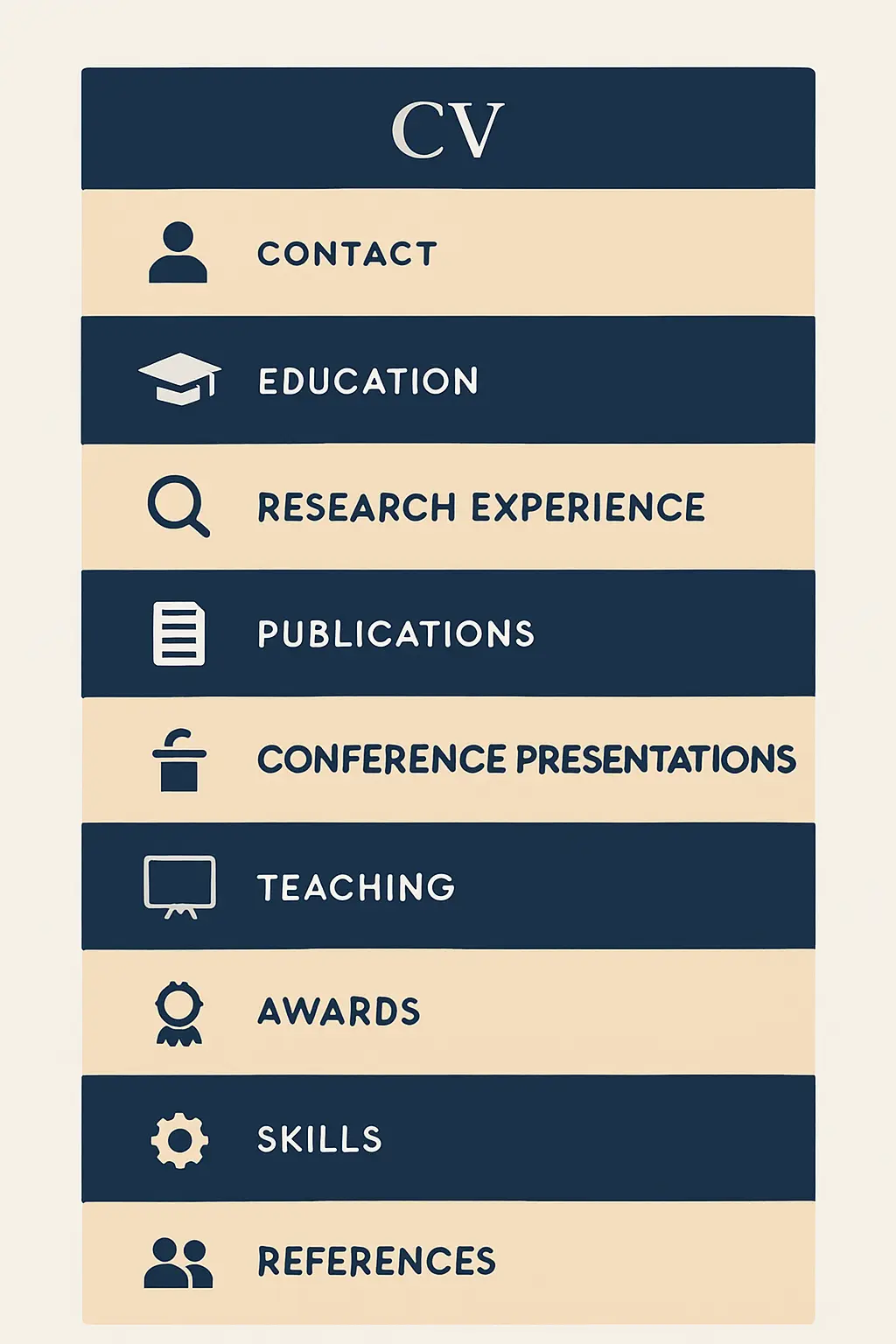
1. Contact information
Place this at the very top. Include your full name (in a slightly larger font or bold), an institutional or professional email address, phone number with country code, city and country, ORCID identifier if you have one, and a link to a personal academic website or Google Scholar profile if it is current and populated.
Do not include a photograph, date of birth, or marital status. These are irrelevant in most Western university contexts and illegal to request in many jurisdictions.
2. Education
List degrees in reverse chronological order (most recent first). For each entry include: degree name, institution, country, years of study, dissertation or thesis title where applicable, supervisor name, and your final grade or GPA where the convention in that system makes it meaningful to cite.
MSc Social Research Methods — University of Edinburgh, UK (2024–2025)
Dissertation: “Navigating Epistemic Authority: How Science Journalists Frame Contested Climate Evidence”
Supervisor: Prof. Alison McGregor | Grade: Distinction
3. Research experience
For an early-career applicant with few publications, this is typically the most important section. For each position, give the role title, institution, dates, and the name of the supervising researcher. Then write two to four bullet points describing what you actually did and — crucially — what the work produced.
Weak: Assisted with a longitudinal study on educational outcomes.
Strong: Conducted semi-structured interviews with 24 secondary-school teachers across three Scottish local authorities, coded transcripts in NVivo 12, and contributed two subsections to a manuscript submitted to the British Educational Research Journal (under review, 2025).
The strong version names a method, a sample size, an analytical tool, and an output. Each of those details signals research readiness in a way that vague “assistance” language does not.
4. Publications
Use the citation format standard in your discipline: APA for social sciences and psychology, Chicago Notes-Bibliography for humanities, Vancouver or AMA for medicine and health sciences. Separate sub-sections — peer-reviewed articles, book chapters, working papers, manuscripts under review — where the volume of entries warrants it.
For work listed as “under review” or “in preparation,” be scrupulous: include it only if the manuscript genuinely exists and has been submitted or is ready to submit. Admissions committees check, and a fabricated entry ends an application immediately.
McAllister, J., & Chen, R. (2025). Algorithmic nudges and adolescent news consumption: A pre-registered experiment. Journal of Communication, 75(2), 112–131. https://doi.org/10.1093/joc/jqae041
If you have no peer-reviewed publications — a common situation at the bachelor’s-to-PhD transition — omit the section heading entirely and fold any relevant written output into Research Experience entries as bullet-point items.
5. Conference presentations
List the presentation title, conference name, location, and date. Distinguish between oral presentations, poster presentations, and panels you organised, since each signals different levels of scholarly engagement.
“Platform Moderation and the Visibility of Scientific Dissent.” Paper presented at the International Communication Association Annual Conference, Gold Coast, Australia, June 2025. [Oral presentation]
6. Teaching experience
Include tutoring roles, lab demonstrating, teaching assistant positions, and any guest lectures. Note the subject, level (undergraduate, postgraduate), institution, and duration. Many doctoral programmes carry a teaching load, and showing prior comfort with classroom or seminar settings is a genuine asset at admission.
7. Awards, grants, and funding
List scholarships, academic prizes, and any competitive funding you have held. Give the award name, awarding body, year, and — where the award’s selectivity is not self-evident — a single line of context. If you are applying for funded studentships, this section signals that other selectors have already backed you with money, which is strong social proof.
If you are researching funding options in parallel with building your CV, the guide to PhD scholarships in 2026 covers the major international fellowships — Gates Cambridge, Rhodes, Fulbright, DAAD, Marshall, Commonwealth — and how to position applications for each.
8. Skills
Keep this section brief and concrete. Divide into Research Methods (e.g., multilevel regression, ethnographic fieldwork, systematic review, fMRI analysis) and Technical Skills (e.g., R, Python, SPSS, NVivo, ATLAS.ti, ArcGIS). Languages spoken at professional working proficiency or above belong here too.
Do not list generic transferable skills such as “teamwork” or “communication.” These are résumé conventions and undermine the scholarly register the rest of the document has been building.
9. References
Name two or three referees who can speak directly to your research capacity — dissertation supervisors, principal investigators you have worked under, or faculty who know your academic work closely. Include full name, title, institution, email address, and a brief note on your relationship to them (“dissertation supervisor,” “research collaborator on Project X”). Always contact your referees before naming them and confirm they will respond promptly to programme requests.
Tailoring your CV to the supervisor and programme

A single generic academic CV sent to twelve programmes is significantly less effective than twelve lightly tailored versions. The tailoring is mostly subtle — you are not rewriting the document from scratch — but the marginal gains compound across a competitive applicant pool.
- Lead with the section most relevant to the programme. Applying to a bench-science or lab-based PhD? Put Research Experience above Publications. Applying to a humanities doctorate? Put Education and Publications first to foreground your scholarly formation.
- Mirror the supervisor’s methodological vocabulary. If the lab works with fMRI and EEG, use those terms precisely rather than a vague catch-all like “neuroimaging techniques” — precision signals you have read their work rather than written a generic application.
- Let the surrounding documents do the contextual work. The CV is the evidence; your cover letter and research statement make the argument. Your CV section order and bullet emphasis tell the reader which evidence is most relevant; the statement explains why it matters to this specific research group.
Before finalising your application package, the guide on how to email a potential PhD supervisor is worth reading in full. The cold-contact email and the academic CV work in tandem: they should feel like documents from the same applicant making the same research case, and inconsistencies between them (different research emphasis, conflicting methodology descriptions) flag a lack of preparation. For a data-backed view of what the academic job market looks like after your PhD — and how that context should shape which programmes you target and which supervisors you approach — the 2026 academic job market statistics on tesify.app covers tenure-track odds, postdoc conversion rates, and outcomes by field.
Your statement of purpose is the direct companion piece to your CV. Where the CV lists what you have done, the SOP explains why those experiences specifically prepared you to pursue this research question in this programme under this supervisor. They should be consistent in tone, cross-reference the same projects and outputs, and together form a coherent picture of an applicant with a clear intellectual trajectory.
Common mistakes that cost offers
- Using a functional or hybrid résumé format. Academic readers expect reverse-chronological, section-by-section structure. A skills-first résumé layout signals that you do not understand academic hiring culture — or that you sent a document prepared for a corporate application without adapting it.
- Including an “Objective” or “Professional Summary” block. These are résumé conventions. Omit them entirely; they consume space and signal genre confusion.
- Inconsistent citation formatting. If you use APA throughout your Publications section and one entry drifts into Chicago, it signals carelessness — precisely the quality a doctoral supervisor does not want in a student who will be producing manuscripts for years.
- Listing irrelevant work experience. A part-time retail job that funded your studies has no place on an academic CV unless you can frame it as directly demonstrating research-relevant capacity — and even then, that framing is usually a stretch.
- Leaving unexplained date gaps. “2023–present” for a position that ended eighteen months ago will invite pointed questions. Use accurate dates and, if there is a genuine gap, address it briefly in your cover letter rather than hoping it goes unnoticed.
- Underselling research outputs. “Helped with data collection” obscures your actual contribution. Write the specific method, the sample scale, and the concrete output produced. If you collected 200 survey responses, cleaned a dataset, and ran descriptives in SPSS, say so.
- Sending one CV to every programme without revision. Even minor tailoring — reordering sections, swapping which research projects you foreground, adjusting your skills emphasis — demonstrates to a supervisor that you have read their work and thought about fit.
Once your application is submitted and you advance to the shortlist, the questions selectors ask in panel conversations probe exactly the material on your CV. The guide to common PhD interview questions walks through how admissions panels interrogate research experience, funding plans, and methodological choices — and how to prepare answers that hold up under follow-up scrutiny.
Template structure
Below is a section-order template you can drop into any word processor. Use a clean 10–12pt font (Times New Roman, Garamond, Georgia, or Calibri all work well), one-inch margins, and consistent bold/italic treatment throughout. Avoid headers, footers with complex formatting, embedded tables in the body, or text boxes — these break screen-reader parsing and some university application portals that process uploaded PDFs.
your.email@institution.ac.uk · +44 7700 900000 · City, Country
ORCID: 0000-0000-0000-0000 · yoursite.com / Google Scholar profile URL
────────────────────────────────────
EDUCATION
────────────────────────────────────
Degree — Institution, Country (Year–Year)
Thesis: “Full thesis title here”
Supervisor: Prof. Name | Final grade / GPA
────────────────────────────────────
RESEARCH EXPERIENCE
────────────────────────────────────
Role Title — Institution (Month Year – Month Year)
Supervisor: Prof. Name
· Method + scale + output
· Method + scale + output
────────────────────────────────────
PUBLICATIONS
────────────────────────────────────
Author, A., & Author, B. (Year). Title. Journal, Vol(Issue), pp–pp. DOI
Under review
Author, A. (2025). Title. Submitted to Journal Name.
────────────────────────────────────
CONFERENCE PRESENTATIONS
────────────────────────────────────
“Presentation Title.” Conference Name, City, Country. Month Year. [Oral / Poster]
────────────────────────────────────
TEACHING EXPERIENCE
────────────────────────────────────
Role — Institution (Year–Year)
· Course name, level (UG/PG), brief description
────────────────────────────────────
AWARDS, GRANTS, AND FUNDING
────────────────────────────────────
Award Name — Awarding Body (Year)
Brief context if selectivity is not self-evident
────────────────────────────────────
SKILLS
────────────────────────────────────
Research methods: [list specific methods]
Technical: [list software and tools]
Languages: [Language (proficiency level)]
────────────────────────────────────
REFERENCES
────────────────────────────────────
Prof. Full Name — Title, Institution — email@institution.edu
Relationship: dissertation supervisor
If you are targeting funded doctoral programmes in the US or UK, the detailed guide to fully funded PhD programmes in 2026 explains what selectors at NSF GRFP, UKRI studentships, and comparable schemes look for in application materials — and the academic CV sits at the centre of every one of those packages.
FAQ
How long should an academic CV be for a PhD application?
Two to three pages is standard for applicants transitioning from a bachelor’s or master’s degree. A fourth page is acceptable if you have meaningful publications, multiple conference presentations, or several distinct research positions. Never force a one-page limit — that is a résumé convention, not an academic CV norm, and it will make your document look like you misunderstood the genre.
What is the difference between a CV and a résumé for PhD applications?
A résumé is a brief, targeted document designed to secure a job interview, typically capped at one or two pages. An academic CV is a comprehensive scholarly record with no page limit, including dedicated sections for publications, conference presentations, teaching, grants, and named references. PhD programmes always expect an academic CV — sending a résumé suggests you have not understood the application process.
What should I do if I have no publications for my PhD application?
Do not include a Publications section heading with nothing beneath it — an empty section reads as padding. Instead, fold any written outputs (a dissertation chapter, a working paper, a submitted manuscript, a poster abstract) into your Research Experience entries as bullet-point outputs. Many strong PhD applicants at the bachelor’s-to-PhD transition have no peer-reviewed publications; committees understand this and look instead for sustained engagement with a research question evidenced through experience bullets.
Can I include non-academic work experience on my academic CV?
Include non-academic work only if it is directly relevant to the research area or demonstrates transferable research capacity — for example, an industry data-science role when applying to a quantitative social science programme. Generic retail, hospitality, or administrative jobs should be omitted; they do not speak to your doctoral research potential and consume space that should be used for scholarly outputs.
Should I include a photo on my academic CV?
No, not for applications to UK, US, Canadian, or Australian programmes. Including a photo raises equal-opportunity concerns and is not conventional in these systems. In some European (notably German, French, and Spanish) and some East Asian contexts, photos are still expected — check the norms for the specific country and institution before deciding.
How do I tailor my academic CV to a specific PhD supervisor?
Reorder sections to foreground the experience most relevant to the supervisor’s active research agenda, use the precise methodological vocabulary of their field rather than generic terms, and adjust which bullet points you expand versus compress based on what that particular lab or programme values. Your cover letter and research statement carry most of the tailoring argument — the CV shifts its emphasis subtly to support that argument with concrete evidence.
Polish every part of your PhD application with Tesify
Tesify helps researchers at every stage — from tightening dissertation drafts to refining the documents that go into doctoral applications. Whether you need feedback on the framing of your research experience bullets, a second read of your statement of purpose, or help ensuring your CV is consistent in register and citation format, Tesify’s AI-assisted review gives you precise, discipline-aware suggestions in minutes.