
How Many References Should a Thesis Have in 2026? Discipline-by-Discipline Benchmarks
If you’ve been Googling how many references should a thesis have and found only vague answers, here’s the clearest version: undergraduate dissertations typically need 30–60 references, master’s theses 60–120, and PhD theses 150–400 or more. But those headline numbers hide a crucial variable — your discipline matters as much as your degree level, and a philosophy doctorate and a biomedical engineering doctorate operate in very different referencing ecosystems.
Quick answer: Undergraduate dissertations typically cite 30–60 sources; master’s theses 60–120; PhD theses 150–400+. Humanities theses skew considerably higher than STEM theses at every level. Quality of engagement — how well each source shapes your argument — matters more to examiners than raw count.
How Many References Should a Thesis Have? Benchmarks by Degree Level
The table below summarises accepted benchmarks across degree levels, drawing on published practice guides and examiner commentary. These are ranges, not rules — your department’s handbook and your supervisor’s explicit guidance always take precedence over any general benchmark.
| Degree level | Typical word count | Reference range | Approx. per 1,000 words |
|---|---|---|---|
| Undergraduate dissertation | 8,000–12,000 | 30–60 | 4–6 |
| Master’s dissertation | 15,000–25,000 | 60–120 | 5–8 |
| PhD thesis | 60,000–100,000 | 150–400+ | 3–6 |
Notice that the per-1,000-words ratio does not scale linearly upward at PhD level. A doctoral thesis builds depth on a narrower topic, so foundational texts recur across chapters as supporting citations rather than being added as new entries. The bibliography grows large because of breadth of literature engagement, not because every page introduces fresh sources. For a comprehensive breakdown of these numbers across document types, ReferenceChecker’s 2026 benchmarks offer useful additional data.
Why Your Discipline Changes Everything
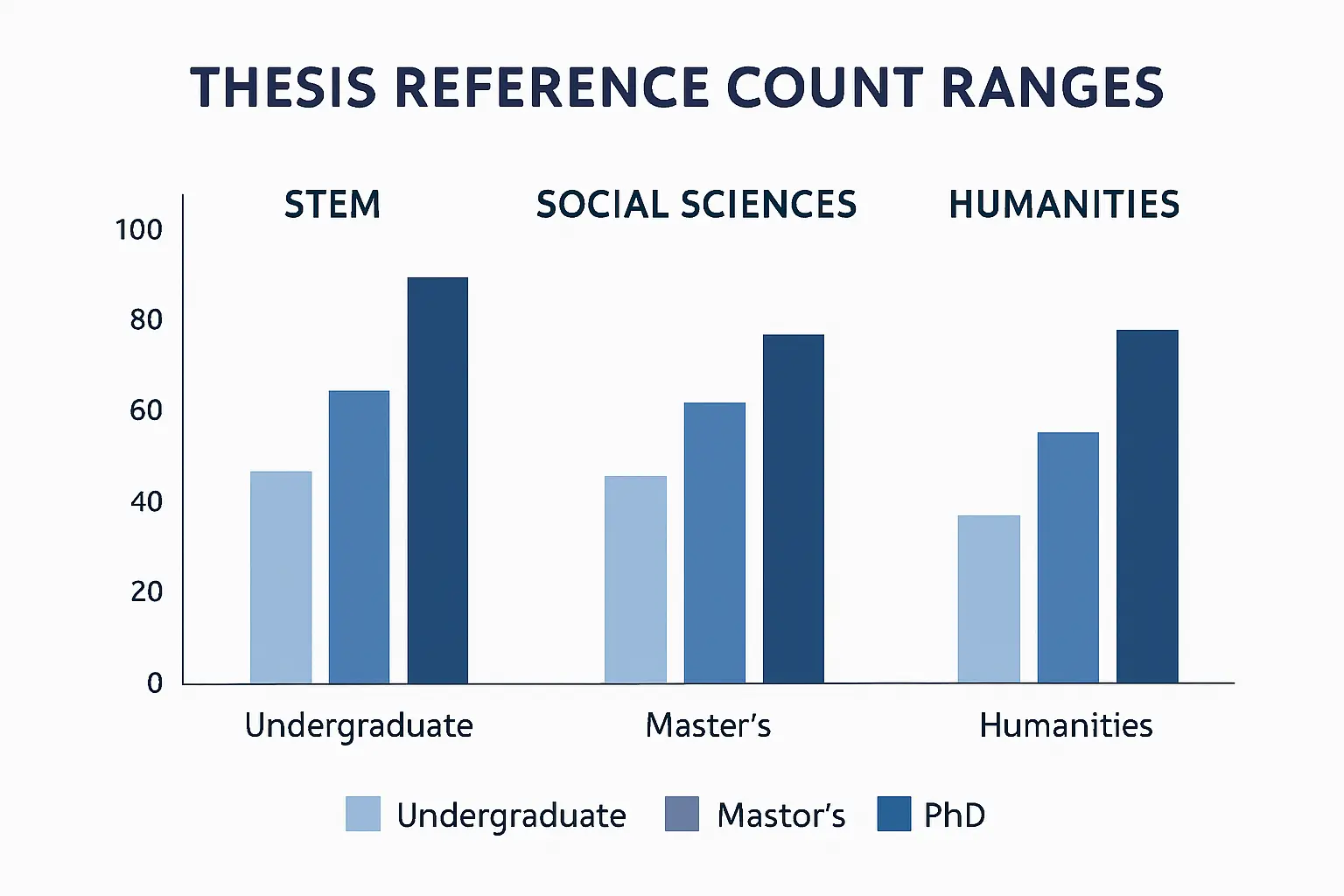
Degree level gives you a starting point, but discipline is the stronger predictor of whether your examiner will consider your reference list thin or bloated. The gap between a humanities PhD and a STEM PhD can easily exceed 200 sources at the same word count. Here is how the three broad groupings behave:
STEM theses (sciences, engineering, computing, medicine)
Laboratory sciences, engineering, computer science, and clinical medicine theses tend toward fewer references per page. The literature in these fields moves fast — a seminal paper from three years ago may already be superseded by newer empirical work — so examiners value currency and precision over breadth. A master’s thesis in biochemistry might comfortably cite 50–80 papers, mostly recent journal articles and conference proceedings, alongside a small number of methodological handbooks. Textbooks and secondary sources rarely appear, and pre-2015 literature needs a strong reason to be included.
Humanities theses (history, literature, philosophy, theology)
Humanities theses demand the widest reference lists because the argument is constructed by positioning itself within a web of prior scholarship spanning decades or even centuries. A humanities PhD will often exceed 300 references, blending primary sources (archival documents, literary texts, manuscripts), theoretical frameworks from different eras, and broad secondary literature. Even a narrowly scoped topic in modern European history may require engaging with scholarly debates from the mid-twentieth century onward. Your literature review in a humanities thesis is itself a major scholarly contribution — not merely a summary of prior work.
Social science theses (psychology, sociology, economics, education)
Social science theses sit between the two poles. Quantitative social science research resembles STEM in its emphasis on recent empirical studies and concise literature reviews. Qualitative and theoretical social science work pulls more heavily from conceptual and critical literature, pushing reference counts toward the humanities range. A mixed-methods master’s in education might land anywhere between 80 and 140 sources depending on how theoretically grounded the framework chapter is.
| Discipline group | Master’s range | PhD range | Dominant source types |
|---|---|---|---|
| STEM | 40–80 | 100–250 | Journal articles, preprints, conference papers |
| Social sciences | 60–120 | 150–250 | Journals, reports, books, grey literature |
| Humanities | 80–160 | 250–400+ | Primary sources, monographs, archival materials |
Practical Self-Checks: Do You Have Enough References?
Numbers are useful anchors but not definitive verdicts. These four tests are more diagnostic than any reference count alone:
- Every factual claim has a citation. Scan your draft for any sentence making a factual assertion, statistic, or theoretical point without an in-text citation. Each unanchored claim is a potential missing reference — and an open invitation for an examiner to question your rigour.
- Your literature review synthesises rather than lists. A literature review that reads as a parade of “Author A found X. Author B found Y.” entries, even with 60 separate citations, does not engage with the scholarship — it catalogues it. Synthesis signals you have read deeply enough to identify patterns and tensions, not just accumulated titles.
- Your most recent source is genuinely recent. If your most current reference is from several years ago and your field moves quickly, reviewers will notice the gap. For STEM and quantitative social science, prioritise sources from the last five years unless you are citing foundational methodology or theory that has not been superseded.
- You have cited the seminal works your examiner will expect. Every subfield has a small number of foundational texts that examiners mentally scan for. Missing them signals that your literature search was incomplete, regardless of your total count.
What Examiners Actually Look For
Examiners do not sit down and count your references. They read for two things: depth of engagement and appropriate scope. A 400-reference list in which many entries are only superficially acknowledged in passing will draw more scepticism than a focused 150-reference list in which every source visibly informs the argument.
Three referencing patterns tend to fail in viva:
- Reference padding — citing sources that appear once in passing and never connect to the central argument. Examiners notice when references disappear after the literature review chapter and play no role in the discussion or conclusion.
- Over-reliance on secondary sources — paraphrasing textbooks or review articles rather than engaging with primary research. In any discipline, the majority of your references should be original research or primary texts, not third-party summaries of what that research found.
- Stale literature — in a rapidly evolving field, a reference list that stops several years before submission looks like an incomplete search regardless of how many total entries it contains.
If you are uncertain about the citation format required by your department — APA 7, Harvard, Vancouver, Chicago, or another style — a dedicated Harvard referencing guide is a good starting point for understanding the structural logic that most author-date systems share.
Building Your Reference List Efficiently
The most common reason students fall short on references is not a lack of effort — it’s an inefficient search process. Searching one database at a time, using only title-level keywords, and stopping at the first page of results leaves significant relevant literature undiscovered.
Three strategies that reliably close the gap:
- Snowball from key papers. Identify two or three seminal works in your area, check their reference lists for foundational sources, and then search forward (who cited those papers after publication). Google Scholar, Scopus, and Web of Science all support forward citation tracking. One well-cited methodological paper can open up a branch of literature you would otherwise miss entirely.
- Use structured search strings across multiple databases. Combine your core concept with synonyms using Boolean operators (AND, OR, NOT). A well-formed string run across three databases recovers substantially more material than repeated ad hoc searches in a single source.
- Organise as you go, not at the end. Reference managers such as Zotero, Mendeley, or EndNote prevent the common crisis of collecting many PDFs without properly recorded metadata. Import directly from database export rather than typing references manually — manual entry introduces errors that are difficult to catch at submission.
Once your bibliography is assembled, Tesify’s AI dissertation writing assistant can help you maintain consistency between in-text citations and your reference list as you draft each chapter — flagging mismatches and formatting entries in APA, Harvard, Vancouver, or Chicago so you are not hunting for formatting errors in the final week before submission.
Frequently Asked Questions
Is there a minimum number of references for a master’s dissertation?
There is no universal minimum, but the 60–120 range covers most master’s dissertations across disciplines. Your department’s assessment criteria and your supervisor’s guidance take precedence over any general figure. A focused empirical study in a STEM field may pass comfortably with 50 well-chosen references; a theoretical thesis in social policy may need 150 or more. Always check your programme handbook for specific expectations.
Can you have too many references in a thesis?
Yes. A reference list padded with marginally relevant sources signals to examiners that you could not identify what was central to your argument. It also creates a credibility risk: a very large bibliography invites examiners to probe your familiarity with the sources you have listed. Every entry should appear because it directly shapes your argument, methodology, or findings — not to inflate the total.
Do all thesis chapters need the same number of references?
No, and an uneven distribution is entirely normal. The literature review chapter carries the largest share of references in most theses. The methodology chapter cites core methods texts and seminal papers that established the approach you are using. Results chapters typically have few citations. The discussion chapter returns to the literature to contextualise your findings. Examiners expect this pattern — they are not looking for uniform citation density across every chapter.
Is the 8-to-12 references per 1,000 words rule reliable?
It is a rough starting point, not a precise formula. The rule works reasonably well for humanities and social science literature reviews, where every paragraph typically engages with multiple sources. It breaks down for STEM theses, where results and methods chapters often contain few or no citations per page. Use it as a sanity check on your literature review chapter rather than a target for your whole thesis word count.
Does grey literature count toward my reference total?
Yes — government reports, policy documents, institutional data, and white papers are fully citable references in most disciplines, and their relevance is particularly high in applied social science, public health, and policy-adjacent research. Cite them in your chosen citation style. Be cautious, however, about relying too heavily on grey literature in disciplines where peer-reviewed research is the expected primary source type, as examiners may note an imbalance.
How do I know when my literature search is complete?
Saturation is the clearest signal: when multiple new searches and snowball mining consistently return sources you already have in your list, your coverage is likely sufficient. Cross-reference your bibliography against the reference lists of the most recent systematic reviews or meta-analyses in your area. If three or four separate search iterations are returning no new foundational sources, you are probably done with your core literature search — though you should continue monitoring for new publications until submission.
Stop wrestling with citation consistency — focus on the argument
The most time-consuming part of managing references is not finding them — it’s keeping in-text citations, bibliography entries, and citation styles perfectly aligned through dozens of revisions. Tesify’s AI dissertation writing assistant handles that consistency layer automatically, formatting your bibliography in APA, Harvard, Vancouver, or Chicago and flagging mismatches as you draft.