Harvard Referencing Guide 2026: In-Text Citations & Reference List Examples
Harvard referencing trips up even experienced researchers — not because the system is complicated, but because there is no single official Harvard manual. Unlike APA (which has a published 7th edition) or MLA (which has a 9th edition handbook), Harvard is a loose family of author-date styles that each university adapts to its own preferences. The most widely adopted guide in UK and Australian higher education is Cite Them Right by Pears and Shields, now in its 12th edition. This Harvard referencing guide follows Cite Them Right conventions while flagging the most common institutional variations — so check your department’s style sheet and treat this as the authoritative starting framework.
What follows is a meticulous, source-type-by-source-type walkthrough: in-text citation rules, reference list formats, and copy-paste templates you can adapt immediately. Every format has been cross-checked against the University of York, University of Leeds, Open University, and Scribbr UK Harvard guides.
Harvard referencing uses an author-date system: cite (Author, Year) in text, then list the full reference at the end in alphabetical order by surname. For books, include Author, Initial(s). (Year) Title in italics. Place: Publisher. For journals, add volume, issue, page range, and DOI where available. Always check your institution’s specific guide — Harvard has no single governing body.
What Is Harvard Referencing?
Harvard referencing is an author-date citation system. Every time you quote, paraphrase, or summarise another person’s work, you insert a brief parenthetical citation in the text — (Author, Year) — and then provide the full bibliographic details in an alphabetical reference list at the end of your document. This allows readers to locate any source quickly without interrupting the flow of reading.
The key phrase is no single governing body. The University of York, the University of Birmingham, Monash University, and the Open University all publish their own “Harvard” guides, and they differ in punctuation, italicisation rules, and the treatment of digital sources. When your institution publishes a guide, that guide overrides general convention. When it does not, Cite Them Right (Pears and Shields) is the recognised default across most UK institutions.
Harvard differs from APA primarily in punctuation and how author names appear in the reference list (APA spells out all initials; Harvard sometimes uses full first names, depending on the guide). If you are writing to a US journal, you are almost certainly writing APA — not Harvard. Understanding that distinction matters: our guide on formatting your paper step by step in APA covers that system in depth.
In-Text Citation Rules
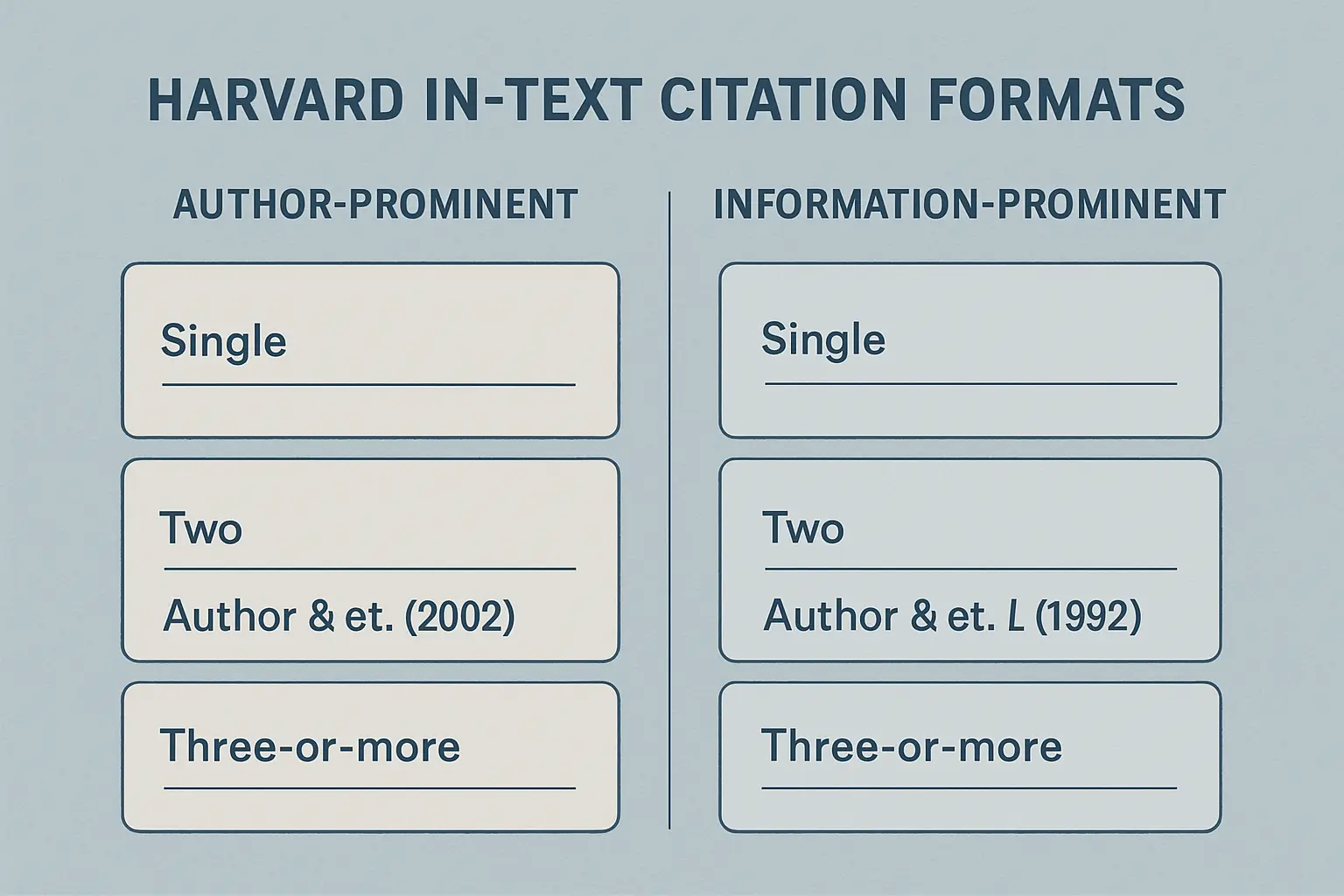
Every Harvard in-text citation contains two elements: the author’s surname and the year of publication, placed inside round brackets. There are two ways to integrate these elements, and both are correct.
Author-Prominent (Narrative) Citations
Use the author’s name as the grammatical subject of the sentence, then put the year in brackets immediately after the name:
Smith (2023) argues that mixed-methods designs increase construct validity in education research.
Information-Prominent (Parenthetical) Citations
Put both the author and the year in brackets at the end of the relevant clause or sentence, before the full stop:
Mixed-methods designs increase construct validity in education research (Smith, 2023).
You can use both forms within the same paper — vary them to improve readability.
Direct Quotations
When you reproduce an author’s exact words, place them in single quotation marks (or indent as a block quote if longer than approximately 40 words) and add a page number to the in-text citation:
‘Referencing is not a bureaucratic exercise but a form of academic respect’ (Brown, 2021, p. 47).
Use p. for a single page and pp. for a range (pp. 47–51). If the source has no page numbers (e.g., an e-book or web page), use a paragraph number (para. 3) or section heading instead.
Multiple Authors
| Number of authors | In-text format | Example |
|---|---|---|
| 1 author | Surname, Year | (Jones, 2024) |
| 2 authors | Surname and Surname, Year | (Jones and Patel, 2024) |
| 3 or more authors | First surname et al., Year | (Jones et al., 2024) |
Note on ampersand vs “and”: Cite Them Right uses “and” (not “&”) between author names in both the in-text citation and the reference list. Some institutional guides permit “&” in parenthetical citations only. Follow your own guide’s convention consistently.
Special In-Text Cases
No Author
If no individual or organisation is named as author, use the first significant word(s) of the title in italics, followed by the year:
The figures showed a sharp rise in postgraduate enrolment (Higher Education Statistics, 2023).
No Date
If no publication date is given, substitute no date (some guides use n.d. — check your institutional style):
(NHS, no date)
Organisation or Corporate Author
Use the full organisation name on first mention. If the abbreviation is widely recognised, you may use it in subsequent citations:
First mention: (World Health Organization, 2023)
Subsequent: (WHO, 2023)
Secondary Sources (Citing a Source You Have Not Read)
If you have read Jones (2024) who quotes or paraphrases Smith (1998), you have not actually read Smith. Cite only what you have read, and flag the relationship:
Smith (1998, cited in Jones, 2024) proposed that cognitive load limits working memory capacity.
Only Jones (2024) appears in your reference list. Overuse of secondary sources is penalised in most departments — always try to access the original. This connects directly to integrity in academic writing and how to avoid plagiarism: fabricating or misrepresenting sources is a serious academic offence.
Same Author, Same Year
If you cite two works by the same author published in the same year, distinguish them alphabetically by title:
(Smith, 2022a) … (Smith, 2022b)
Apply the same a/b suffix in the reference list.
Reference List: Core Rules
The reference list appears on a new page at the end of your work, headed References (not “Bibliography” — a bibliography also includes sources you read but did not cite; a reference list contains only cited sources). Core formatting rules:
- Arrange entries alphabetically by the first author’s surname.
- Use a hanging indent: the first line of each entry is flush left; all subsequent lines are indented by 1.25 cm (0.5 in).
- Do not number entries or add bullet points.
- Include all sources cited in-text and no others.
- The author’s surname comes first, followed by initials (or first name, depending on your guide).
- The year appears in round brackets immediately after the author name(s).
- Italicise book titles, journal titles, report titles, and newspaper titles. Article titles and chapter titles go in single quotation marks and are not italicised.
Books
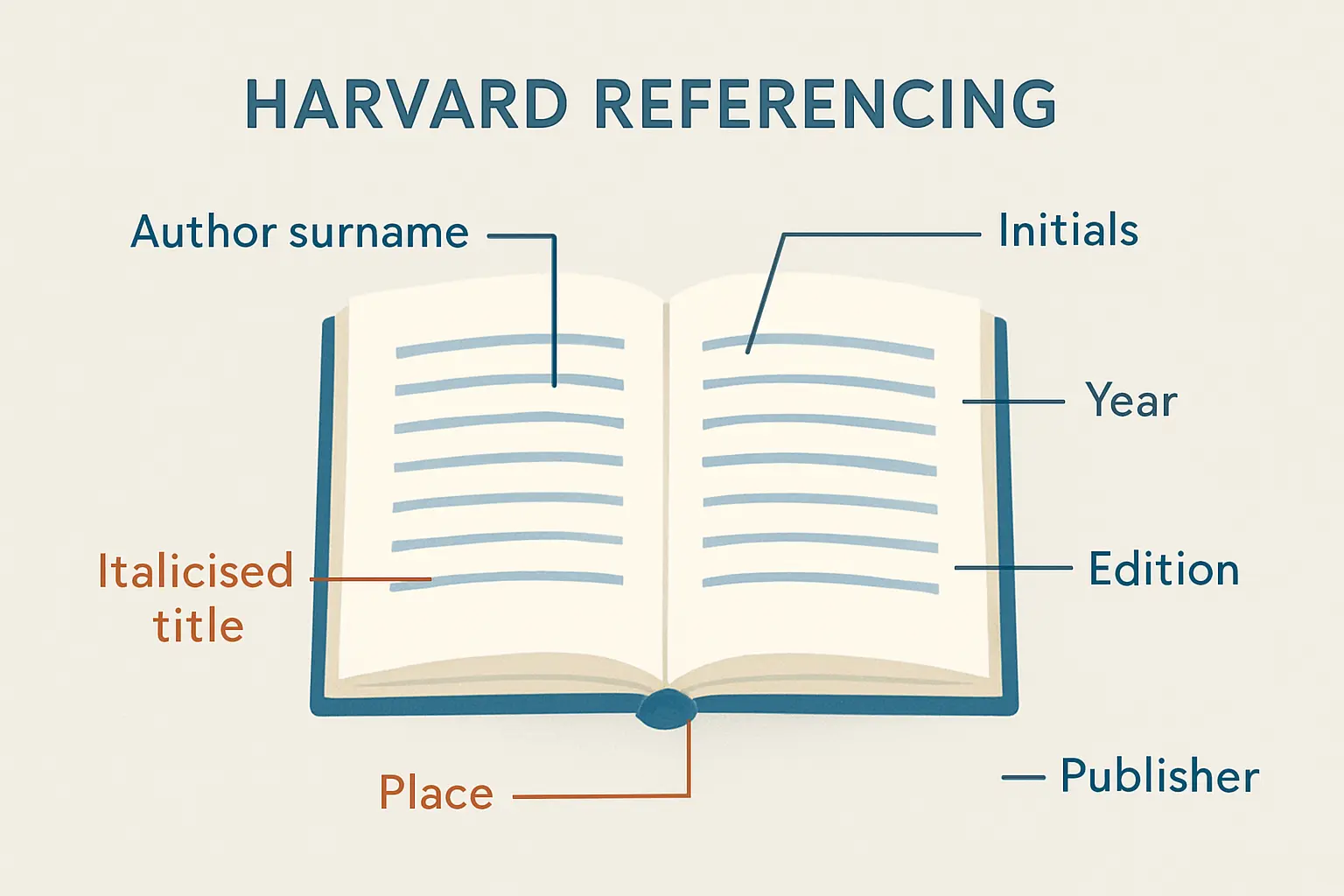
Basic Format
Author, Initial(s). (Year) Title of Book: Subtitle if Any. Place of Publication: Publisher.
Examples
Single author:
Creswell, J.W. (2023) Research Design: Qualitative, Quantitative, and Mixed Methods Approaches. 6th edn. Thousand Oaks, CA: SAGE.
Two authors:
Pears, R. and Shields, G. (2022) Cite Them Right: The Essential Referencing Guide. 12th edn. London: Bloomsbury Academic.
Three or more authors:
Cohen, L., Manion, L. and Morrison, K. (2018) Research Methods in Education. 8th edn. Abingdon: Routledge.
Key details: State the edition only if it is not the first. The place of publication should be the city, not the country. Use a colon to separate city from publisher.
Journal Articles
Basic Format
Author, Initial(s). (Year) 'Title of article', Title of Journal, Volume(Issue), pp. First–Last. doi: xxxxx [if available].
Examples
With DOI (preferred):
Skelton, A. (2012) ‘Value conflicts in higher education teaching’, Teaching in Higher Education, 17(3), pp. 257–268. doi: 10.1080/13562517.2011.611875.
Without DOI (online — include URL and access date):
Taylor, R. (2022) ‘Research methods in education’, Journal of Academic Studies, 15(2), pp. 45–60. Available at: https://www.example.com (Accessed: 10 June 2026).
When a DOI exists, use it — DOIs are permanent, whereas URLs are not. Paste the DOI in the format doi: 10.xxxx/xxxxx (Cite Them Right) rather than as a full hyperlink. Omit “Available at” and “Accessed” when a DOI is present, because the DOI is itself a permanent locator.
Wondering how to cite individual web pages using a different style? Our guide on how to cite a website in APA shows how the same source type is handled under a different author-date convention — useful for comparing the two systems.
Chapters in Edited Books
This is one of the most frequently mis-formatted source types. The chapter author comes first, not the book editor.
Basic Format
Chapter Author, Initial(s). (Year) 'Title of chapter', in Editor Initial(s). Surname (ed./eds.) Title of Book. Place: Publisher, pp. First–Last.
Example
Braun, V. and Clarke, V. (2022) ‘Thematic analysis: a reflexive approach’, in D. Silverman (ed.) Qualitative Research. 5th edn. London: SAGE, pp. 181–200.
Use ed. for a single editor and eds. for multiple editors. The editor’s initial(s) precede the surname in this context because the author list has already been established. Page numbers at the end refer to the chapter’s location within the book.
Websites and Web Pages
Basic Format
Author/Organisation (Year) Title of Web Page [Online]. Available at: URL (Accessed: DD Month YYYY).
Examples
Named author:
Brown, A. (2024) Academic Integrity in the Digital Age [Online]. Available at: https://www.university.ac.uk/academic-integrity (Accessed: 10 June 2026).
Organisation as author:
NHS (2025) Mental Health Support for Students [Online]. Available at: https://www.nhs.uk/mental-health/students (Accessed: 3 January 2026).
The access date is essential for websites because content can change or disappear. Include the full date in day–month–year format. Note [Online] in square brackets before “Available at” — some institutional guides require this; others omit it. Check your own style sheet.
The equivalent process in MLA looks quite different: our MLA 9 Works Cited format guide shows the container-based approach MLA 9th edition uses for web sources, which is a useful contrast if your department switches between styles.
Government and Institutional Reports
Basic Format
Organisation (Year) Title of Report. Place: Publisher. Available at: URL (Accessed: DD Month YYYY) [if online].
Examples
Print report:
Office for Students (2023) National Student Survey 2023: Findings and Trends. Bristol: Office for Students.
Online report:
HESA (2025) Higher Education Student Statistics: UK, 2023–24 [Online]. Cheltenham: HESA. Available at: https://www.hesa.ac.uk/data-and-analysis (Accessed: 12 March 2026).
Common Mistakes and How to Fix Them
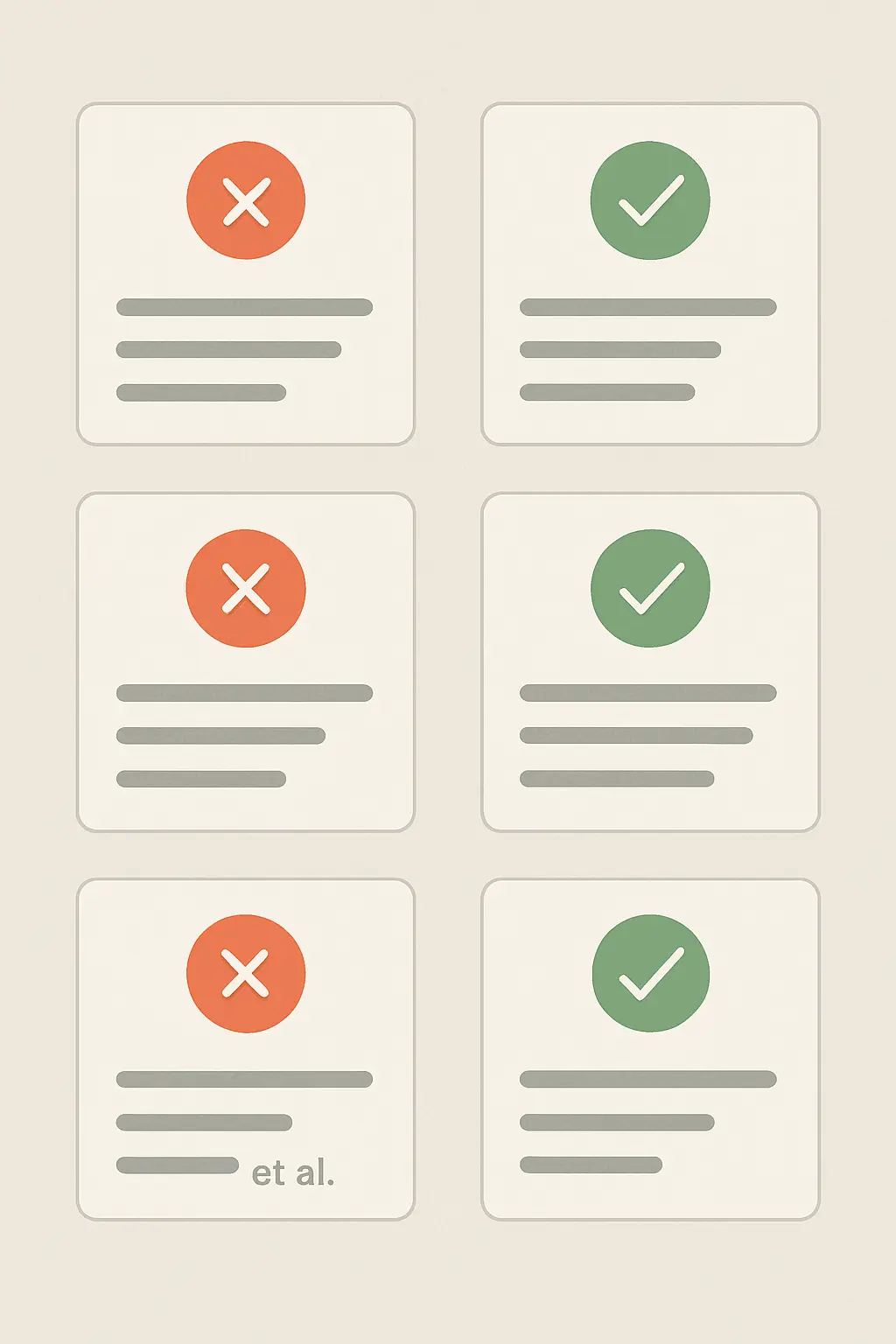
Reference-list errors rarely lose marks individually, but patterns of error signal carelessness. These are the mistakes markers encounter most often.
1. Italicising Article Titles Instead of Journal Titles
Wrong: Smith, J. (2023) ‘The effect of feedback on learning’, Journal of Education, 12(1), pp. 5–20.
Correct: Smith, J. (2023) ‘The effect of feedback on learning’, Journal of Education, 12(1), pp. 5–20.
Rule: italicise the container (journal, book, newspaper), not the article or chapter title.
2. Mixing et al. Threshold Rules
In Cite Them Right Harvard, use et al. as soon as there are three or more authors — even on first mention. APA 7 uses et al. only from the first citation when there are three or more; with one or two authors, you always spell them out. If you are using both styles in the same project (e.g., a methods chapter cross-referencing different style guides), pick one and apply it consistently.
3. Omitting the Access Date for Websites
Web content is not static. A page you accessed in January 2026 may have been updated or removed by June. Always record the access date at the time of retrieval and include it in your reference. A reference manager can help — but its auto-populated access dates are only accurate when you import the source immediately.
4. Incorrect Treatment of Secondary Sources
Writing “(Smith, 1998)” when you have only read Jones’s (2024) summary of Smith is an error that can constitute plagiarism — you are implying you consulted Smith directly when you did not. Always use the “cited in” formula and list only the source you actually read.
5. Ignoring Institutional Variants
If your institution’s guide says to spell out “and” in all citations, do not use “&” because you prefer it. If it requires full first names rather than initials in the reference list, use them. Consistency within a guide matters more than following a general external template.
Automating Harvard References with Software
Building a reference list manually for a dissertation with 80 or more sources is time-consuming and error-prone. Reference management software such as Zotero, Mendeley, and EndNote can generate Harvard-formatted references from DOIs, ISBNs, or web pages — and instantly reformat an entire reference list if your department switches style guides. Before you commit to a tool, weigh the factors that matter for long-form academic writing. Our side-by-side comparison of Zotero vs Mendeley covers storage, Word integration, and collaboration features for each.
If you are writing in LaTeX, the requirements are different — BibTeX and BibLaTeX handle citations programmatically, and the choice of reference manager changes accordingly. The guide on best reference managers for LaTeX and BibTeX on Tesify covers JabRef, Zotero with Better BibTeX, Mendeley, and Citavi in detail, including how each handles Harvard author-date output in LaTeX documents.
Whichever tool you choose, always audit the output. Reference managers mis-format sources regularly — particularly edited book chapters, government reports, and social media posts. The generated entry is a starting point, not a final product.
Frequently Asked Questions
Is there one official Harvard referencing guide?
No. Harvard is not governed by a single institution or manual. The most widely used guide in the UK is Cite Them Right by Pears and Shields (currently in its 12th edition). Australian universities often use the AGPS or their own institutional variations. Always download and follow your institution’s specific Harvard guide — if none exists, default to Cite Them Right.
How do I cite a source with three or more authors in Harvard?
In Cite Them Right Harvard, use the first author’s surname followed by et al. and the year: (Smith et al., 2024). In the reference list, list all authors — do not use et al. in the full reference entry. Some institutional guides cap the reference list listing at six or seven authors before using et al. — check your guide.
Do I need page numbers in Harvard in-text citations?
Page numbers are required for direct quotations. They are strongly recommended — but technically optional in Cite Them Right — when you paraphrase a specific argument from a particular section of a long text. When citing a whole book’s argument generally, page numbers are not needed. If the source has no page numbers (e.g., a webpage or e-book), use a paragraph number (para. 4) or section heading instead.
What is the difference between a reference list and a bibliography in Harvard?
A reference list includes only the sources you cited in your text. A bibliography also includes background reading you consulted but did not cite directly. Most academic assignments ask for a reference list only. Check your brief — using a bibliography when a reference list is required (or vice versa) will be penalised in some departments.
How do I cite the same author twice in the same year in Harvard?
Add a lowercase letter immediately after the year to distinguish the two works: (Smith, 2023a) and (Smith, 2023b). Assign the letters alphabetically based on the first significant word of each title. Apply the same a/b suffix in the reference list entries so the reader can match in-text citations to their full references.
How does Harvard referencing differ from APA?
Both systems use author-date in-text citations, but APA 7 (published by the American Psychological Association) is a standardised manual with precise rules, used mainly in US journals and social-science departments. Harvard has no single governing body and varies by institution. APA uses an ampersand (&) between authors in parenthetical citations; Cite Them Right Harvard uses “and”. APA writes publisher location only for certain sources; most Harvard guides include it consistently for books. For APA-specific formatting, see our APA paper formatting guide.
Get Your Reference List Right From the Start
Referencing is one of the last things students think about — and one of the first things markers check. If you are writing a dissertation or thesis, Tesify structures your document with the correct Harvard (or APA, MLA, Chicago, or Vancouver) reference format built in from the first draft. No credit card required — start free and keep your reference list accurate as you write.