How to Paraphrase Without Plagiarising in 2026: The Quote–Paraphrase–Summary Rules (with Worked Examples)
Knowing how to paraphrase without plagiarising is one of the most transferable skills in academic writing — and one of the most widely misunderstood. Most students who commit inadvertent plagiarism are not trying to deceive anyone; they simply have not yet learned the difference between genuine restatement and patchwriting, where a few words get swapped but the underlying sentence structure is borrowed unchanged.
This guide unpacks the mechanics: what real paraphrasing looks like, how to separate it from the two alternatives (direct quotation and summary), and how to apply the read–cover–rewrite method so that your version is genuinely your own. Every principle is illustrated with side-by-side before-and-after examples you can study and replicate.
Paraphrasing vs Patchwriting: What Is the Difference?
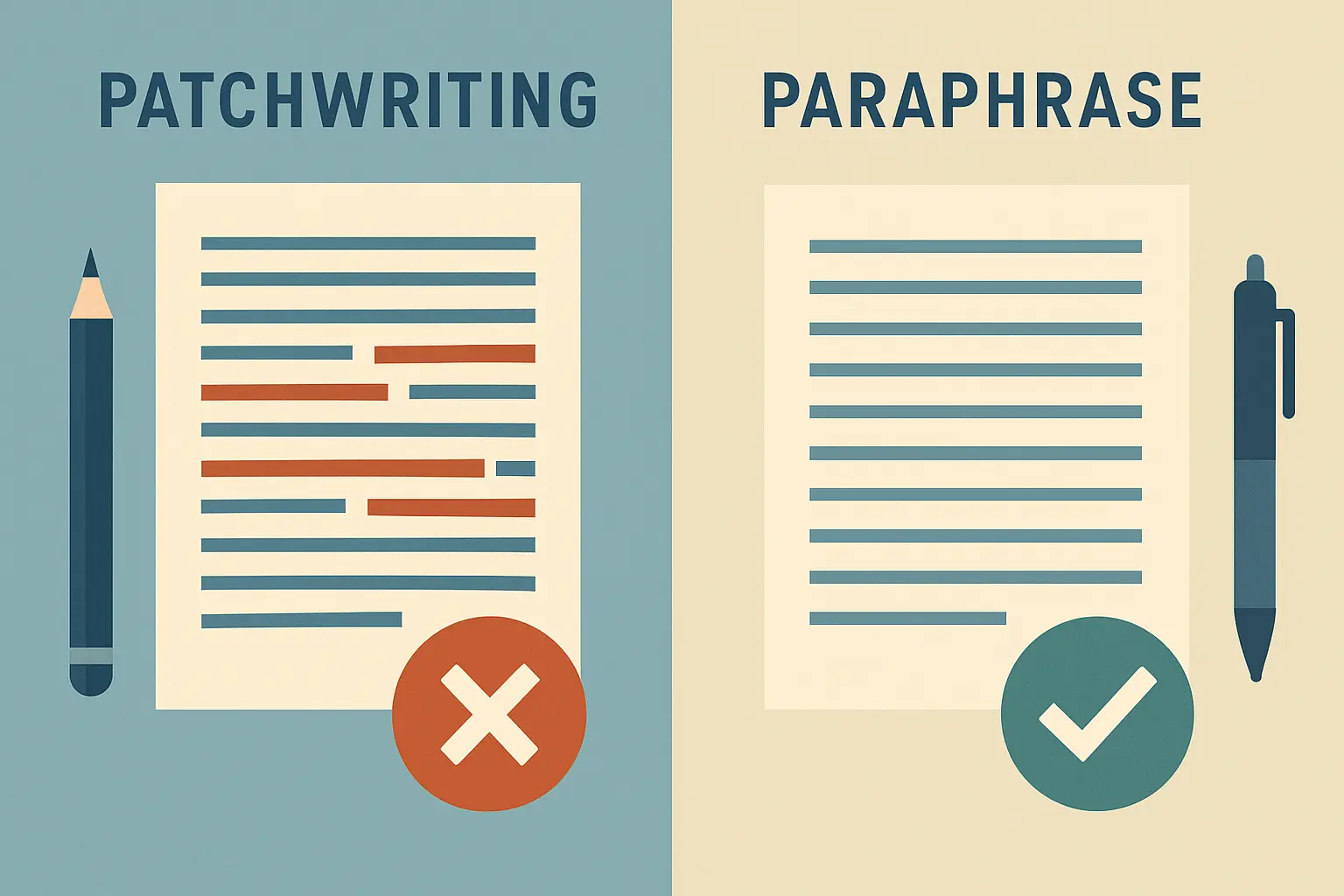
A paraphrase reconstructs an author’s idea using your own sentence architecture and vocabulary while preserving the original meaning. The information flows through your understanding and comes out shaped by your language choices. A patchwrite, by contrast, keeps most of the source’s sentence structure and just substitutes a handful of synonyms. The result is not your own prose — it is borrowed prose with a light coat of paint.
Why Patchwriting Is Still Plagiarism
Universities and integrity committees treat patchwriting as a form of plagiarism even when a citation is present, because the sentence structure itself reflects the author’s intellectual work. If a reader can reconstruct the original sentence by swapping your synonyms back in, you have not genuinely transformed the source — you have copied it with a thin disguise. Citation does not fix patchwriting; only rewriting does.
Illustrative passage — created for this exercise
Original source text:
“Students who regularly engage in peer review activities develop stronger critical thinking skills and produce higher-quality written work than those who write in isolation.”
Patchwrite (problematic):
“Learners who consistently take part in peer review tasks develop better critical reasoning abilities and create superior written assignments than students who compose alone (Author, 2022).”
Problem: Same sentence skeleton. Only individual words were swapped — “students” to “learners”, “engage in” to “take part in”. The citation does not fix this.
Genuine paraphrase (correct):
“Collaborative feedback processes such as peer review appear to sharpen students’ analytical capacities and lift the overall quality of their writing — benefits not observed to the same degree when students work in isolation (Author, 2022).”
Why it works: Different grammatical subject, different clause order, writer’s own vocabulary throughout. The idea is preserved; nothing else is borrowed.
The Read–Cover–Rewrite Method
The most reliable technique for producing genuine paraphrases is the read–cover–rewrite sequence. It works because it forces a memory-mediated reconstruction — your brain filters the idea through your own understanding before your hand writes anything.
- Read the source passage carefully until you understand the core argument, not just the surface words. Read it twice if needed.
- Cover (or close) the source. Minimise the window, flip the book over, or scroll past it. Do not look at it while you write.
- Rewrite the idea from memory in your own words. Do not try to translate word by word — focus on meaning, not phrasing.
- Compare your draft against the original. If any clause is structurally identical, rewrite that clause. Then add the citation.
- Integrate the sentence into your paragraph so it connects logically with what came before and after it.
The comparison step is essential. Many students skip it and discover only at submission — or worse, at the integrity panel — that their “paraphrase” retained more of the original than they thought. A thirty-second side-by-side check catches structural echoes before they become a problem.
One practical tip: after writing a paraphrased sentence, ask yourself whether you would have phrased it this way had you never encountered the source. If the answer is no — if the wording only makes sense because you were looking at or had just read the original — revise it until the sentence stands independently.
Quote, Paraphrase, or Summarise? The Decision Guide
Paraphrasing is not always the right tool. Knowing when to quote directly and when to summarise instead is part of skilled academic writing. The following table covers the most common situations.
| Situation | Use this | Why |
|---|---|---|
| The author’s exact wording is what matters — a definition, a legal clause, a famous theoretical formulation | Direct quote | Changing the words would change the meaning or lose authoritative precision |
| You want to use a specific finding, argument, or idea within your own analysis | Paraphrase | Integrates smoothly into your prose and demonstrates you understood the source |
| You need to reference a long work or several sources to give background context | Summary | Condenses efficiently; avoids over-quoting or over-paraphrasing any one source |
| Multiple sources make the same broad point and you want to credit all of them | Summary with multiple citations | Shows command of the literature without cluttering your argument with four separate paraphrases |
On the use of direct quotes: In social sciences and STEM disciplines, excessive quotation is a marker of weak engagement — it suggests you are padding your word count rather than analysing the material. Reserve direct quotes for passages where the exact language carries irreplaceable weight. Most of your engagement with sources should be through paraphrase and summary, each followed by an analytical sentence that is entirely your own.
Three Worked Examples Side by Side
Each example below shows the same source passage handled badly (patchwriting), then handled correctly (genuine paraphrase), and as a brief summary where useful. The source passages are illustrative constructions created for this exercise.
Example 1: Psychology / Social Science
Illustrative source passage
Original: “Children raised in bilingual households demonstrate enhanced executive function — particularly in tasks requiring inhibitory control and cognitive flexibility — compared with monolingual peers (Author, 2023).”
Patchwrite: “Kids who grow up in bilingual homes show improved executive functioning — especially in activities demanding inhibitory control and mental flexibility — relative to monolingual children (Author, 2023).”
Every clause mirrors the original. Synonyms were swapped; no sentence was genuinely reconstructed.
Paraphrase: “Executive function — the cluster of mental processes governing self-regulation and adaptability — appears to develop more robustly in children exposed to two languages from an early age (Author, 2023).”
The idea is unchanged; the clause structure, grammatical subject, and framing are entirely the writer’s own.
Summary (for a literature review paragraph): “Research links early bilingual exposure to measurable advantages in executive function, including stronger inhibitory control (Author, 2023).”
Example 2: Science / Environmental Studies
Illustrative source passage
Original: “Microplastic concentrations in coastal sediments have increased substantially over the past four decades, with the highest densities recorded near urban river outflows and recreational beaches (Author, 2022).”
Patchwrite: “Microplastic levels in coastal sediment have risen considerably over the last forty years, with the greatest concentrations found near urban river outlets and leisure beaches (Author, 2022).”
Only “substantially” became “considerably” and a handful of other near-synonyms were substituted. The sentence is structurally identical to the original.
Paraphrase: “Urban river outflows and popular recreational beaches have emerged as particular hotspots for microplastic accumulation in coastal sediments, with pollution densities having risen markedly across a forty-year period (Author, 2022).”
The writer leads with location (a different angle), uses “hotspots” and “accumulation” as their own framing, and restructures clause order completely.
Example 3: Humanities / History
Illustrative source passage
Original: “The printing press did not simply accelerate the spread of ideas; it fundamentally altered the relationship between reader, text, and authority, shifting interpretive power away from clerical institutions toward a broader literate public (Author, 2021).”
Patchwrite: “The printing press did not merely speed up the dissemination of ideas; it fundamentally transformed the relationship between reader, text, and authority, moving interpretive power from clerical institutions to a wider literate public (Author, 2021).”
“accelerate” became “speed up”, “altered” became “transformed”, “shifting” became “moving”. The architecture of every clause is identical.
Paraphrase: “Beyond merely circulating knowledge more rapidly, the printing press reconfigured who held interpretive authority over texts — gradually eroding the privileged position of clerical readers and opening that space to a larger secular audience (Author, 2021).”
The writer begins with a concessive clause of their own design, uses “reconfigured” and “eroding” as their vocabulary choices, and inverts the original’s “shifting toward” construction into a different grammatical pattern.
When You Still Must Cite a Good Paraphrase
A well-executed paraphrase that looks entirely like your own prose still requires a citation. This is one of the most persistent misconceptions in student writing: the idea that once words have been changed sufficiently, the citation becomes optional. It does not. The obligation to cite is triggered by the origin of the idea, not the origin of the words.
You must cite whenever you paraphrase:
- A specific argument, claim, or conclusion drawn by another author
- A data finding or statistic, even if you restate the number in different syntax
- A conceptual framework, model, or theoretical lens developed by someone else
- Any interpretive position that is not widely considered common knowledge in your field
What does not need a citation is genuine common knowledge: facts that appear without attribution across numerous sources and would not surprise any educated reader in the field. “The First World War ended in 1918” or “water boils at 100 °C at sea level” are common knowledge. A researcher’s specific interpretation of those events is not. When in doubt, cite.
For guidance on in-text citation formats across major referencing styles, the Harvard Referencing Guide 2026 on this site covers the core rules and copy-ready examples. If you want to run a pre-submission check on your paraphrased passages, How to Check for Plagiarism in 2026 covers the most reliable free and paid tools available to students.
Self-Check: Five Questions Before You Submit
Before finalising any paraphrased passage, work through these five questions:
- Did I write this sentence without looking at the source? If you were staring at the original while writing, there is a significant risk of structural imitation. Reapply the read–cover–rewrite method from the start.
- If I swap my words back for the source’s words, does the original sentence reappear? If yes, you have patchwritten. Restructure the sentence from scratch — begin with a different grammatical subject.
- Is the idea in this sentence mine, or does it come from a source? If it comes from a source, is a citation present?
- Am I quoting where I should be paraphrasing? Heavy reliance on direct quotation reads as a failure to engage analytically with the material — and in some disciplines is penalised explicitly in marking rubrics.
- Have I balanced my paraphrases with my own analytical sentences? Paraphrase should support your argument, not replace it. Each paraphrased passage should be followed by a sentence expressing what you make of that evidence.
These habits sit inside a wider set of practices around note-taking, source management, and originality awareness. For the full picture, see the guide on how to avoid plagiarism in 2026 — paraphrasing well is a prerequisite, not a complete solution on its own. If you are working on a dissertation or thesis, the dedicated guide on how to avoid plagiarism in a thesis walks through citation management, self-plagiarism, and AI detection in the specific context of long-form academic writing.
Frequently Asked Questions
Is paraphrasing without a citation still plagiarism?
Yes. Paraphrasing an author’s idea without crediting them is plagiarism regardless of how thoroughly the wording is changed. The obligation to cite is triggered by the origin of the idea, not the origin of the words. Always include an in-text citation when using another person’s argument, finding, or framework — even after thorough rewriting.
How much must I change a sentence for it to count as a paraphrase?
There is no percentage threshold. The test is whether your sentence has its own independent grammatical structure and vocabulary — not whether you changed a certain proportion of words. If a reader could reconstruct the original by swapping synonyms back in, the paraphrase is not genuine. The read–cover–rewrite method produces authentic results more reliably than any word-count rule.
When should I use a direct quote instead of a paraphrase?
Use a direct quote when the author’s exact wording is essential to your point — a precise definition, a famous theoretical formulation, or language whose alteration would misrepresent the original meaning. In most social-science, STEM, and professional disciplines, paraphrase is preferred over direct quotation because it demonstrates active engagement with the material. In literary studies and law, direct quotation is more commonly expected and accepted.
Can I paraphrase the same source multiple times in one paragraph?
Yes, but each new paraphrased idea still needs its own citation marker. In APA 7, if you are drawing on the same source continuously within a single paragraph, you may introduce the citation clearly at the start of the relevant passage. However, over-reliance on a single source within one paragraph can signal a lack of breadth in your reading, so balance multiple-citation paragraphs with evidence from a wider range of literature.
Does a genuine paraphrase show up on a similarity checker?
A genuinely restructured paraphrase — with its own vocabulary and syntax — will not generate a similarity match, because text-matching tools compare strings of consecutive words rather than ideas. Patchwriting, however, often does flag, because three-to-five-word sequences from the original survive intact. A low similarity score on a patchwritten passage is not confirmation that the paraphrase was acceptable; your marker reads for structure, not just word matches.
Build Every Skill, Not Just This One
Paraphrasing is one part of a larger originality toolkit. The full guide on how to avoid plagiarism in 2026 covers citation management, effective note-taking systems, and pre-submission originality checks — everything you need alongside the technique practised here.
Tesify helps you plan chapters, manage your sources, and produce well-referenced drafts — so the writing stays yours and the citations are never an afterthought. Start free at tesify.pro.