
How to Write a Thesis Abstract Step by Step in 2026 (With Word Counts & Examples)
Most students write the abstract last — and then rush it in thirty minutes because the submission deadline is tomorrow. That’s a mistake. Your abstract is the first thing a committee member, reviewer, or examiner reads; in many cases it is the only section they read before deciding whether to engage with the full document. Getting it right matters. This guide walks you through exactly how to write an abstract step by step, from identifying the format your discipline requires to producing a polished, keyword-rich summary you can submit with confidence.
The good news: the abstract is also the shortest section of your thesis — typically 150 to 350 words. Work through the eight steps below and you can write a submission-quality abstract in under ninety minutes, even if you have never done it before.
What a Thesis Abstract Actually Does
An abstract is a self-contained summary of your entire thesis. It answers four questions in miniature: Why did you do this study? How did you do it? What did you find? Why does it matter? Examiners use it to preview your argument before reading the full document. Academic databases — ProQuest, JSTOR, Scopus, EBSCO — index the abstract so that future researchers can discover your work through keyword searches.
The abstract is not a teaser or an introduction. It does not build slowly toward a research question — it states the research question and answers it. A reader should understand your complete argument from the abstract alone, without opening a single chapter. If you are still working on the larger structure, the guide to writing a dissertation step by step maps out how the abstract fits alongside every other section of the full document.
Structured vs Unstructured Abstract
Before you write a single word, identify which format your institution and discipline require. The two formats carry the same information in different layouts.
| Format | What it looks like | Typical disciplines |
|---|---|---|
| Structured | Uses bold or capitalised subheadings — Background, Objectives, Methods, Results, Conclusions — to divide the text into labelled sections | Medicine, clinical science, public health, nursing, engineering, pharmacology |
| Unstructured | A single continuous paragraph that weaves all five elements together without visible headings | Humanities, social sciences, education, law, business, psychology, linguistics |
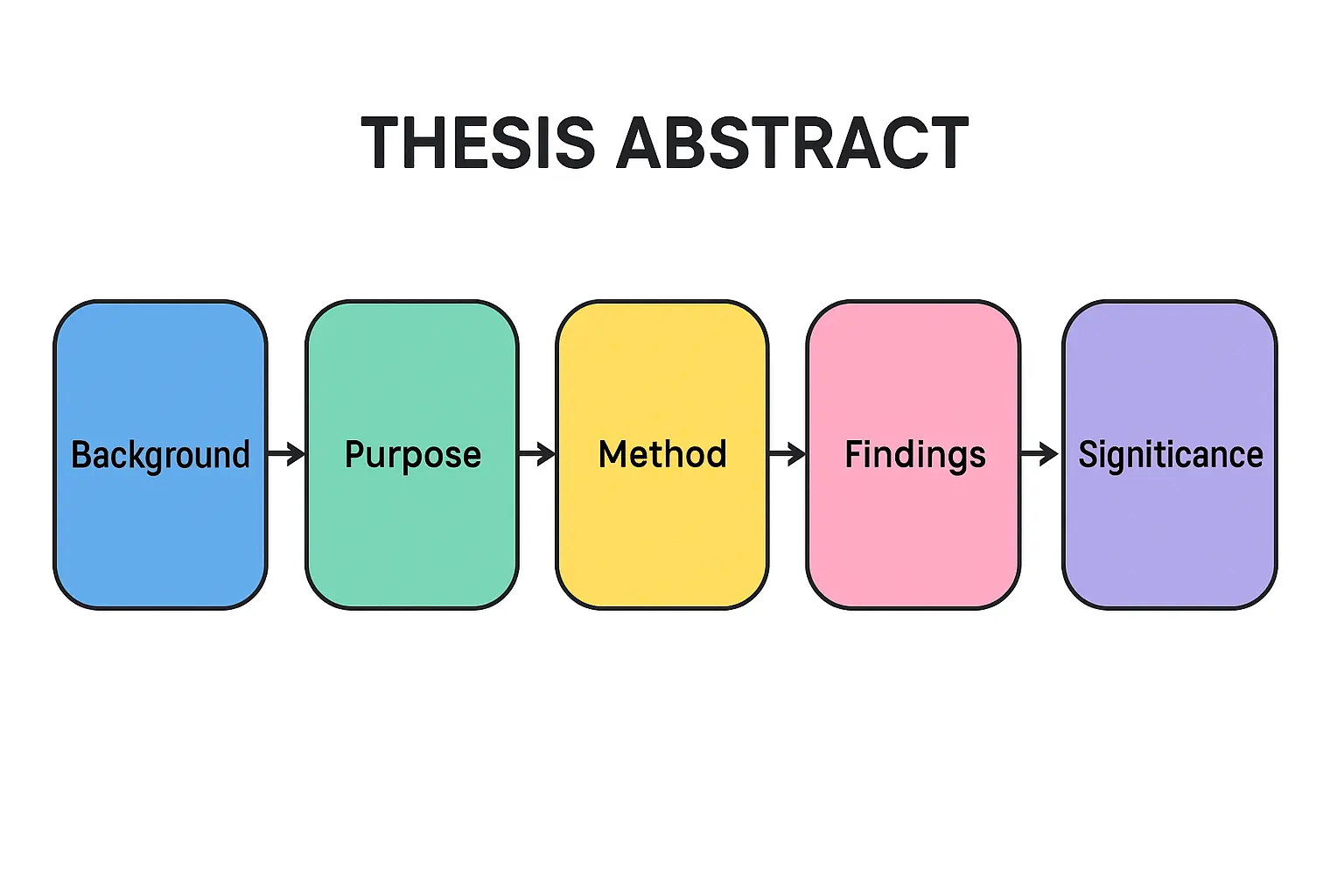
If your supervisor or thesis handbook does not specify a format, default to the unstructured paragraph — it is the more widely accepted form across most disciplines and word-count targets. Whichever format you use, the five content elements remain the same: background, purpose, method, findings, and significance.
Abstract Word Count by Degree Level
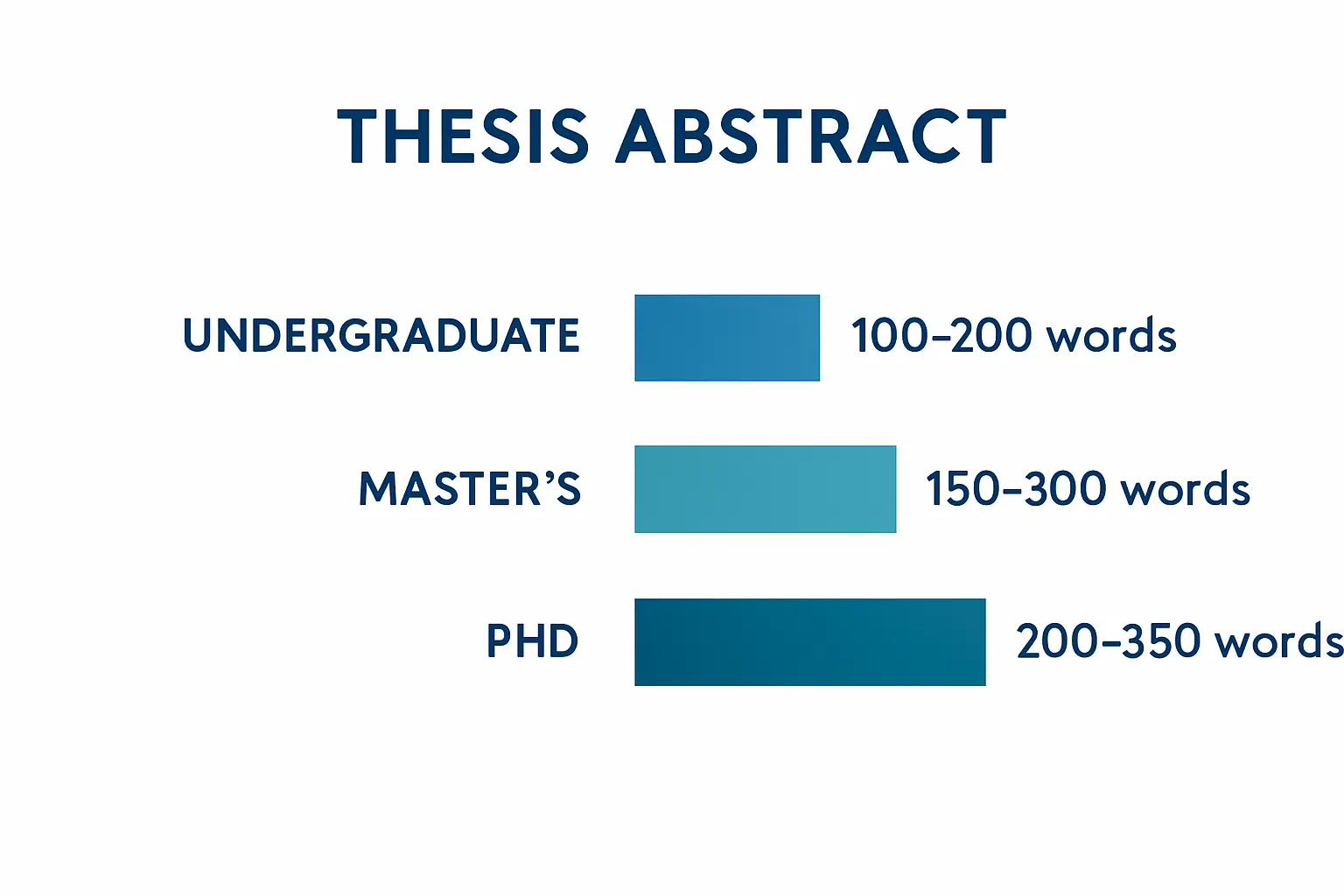
Set your word-count target before you start drafting. If your limit is 250 words, allocating roughly 30–40 words per content element keeps each section proportionate and forces the precision the abstract demands.
| Degree level | Recommended range | Archive / repository limit |
|---|---|---|
| Undergraduate thesis / Honours dissertation | 100–200 words | Varies by institution |
| Master’s thesis / taught dissertation | 150–300 words | 150 words (Canada) – 300 words (most institutions) |
| PhD dissertation / doctoral thesis | 200–350 words | 350 words (ProQuest; Cornell Graduate School) |
How to Write an Abstract Step by Step (8 Steps)
This sequence shows you exactly how to write an abstract step by step. Work through it in order. Do not skip Step 1 or you will end up rewriting the entire abstract once your findings change.
-
Finish the thesis first
The abstract summarises a completed argument. Writing it mid-draft almost guarantees that your stated findings will contradict your final results. Complete at minimum your Results and Discussion chapters before you open the abstract document. If you are writing an abstract for a proposal — describing research you plan to do rather than research already completed — see the research proposal step-by-step guide, which covers the prospective abstract format specifically.
-
Confirm your word limit and format
Find three things in your thesis handbook before drafting: (a) the maximum word count, (b) structured or unstructured format, and (c) whether keywords must be listed below the abstract. Some institutions also specify the font, line spacing, or page position of the abstract. Resolving these formatting questions now avoids last-minute reformatting during the submission window.
-
Write the background sentence
Open with one or two sentences that situate the reader in the research landscape. Do not assume specialist knowledge. Name the gap in existing knowledge or the real-world problem your thesis addresses. Example: “Antimicrobial resistance is outpacing the development of new treatments, leaving certain hospital-acquired infections increasingly untreatable in high-dependency clinical settings.” This sentence answers the implicit question why should I care?
-
State the research purpose and question
Write a single sentence that names exactly what your study set out to do. Use a precise active verb: investigate, examine, analyse, compare, evaluate, develop, test. Avoid vague openers like “this thesis looks at” or “the aim of this research is to explore.” Example: “This study investigated whether nurse-led antibiotic stewardship programmes reduce carbapenem-resistant Enterobacteriaceae rates in UK intensive care units.”
-
Describe your methodology in one sentence
Specify the research design, data source, and key analytical approach — nothing more. The abstract is not the place for methodological justification; that belongs in the methodology chapter. If you are still deciding between designs, the guide to research methodology types and approaches covers the main options. Example: “A retrospective cohort analysis of 1,400 patient records from four NHS trusts (2022–2025) was conducted using multivariate logistic regression.”
-
Report your main findings
This is the most important step. State what you found, not what you looked for. Be specific. Lead with your headline result. Avoid hedged language such as “findings suggest there may be a possible relationship.” If the relationship exists in your data, state it plainly. Note: always report your own results — never copy a statistic from a published study and present it as your finding.
-
State the significance and implications
Close with one or two sentences on why the finding matters and who it affects — clinicians, policymakers, educators, or future researchers. Avoid grandiose claims. Be precise about who can act on this finding and in what context. Example: “These findings support the adoption of stewardship protocols in high-dependency units and indicate a need for controlled trials in community hospital settings.”
-
Review and tighten the draft
Read the complete draft aloud. Cut every word that does not carry information — articles, redundant adjectives, throat-clearing phrases like “it is important to note that.” Run a word count. If you are over the limit, reduce each element by cutting the least specific sentence. Then check that the abstract can stand alone: a reader who has not seen your thesis should understand the complete argument from these words alone.
Worked Example Abstract
The following is an example abstract for a Master’s dissertation in education, written as an unstructured paragraph (246 words). Each sentence is annotated with a colour-coded label identifying the element it covers.
BACKGROUNDAcademic writing interventions in secondary schools frequently prioritise grammar instruction over disciplinary literacy, despite evidence that domain-specific writing conventions are acquired through sustained practice within subject communities. PURPOSEThis study examined whether a structured peer-feedback protocol embedded in history lessons improved the argumentative writing quality of Year 10 students in three UK state secondary schools. METHODA mixed-methods design was used: pre- and post-intervention essays from 186 students were scored using a validated six-dimension analytical rubric, and twelve semi-structured interviews with students and teachers captured implementation experiences. FINDINGSStudents in the intervention group demonstrated statistically significant gains in claim specificity and evidential reasoning relative to control-group peers; teacher interviews revealed that structured feedback redistributed the marking burden onto students without reducing feedback quality. SIGNIFICANCEThe findings offer a low-cost, timetable-compatible model for disciplinary writing development that subject-department teams can implement without specialist training, and point to the value of longitudinal replication across curriculum subjects.
Keywords: disciplinary literacy; peer feedback; argumentative writing; history education; secondary schools; United Kingdom; mixed methods
Notice what this abstract does not contain: citations to other authors, full methodological detail, hedged language, and anything that does not appear in the thesis body. Every sentence earns its place. For a broader view of how this abstract connects to the thesis structure it summarises, the literature review guide covers how to build the evidence base that grounds the background sentence.
For a collection of annotated thesis abstract examples and templates broken down by discipline — including sciences, social sciences, and humanities — Tesify’s companion guide shows exactly how the five elements play out across different academic contexts.
How to Choose Keywords for Your Abstract
Most institutions and repositories ask for 5–10 keywords listed below the abstract, separated by commas or semicolons. These terms determine how discoverable your thesis is in database searches. Use this checklist when selecting them:
- Cover the main concept — the central variable, phenomenon, or theory your study addresses
- Name the method — e.g., systematic review, ethnography, randomised controlled trial, discourse analysis
- Specify the population or context — e.g., undergraduate students, NHS intensive care, SMEs in rural Ireland
- Use controlled vocabulary where available — check MeSH (medicine), ERIC Thesaurus (education), PsycINFO (psychology), or your discipline’s standard index terms
- Avoid duplicating the title exactly — databases already index title words; use the keyword field for synonyms, related concepts, and alternative phrasings a researcher might search
Five Mistakes That Get Abstracts Rejected
- Writing it first. An abstract must reflect the finished thesis. Writing it early and failing to update it is among the most common errors examiners flag — and the easiest to avoid.
- Including citations. Abstracts should be self-contained and citation-free. Do not cite other authors — situating your work within the literature is the role of the introduction and the chapters that follow.
- Introducing new information. Every claim in the abstract must appear in the thesis body. Any finding, theory, or conclusion mentioned in the abstract that cannot be located in the main text is a submission error.
- Vague findings. “Results showed mixed outcomes” communicates nothing. Name the actual result — direction, population, context — so that a reader who skims only the abstract still understands what you found.
- Exceeding the word limit. An overlong abstract signals weak editing to an examiner and may cause an electronic submission system to reject the file outright. Cut aggressively until you land inside the limit.
Frequently Asked Questions
How long should a thesis abstract be?
For an undergraduate thesis, 100–200 words is standard. For a master’s dissertation, most institutions accept 150–300 words. For a PhD dissertation, the widely accepted ceiling is 350 words — the limit set by ProQuest Dissertations & Theses and cited by universities including Cornell. Your own institution’s thesis handbook takes precedence over any general guidance.
Can I write the abstract before finishing the thesis?
For a thesis submission, write the abstract after the thesis is complete. Writing it earlier is possible as a planning exercise, but you will almost certainly need to rewrite it once your findings are confirmed. The exception is a prospective abstract in a research proposal, which describes planned work — that version uses future tense and a different structure.
What is the difference between a structured and an unstructured abstract?
A structured abstract uses explicit subheadings — typically Background, Objectives, Methods, Results, and Conclusions — to divide the text into clearly labelled sections. It is most common in medical and clinical disciplines. An unstructured abstract presents exactly the same five elements as a single continuous paragraph without visible headings. It is standard in the humanities, social sciences, education, and law.
Should an abstract include citations?
No. An abstract should be self-contained and citation-free. Its purpose is to summarise your own study, not to situate it within the broader literature — that is the role of the introduction and literature review. Including citations in the abstract is a common error that examiners notice and that many style guides explicitly prohibit.
Does the abstract go before or after the table of contents?
In most university formatting guidelines the abstract appears on its own page immediately after the title page or declaration page, and before the table of contents and acknowledgements. Check your institution’s required front-matter order, as it varies — some institutions place acknowledgements before the abstract, and a small number place it after the table of contents.
How is an abstract different from an introduction?
The abstract is a complete, standalone summary of the entire thesis — including the findings and implications. The introduction is the opening chapter of the thesis body; it provides context and builds toward the research question but does not reveal the results. A reader should fully understand what you found from the abstract alone without reading the introduction.
Write Every Chapter — Not Just the Abstract — with Clarity
An abstract takes ninety minutes. The full thesis takes months. Tesify is an AI thesis writing assistant built for academic integrity: it helps you plan chapter structures, build argument outlines, and draft sections while keeping complete ownership and transparency in your hands. Start free — no commitment required.