What Is a Conceptual Framework? Definition, Diagram & Examples (2026)
A conceptual framework is a structured visual or written model that identifies the key variables in your study and maps the relationships between them. Drawn from your literature review, it clarifies what you are measuring, which factors you expect to influence others, and why — before a single data point is collected.
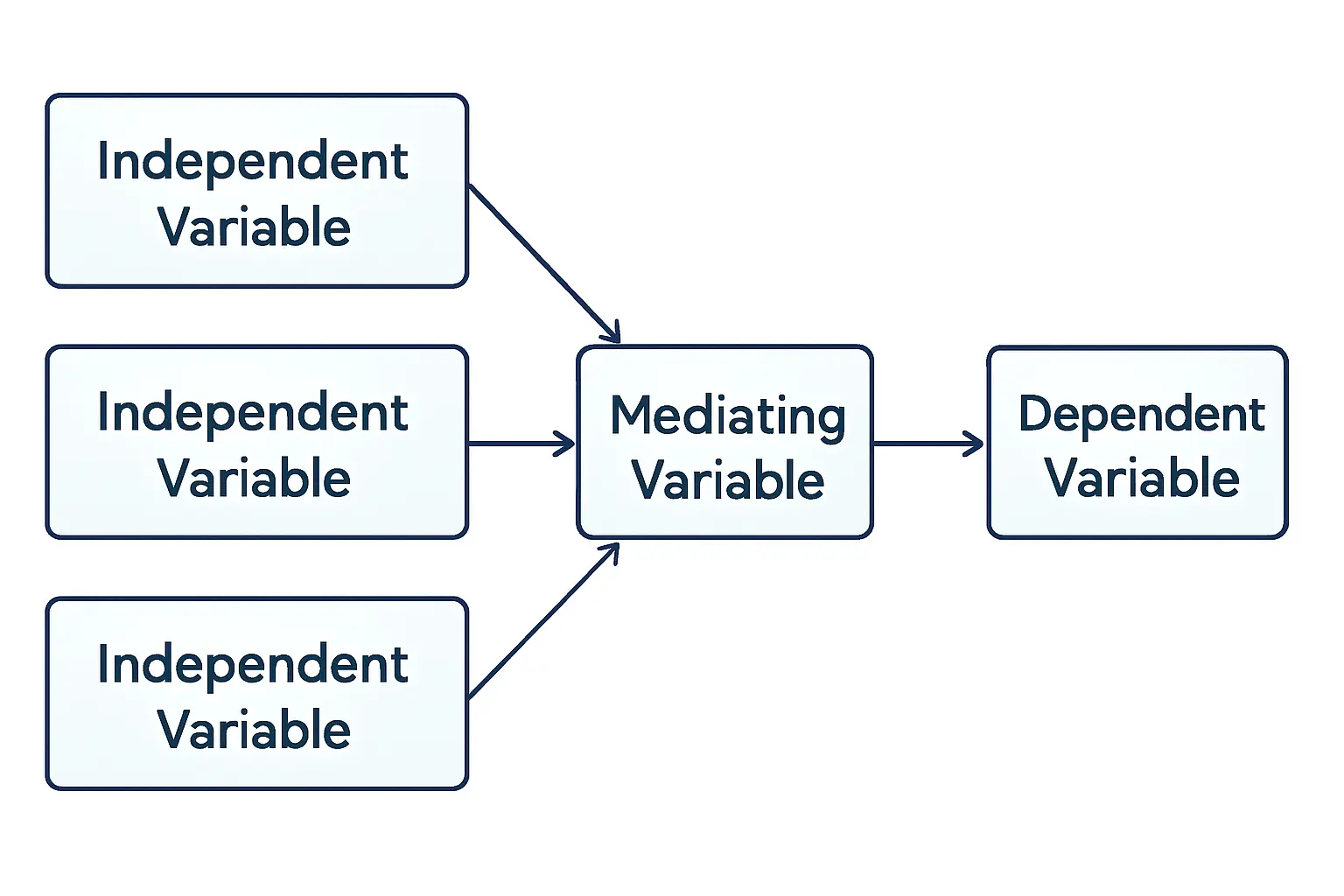
Quick answer: A conceptual framework is the researcher’s own model of how specific concepts in a study connect. It maps independent, dependent, mediating, and moderating variables as labelled boxes joined by directional arrows. It differs from a theoretical framework, which names an established theory from the literature rather than proposing an original variable map.
What Does a Conceptual Framework Do in Research?
The conceptual framework performs three functions simultaneously. It forces you to commit to a precise definition of every variable before data collection begins, eliminating vagueness that derails analysis later. It makes your hypotheses visible in diagram form — each arrow is a hypothesis. And it gives your examiner a single-page summary of your entire intellectual argument.
Without a conceptual framework, a study risks collecting data that answers the wrong question or that cannot be analysed coherently. With one, every survey item, interview question, or experimental condition can be traced back to a specific relationship in the diagram. That traceability is exactly what reviewers look for when assessing whether a methodology chapter is internally consistent.
A well-constructed framework also signals methodological maturity. It shows you have moved beyond summarising the literature and have synthesised it into an original research position. Examiners often turn to the conceptual framework before any other chapter precisely because it tells them at a glance whether the study design is coherent.
How Is a Conceptual Framework Different from a Theoretical Framework?
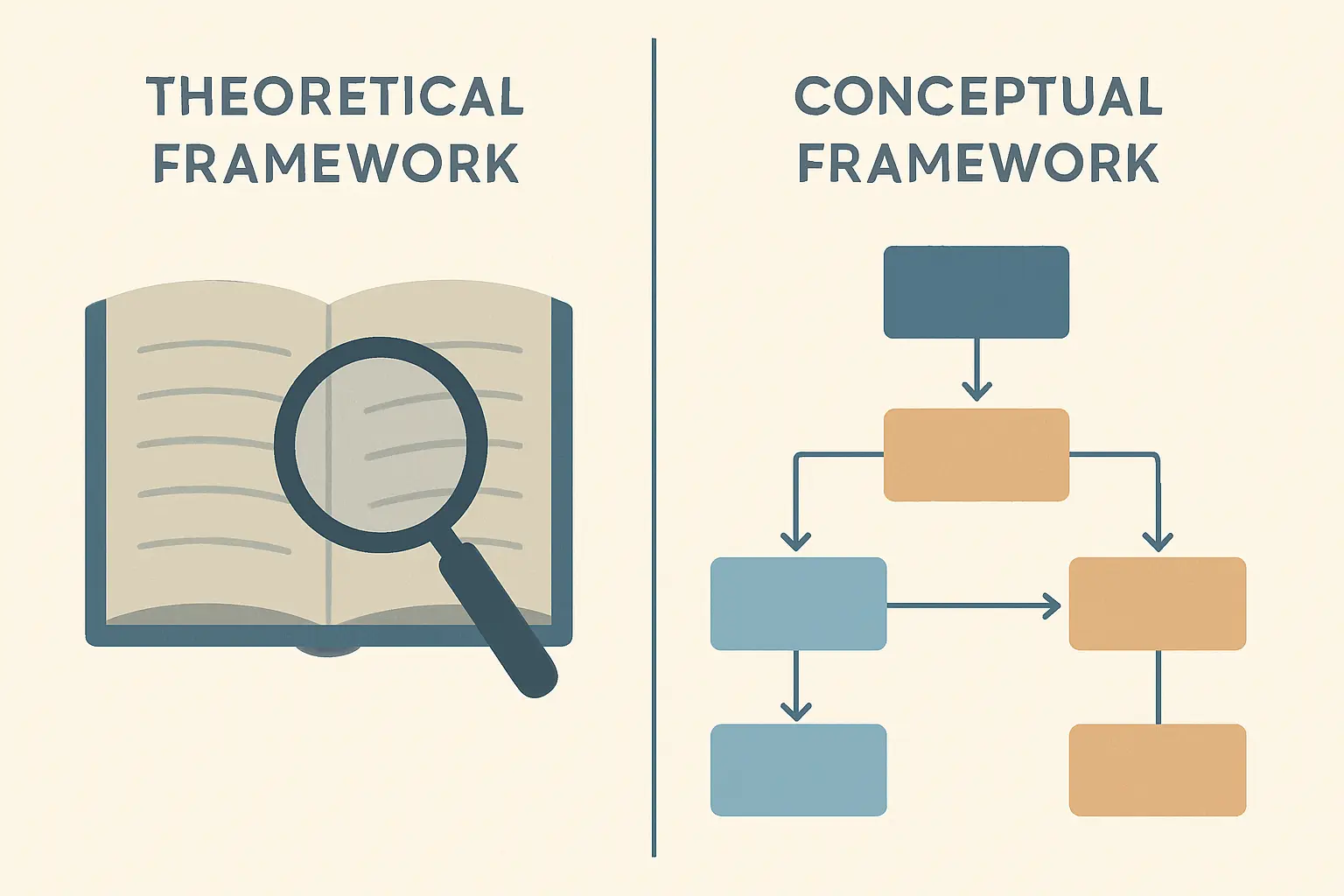
Students frequently conflate these two terms. The distinction matters because the two frameworks serve different purposes and appear in different parts of the thesis.
| Feature | Theoretical Framework | Conceptual Framework |
|---|---|---|
| What it is | An established theory (e.g. TAM, Social Learning Theory) | Your original model built for this specific study |
| Source | Named scholars and published theoretical work | Synthesised from multiple sources and your research gap |
| Form | Written prose explaining and applying the theory | Diagram with labelled boxes and directional arrows |
| Originality | Borrowed — you adopt and apply it | Original — you construct it |
| Typical placement | Early in Chapter 2 (Literature Review) | End of Chapter 2 or start of Chapter 3 |
For a fuller side-by-side comparison with worked examples from psychology, education, and business research, see Theoretical vs Conceptual Framework: Key Differences Explained (2026).
What Components Does a Conceptual Framework Include?
- Independent variables (IV): The factors you assume cause or predict change. In a study on employee performance, training hours might be the IV.
- Dependent variables (DV): The outcomes you measure. Performance scores would be the DV.
- Mediating variables: Variables that explain how an IV affects a DV. Motivation might mediate the relationship between training and performance.
- Moderating variables: Variables that alter the strength or direction of the IV–DV relationship. Manager support might moderate whether training actually translates into performance gains.
- Directional arrows: Lines with arrowheads connecting variables — one per hypothesised relationship.
- Boundary conditions: A label specifying context (e.g. “SME manufacturing firms, Malaysia, 2026”) that defines what the framework claims and what lies outside its scope.
Not every study needs all four variable types. A straightforward correlational study may include only IVs and a DV. Add mediators and moderators only when your literature review provides genuine evidence they belong — not because they make the diagram look more sophisticated.
How Do You Build a Conceptual Framework Step by Step?
- State your research problem in one sentence. Everything in the framework must link back to this problem statement.
- List your research questions or hypotheses. Every question should map to at least one relationship in the diagram. Your research methodology choices — qualitative, quantitative, or mixed — must be consistent with the kind of relationships you are proposing.
- Extract key concepts from your literature review. Highlight variables that appear repeatedly across your synthesised sources. For guidance on building the review itself, see How to Write a Literature Review in 2026.
- Establish direction. For each variable pair, decide: does A predict B, does B predict A, or is the relationship bidirectional? Only claim directionality the literature can support.
- Draft the diagram on paper first. Place IVs on the left, DVs on the right, mediators in the centre, and moderators above or below the main arrow.
- Write a brief narrative paragraph. Describe every element and every arrow in plain language. This narrative accompanies the diagram in your thesis (200–400 words).
- Cross-check against your research questions. If a variable in the diagram does not appear in any research question, remove it. If a research question references a variable absent from the diagram, add it.
What Does a Conceptual Framework Diagram Look Like?
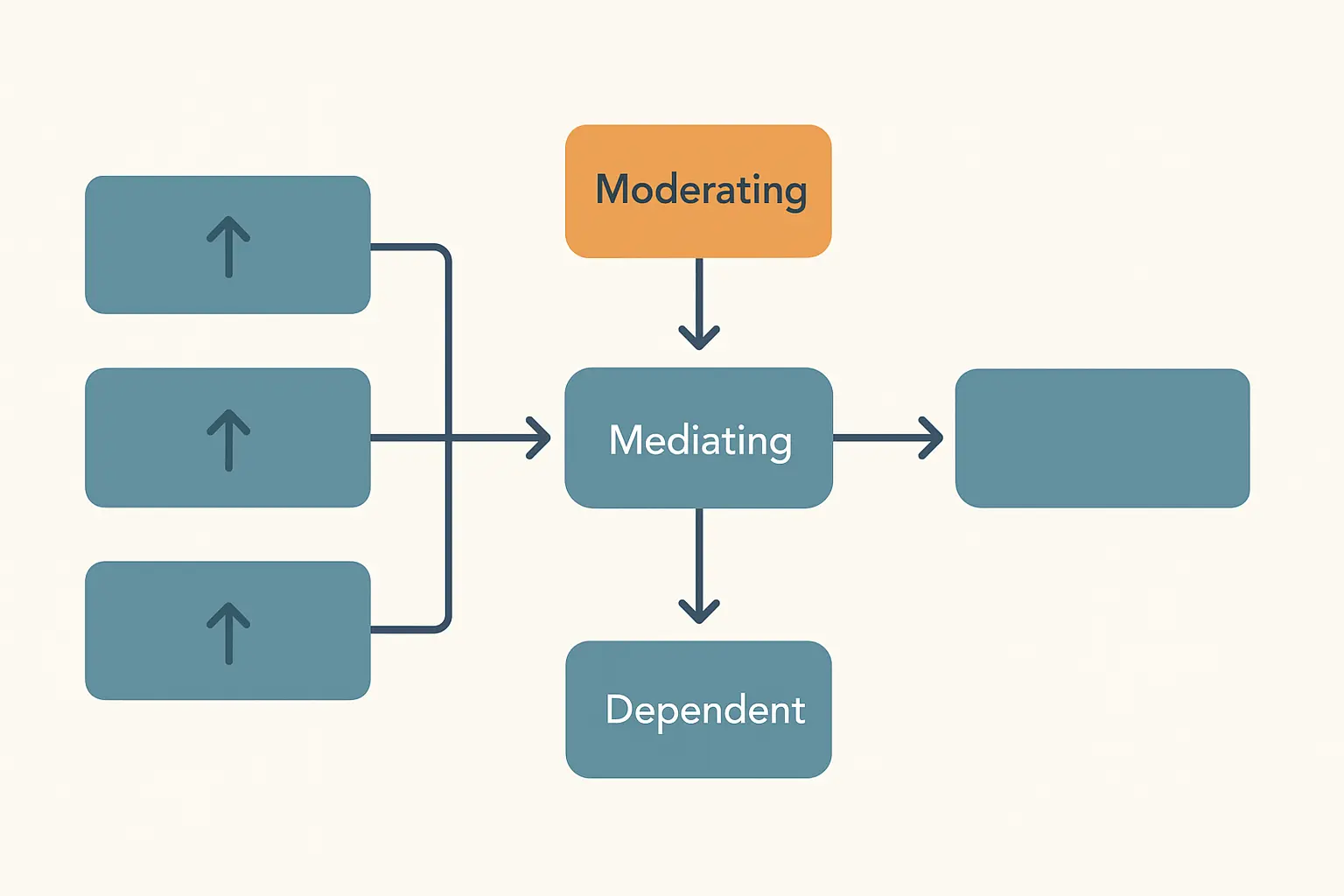
The standard layout flows left to right. The table below shows each element’s position alongside a worked example from a job-satisfaction study.
| Position in diagram | Element | Example (job satisfaction study) |
|---|---|---|
| Left boxes | Independent variables | Workload, Pay equity, Supervisor support |
| Centre box | Mediating variable | Employee engagement |
| Right box | Dependent variable | Job satisfaction |
| Above the main arrow | Moderating variable | Organisational culture (collectivist vs individualist) |
| Connecting lines | Directional arrows | One per hypothesised relationship |
For software, PowerPoint and Google Slides are adequate for most undergraduate and master’s frameworks. Lucidchart and draw.io export at higher resolution for journal submission. If you are already working in ATLAS.ti or NVivo for qualitative coding, both include a concept-map function that lets you build the framework directly from coded data.
Where Does a Conceptual Framework Go in a Thesis?
- End of Chapter 2 (Literature Review) — most common. The framework appears as the synthesis conclusion, showing how the literature points toward a specific research gap and a set of hypothesised relationships. This is consistent with APA 7 thesis conventions.
- Start of Chapter 3 (Methodology). Some supervisors prefer this because the framework directly introduces the variables being operationalised, tying the diagram to instrument design.
- Standalone chapter — rare. A small number of doctoral programmes in management or social policy require a dedicated analytical framework chapter. Confirm with your programme handbook before adopting this structure.
Wherever it appears, place the narrative explanation immediately after the diagram. For a complete picture of how all thesis chapters connect, see How to Write a Dissertation in 2026.
Conceptual Framework Examples by Discipline
Education (quantitative)
Topic: Effect of flipped classroom instruction on student achievement.
IVs: Flipped classroom use (yes/no); pre-class video completion rate.
DV: Post-test achievement score.
Moderator: Prior academic achievement (high vs low entry GPA).
Diagram summary: Flipped instruction → student achievement, with effect strength moderated by prior GPA.
Health sciences (mixed methods)
Topic: Patient adherence to diabetes medication.
IVs: Health literacy; provider communication quality.
Mediator: Patient self-efficacy.
DV: Medication adherence (HbA1c reduction at 6 months).
Diagram summary: Health literacy and provider communication → self-efficacy → adherence.
Business and management (survey-based)
Topic: Social media marketing and brand loyalty in e-commerce.
IVs: Content quality; engagement rate; influencer credibility.
Mediator: Brand trust.
DV: Brand loyalty (repeat purchase intent).
Moderator: Consumer age cohort (Gen Z vs Millennial).
Diagram summary: All three IVs → brand trust → brand loyalty, moderated by age cohort.
When you are ready to present your framework in a full proposal, the guide on How to Write a Research Proposal Step by Step (2026) covers every section. Tesify’s structured writing environment lets you draft and annotate your conceptual framework alongside your methodology chapter, keeping variable definitions consistent from proposal through to final submission.
Frequently Asked Questions
What is the difference between a conceptual and a theoretical framework?
A theoretical framework borrows an established theory — such as Vygotsky’s Zone of Proximal Development or the Technology Acceptance Model — and applies it to your research context. A conceptual framework is your original variable map, synthesised from multiple sources and tailored to your specific study. Both can coexist in the same thesis, with the theoretical framework usually appearing earlier in the literature review.
Does every thesis need a conceptual framework?
Most quantitative and mixed-methods theses require one because they explicitly test relationships between variables. Purely qualitative studies — phenomenology, grounded theory, discourse analysis — sometimes use an analytical lens in written form rather than a diagram-based framework. Requirements vary by discipline and degree level; confirm with your supervisor at the proposal stage.
How many variables should a conceptual framework have?
For a master’s thesis, two to five variables is a practical range. Doctoral frameworks can be more complex, but clarity matters more than completeness. Every variable must be measurable with your chosen instruments. If you cannot specify how you will operationalise a variable, remove it from the framework.
Can a conceptual framework be a table instead of a diagram?
Yes. Disciplines such as the humanities and legal studies often present conceptual frameworks as structured tables mapping concepts to definitions and key sources, rather than box-and-arrow diagrams. The essential requirement is that the relationships between concepts are made explicit in whatever format your field prefers.
How long should the conceptual framework section be in a thesis?
The diagram fits on one page. The accompanying narrative typically runs 200–400 words for a master’s thesis and up to 600 words for a PhD. Every sentence should add interpretive value beyond what the diagram already shows visually.
Can I adapt someone else’s conceptual framework?
Yes, and it is methodologically legitimate to do so when a published framework closely matches your research context. Cite the original source in APA 7 format, state explicitly which elements you retained, modified, or added, and explain why. Copying a published framework without adaptation or citation constitutes plagiarism.
What software should I use to draw a conceptual framework?
PowerPoint and Google Slides meet the needs of most students at master’s level. For higher-resolution outputs, Lucidchart, draw.io, or Canva are reliable choices. If you are already using ATLAS.ti or NVivo for qualitative coding, both include a network or concept-map function that can generate the framework directly from your coded data.
What is the difference between a conceptual framework and a research model?
These terms are often used interchangeably in social science. When a distinction is drawn, a research model is a formally specified, testable version of the conceptual framework — often expressed with structural equation modelling (SEM) path coefficients. The conceptual framework is the pre-quantification blueprint; the research model is its statistical realisation after data analysis.
What happens if my results do not match my conceptual framework?
A mismatch between your framework and your results is a finding, not a failure. In the discussion chapter, explain why the expected relationship did not hold — contextual factors, measurement limitations, sample characteristics, or genuine disconfirmation of the assumed relationship. Critical reflection on non-findings is exactly what doctoral examiners expect to see.