
What Is a Thesis Statement? Definition, Examples & How to Write One (2026)
A thesis statement is a single sentence — usually placed at the end of your introduction — that states the central argument or main claim of your paper. It tells the reader exactly what you will argue and, briefly, why, giving the entire essay a clear direction and purpose so every body paragraph has something concrete to prove.
Definition: What a Thesis Statement Actually Is
A thesis statement is the single sentence that anchors your entire paper. It does three things simultaneously: identifies your topic, states your position on that topic, and signals to the reader the reasoning or evidence you will use to support that position. Without a thesis statement, an academic essay is simply a collection of observations — with one, it becomes an argument.
The word “thesis” comes from the Greek thesis, meaning “a proposition.” In academic writing, a thesis statement is not a question, a statement of fact, or a summary of what you will do. It is a claim — a position a reasonable person could disagree with — that your writing will prove. This is the defining characteristic that separates a thesis statement from every other sentence in your introduction.
Contrast these two opening statements:
- Not a thesis: “Shakespeare wrote many plays about love.” — This is a fact that requires no argument.
- Thesis: “Shakespeare’s romantic comedies use disguise and mistaken identity to expose the performative nature of courtship, arguing that love requires self-knowledge before it can be genuine.” — This is a debatable interpretation the essay will defend.
The thesis statement lives at the intersection of scope and argument. It is narrow enough to be addressed in the length of your paper, yet bold enough to require evidence and reasoning. A thesis that could describe every essay written about a topic is too broad; a thesis that could only be argued in a 500-page monograph is too narrow.
Why Your Thesis Statement Matters
Your thesis statement is the single most important sentence in your essay. It functions as a contract with the reader: you promise to argue a specific point, and every body paragraph must deliver on that promise. Instructors, markers, and peer reviewers use the thesis as the primary benchmark when evaluating whether the rest of the paper stays on track and whether the argument is coherent.
A clear thesis also keeps you on track as a writer. When you know exactly what you are arguing, you can reject information that does not serve your argument and prioritise the evidence that does. Many writers discover their real argument only after drafting — and then return to refine the thesis once the paper’s direction becomes clear. This is entirely normal and encouraged: treat your first thesis as a working hypothesis, not a permanent commitment.
If you are working on a longer academic document rather than a short essay, the thesis statement expands into a research question and hypothesis. For a full overview of how shorter essays and long-form academic work differ structurally, see the difference between a thesis and a dissertation.
Three Types of Thesis Statements
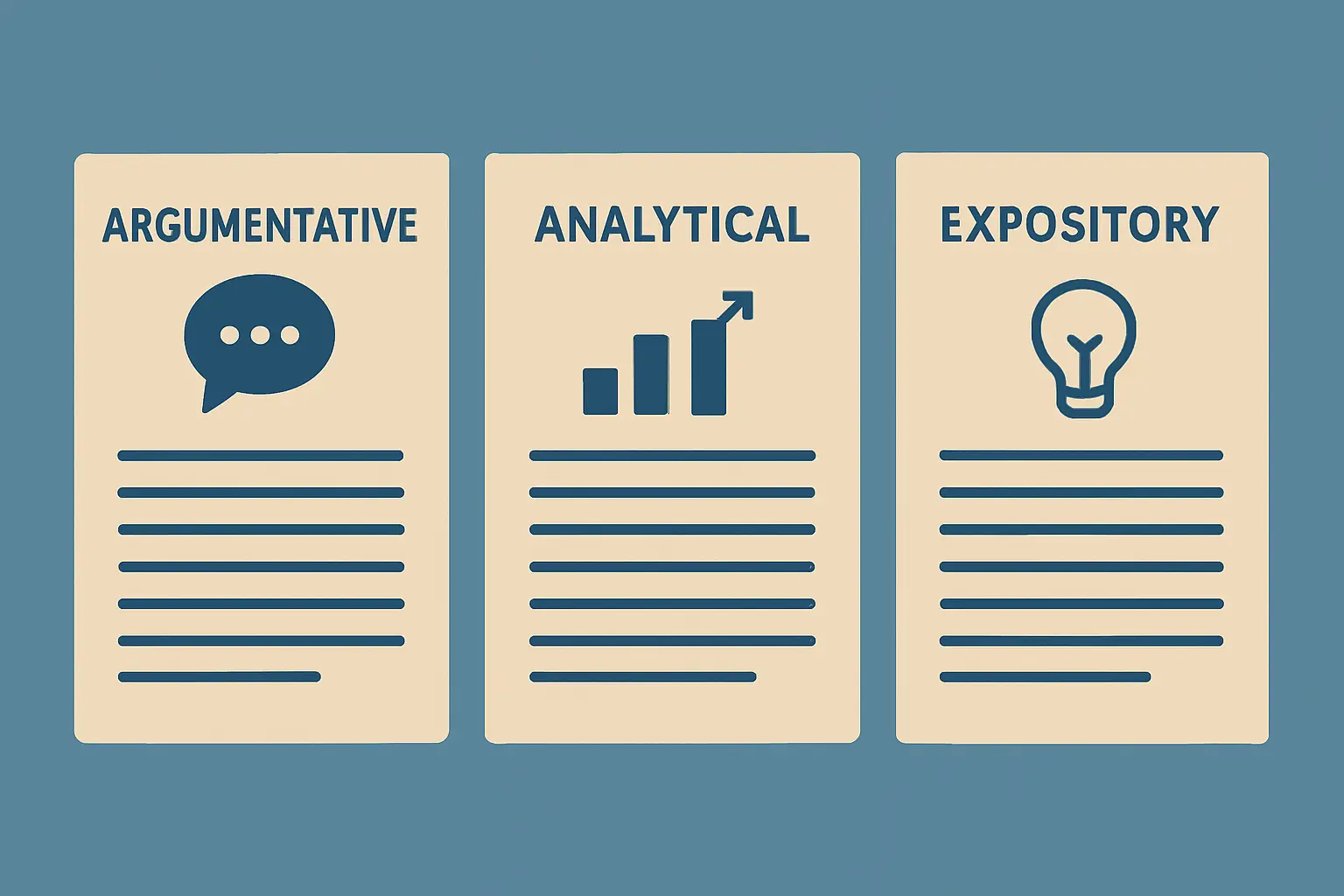
Not every paper makes the same kind of argument. Academic writing generally produces three thesis types, each suited to a different purpose. Recognising which type you need before you write saves significant revision time.
1. Argumentative Thesis
Used in persuasive essays and research papers, an argumentative thesis takes a clear, debatable stance and signals that evidence will follow to defend it. This is the most common type in undergraduate and postgraduate work.
“Remote working policies introduced post-2020 have improved wellbeing for knowledge workers but have exacerbated inequality for hourly and service-sector employees who cannot access flexible arrangements.”
Notice the specificity: it names a time period, a population, a mechanism, and a tension. A reader who disagreed could construct a counter-argument — which is the hallmark of a properly argumentative thesis.
2. Analytical Thesis
An analytical thesis breaks a subject into its component parts and explains the relationship between them. It does not necessarily advocate for a normative position — it illuminates structure, cause, or pattern.
“An analysis of Toni Morrison’s Beloved reveals that the novel’s circular narrative structure, fragmented chronology, and collective point of view collectively mirror the psychological experience of intergenerational trauma.”
3. Expository Thesis
An expository thesis explains or informs. It is common in informational essays, literature reviews, and explainer assignments where the task is to describe or define rather than advocate for a position.
“The three main approaches to qualitative data analysis — thematic analysis, grounded theory, and narrative inquiry — each prioritise different aspects of lived experience and require different levels of researcher reflexivity.”
For 25 subject-specific examples across all three types, browse our curated collection of thesis statement examples, organised by discipline and essay type.
Weak vs. Strong: Side-by-Side Examples
The gap between a weak and a strong thesis is almost always about specificity, debatability, and clarity of reasoning. The table below shows the same topic rewritten from weak to strong.
| Topic | Weak Thesis | Strong Thesis |
|---|---|---|
| Climate change | “Climate change is a serious problem.” | “Carbon pricing is a more effective policy instrument for reducing industrial emissions than voluntary corporate pledges, because it creates enforceable economic incentives rather than reputational ones.” |
| Social media | “Social media has both good and bad effects on teenagers.” | “Instagram’s algorithmic reward of image-based content intensifies appearance-related anxiety among adolescent girls more than passive consumption alone, making platform design a key target for mental health intervention.” |
| AI in education | “AI is changing education in many ways.” | “Generative AI tools in secondary classrooms reduce surface-level plagiarism but displace the cognitive struggle necessary for deep learning, producing students who perform better on immediate assessments but retain less knowledge over time.” |
| Immigration | “Immigration is a controversial subject.” | “High-skilled immigration policies that prioritise labour-market outcomes over family reunification may address short-term economic shortfalls but undermine long-term social integration and civic trust.” |
Every strong example in the table names a mechanism, a specific population or context, and a tension — all qualities that give body paragraphs something concrete to prove. The weak versions are statements of fact or of controversy; the strong versions are claims that demand evidence.
The Thesis Statement Formula (Step by Step)

If you are staring at a blank page, the following three-part formula will help you get started. Treat it as a scaffold, not a permanent template — once you have a working thesis, refine the language so it reads naturally and with authority.
[Specific topic] + [Your claim or position] + [because / by / through + key reason or mechanism]
Step 1 — Narrow your topic. “Renewable energy” is too broad; “offshore wind procurement in the UK” is a topic you can argue about in a 3,000-word essay. The more constrained the topic, the more focused the thesis can be.
Step 2 — State your claim directly. What do you think is true, important, or worth arguing? Avoid hedging phrases like “I think” or “In my opinion” — state the claim as if it were a fact you are about to prove. The body paragraphs supply the tentativeness through evidence and counterargument.
Step 3 — Add the reason or mechanism. Why is your claim true? The “because” or “by” clause tells the reader where your argument will go. It does not need to summarise every paragraph — just signal the main line of reasoning so the reader can follow your logic from the outset.
Worked example:
- Topic: Remote work policies in technology companies
- Claim: They have paradoxically widened the gender pay gap
- Mechanism: By removing the in-office visibility dynamics that previously disadvantaged women in open-plan environments, while introducing domestic-labour burdens that fall disproportionately on mothers
Combined: “Remote work policies in major technology companies have paradoxically widened the gender pay gap by eliminating the in-office visibility dynamics that briefly favoured women while introducing domestic-labour asymmetries that fall disproportionately on mothers.”
Once you have a draft thesis, apply a single self-check: Could a thoughtful, informed person disagree with this? If yes, you have an argument worth writing. If no — if it is a fact everyone accepts — revise until you have a real claim.
Where Does a Thesis Statement Go?
In most Western academic traditions, the thesis statement appears at the end of the introduction, after you have established context for the reader. The introduction typically moves from broad to narrow — opening with the general topic or field, narrowing to the specific issue or gap, and closing with the thesis as the focal point. This structure is sometimes called the “funnel” pattern and is the default expectation in most humanities, social science, and business disciplines.
Some disciplines — particularly in the natural sciences — replace the explicit argumentative thesis with a research question and hypothesis, which appear in a dedicated Introduction or Methods section. In these contexts, the thesis equivalent is your hypothesis: the claim your study is designed to test. The function is identical even if the form differs.
For a full walkthrough of how to build the introduction that frames your thesis statement, see our step-by-step guide on how to write an introduction.
In longer academic papers — dissertations, literature reviews, and book-length theses — you will often see the thesis restated and reinforced at the end of the literature review chapter, where it emerges as the natural response to the gap in existing scholarship. Our companion article on how to write a literature review in 2026 covers exactly how to build toward that moment.
Common Thesis Statement Mistakes to Avoid
1. Announcing instead of arguing. “In this essay, I will discuss the effects of social media on mental health” is not a thesis — it is a table of contents. State the argument, not your intention to make one.
2. Being too broad. A thesis that could apply to any essay ever written about a topic (“Education is important for society”) gives the reader nothing to hold onto. Narrow it until it can only describe your specific paper.
3. Stating a verifiable fact. “Shakespeare was born in Stratford-upon-Avon in 1564” cannot be argued — it can only be confirmed. A thesis must be a claim someone could mount a counter-argument against.
4. Both-sidesing without a position. “There are both advantages and disadvantages to remote work” is a balanced observation, not an argument. Take a position, or name the mechanism that determines when the advantages outweigh the disadvantages.
5. Burying it in the middle of the introduction. Readers expect the thesis at the end of the introduction. Placing it earlier reduces its impact; placing it later — or omitting it entirely — leaves the reader without a roadmap.
6. Forgetting to revise after drafting. A first thesis is a working hypothesis. After completing a full draft, return to the thesis and sharpen it to match the argument you actually made. The finished paper almost always teaches you something your initial thesis did not know.
Frequently Asked Questions
What is a thesis statement in simple terms?
A thesis statement is one or two sentences that tell the reader the main point of your paper and the position you are taking on the topic. It usually appears at the end of your introduction and acts as a roadmap for everything that follows. It is never a question, and it is never simply a statement of fact.
How long should a thesis statement be?
A thesis statement is typically one to two sentences long. For shorter essays (under 2,000 words), a single focused sentence is usually sufficient. For longer research papers and dissertations, a two-sentence thesis — one stating the claim, one outlining the main line of reasoning — provides more direction without becoming a paragraph-length summary.
What is the difference between a thesis statement and a topic sentence?
A thesis statement controls the entire essay — it is the paper’s central argument. A topic sentence controls a single paragraph — it states what that paragraph will contribute to the overall argument. Every topic sentence should connect back to and support the thesis statement. Think of the thesis as the trunk of a tree and topic sentences as the branches.
Can a thesis statement be a question?
No. A thesis statement must be a declarative sentence — a claim, not a question. Your research question is a separate planning tool you use to guide your inquiry. The thesis statement is the answer to that question, stated as a position you will defend.
Where exactly does a thesis statement go in an essay?
The thesis statement typically appears as the last sentence of your introduction paragraph. In longer papers with multi-paragraph introductions, it appears at the end of that introductory section. This placement signals to the reader that background context has been established and the argument is about to begin.
How do I know if my thesis statement is strong?
Apply three tests. First, specificity: does it apply only to your paper, not to every essay on the same topic? Second, debatability: could a reasonable, informed person disagree with it? Third, supportability: can you provide evidence and reasoning for every part of the claim? If all three answers are yes, your thesis is strong.
From Thesis Statement to Complete Draft
Once you have a clear thesis statement, the next challenge is translating that one-sentence argument into a coherent full paper. If you are working under time pressure, how to write your thesis first draft fast with an AI workflow on Tesify’s companion site walks through the process of moving from an approved thesis to a complete structured draft — while keeping your own argument firmly at the centre.
If you are working toward a full dissertation, our complete guide on how to write a dissertation in 2026 covers every chapter from your introduction to your conclusion and reference list.
Develop and Stress-Test Your Thesis with Tesify
Tesify’s AI writing assistant helps you develop, refine, and stress-test your thesis statement — then structures the chapters around it, generates formatted references in APA, MLA, Chicago, or Vancouver, and runs an originality check before you submit. Start free — no credit card required.