
AI Academic Writing Assistant in 2026: How Tesify Helps You Write Better, Faster
You have a research paper due next week, a blank document open, and a folder full of journal articles you haven’t finished reading. Sound familiar? For students writing essays, seminar papers, and dissertations in 2026, an AI academic writing assistant has become the difference between drowning in the process and actually finishing the work — with your argument intact and your citations correct.
The challenge is separating tools built for real academic writing from the general-purpose chatbots that hallucinate sources and generate prose that sounds fluent but collapses under scrutiny. Academic writing is structural, evidence-driven, and subject to institutional integrity standards. The best AI assistants in 2026 understand that. The worst ones can get you into serious trouble with your institution before you realise what went wrong.
This guide covers what a purpose-built AI academic writing assistant actually does across essays, research papers, and dissertations, the five tasks where it saves students the most time, how to use one without running afoul of your institution’s policy, and why Tesify’s integrity-first approach makes it the right choice for students who care about producing original, defensible work.
What an AI Academic Writing Assistant Actually Does
The phrase “AI writing assistant” covers an enormous range of tools — grammar checkers, autocomplete engines, full-draft generators, and everything in between. An AI academic writing assistant occupies a specific category: a tool designed around the structural, citation, and integrity requirements of academic work. It understands that a literature review is not a summary, that a methodology chapter has a different logic from a discussion section, and that every claim requires a real source formatted to a specific standard.
At its core, a purpose-built academic AI assistant does three things that generic tools do not:
- It understands academic structure. Essays follow introduction-body-conclusion logic with a clearly stated argument. Literature reviews require synthesis, not summary. Research papers separate methodology, results, and discussion into distinct sections with defined conventions. A tool built for academic writing applies these conventions to your specific assignment, level, and discipline — not a generic template.
- It generates real, formatted citations. The defining failure mode of general AI is citation hallucination — fluent-sounding references that lead nowhere when you try to retrieve them. Purpose-built academic tools retrieve citations from real publication databases and format them in the style your institution requires: APA 7, MLA 9, Chicago, Vancouver. Every reference is verifiable.
- It preserves your intellectual ownership. Legitimate academic AI assists with structure and expression — it does not replace your research, your argument, or your original analysis. That distinction matters both for your ability to defend the work in a viva or oral examination, and for compliance with your university’s AI use policy.
What it does not do, if built ethically: write your entire paper from scratch without your input, fabricate sources you didn’t find, or claim to “pass AI detectors.” Tools that market themselves on those features expose you to academic misconduct findings that can end your degree programme.
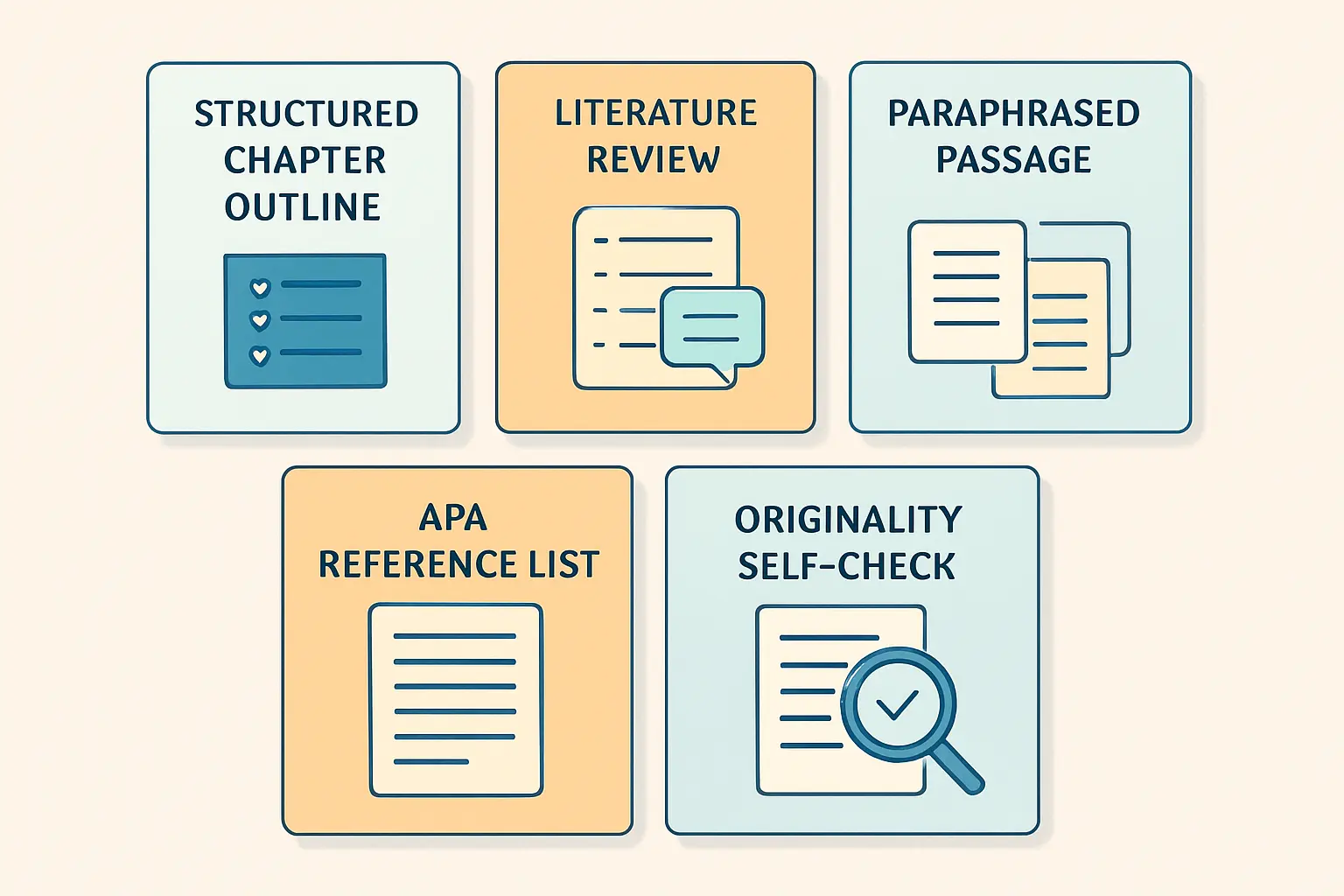
5 Tasks Where AI Saves the Most Academic Writing Time
1. Structuring and Outlining Any Paper
Structure is where most students lose the most time. You may know your argument clearly, but translating it into a logical, coherent section order for a 5,000-word essay or a 20,000-word thesis takes experience and iteration. An AI academic writing assistant can take your topic, your research question, and your word count requirement, and generate a viable working outline in seconds.
This is not the AI writing your paper. It is the AI doing what an experienced supervisor does in a first meeting: pointing you toward a structure that works so you can focus on the intellectual content. For longer pieces, this structural scaffolding is particularly valuable — see our complete step-by-step dissertation writing guide for what each chapter needs to contain before you begin drafting.
2. Drafting Literature Reviews
The literature review is the section students most consistently avoid starting. It requires synthesising often dozens of sources into a coherent narrative that positions your own research within the existing field — without simply listing what each paper found. AI can dramatically accelerate this process: not by writing the review in place of your reading, but by helping you organise sources thematically, identify conceptual gaps, and draft paragraph-level synthesis from your annotated notes.
Once you have your sources read and annotated, our guide to writing a literature review in 2026 covers the full methodology. An AI writing assistant then helps you move from bullet-point research notes to coherent academic prose while preserving your own argumentative thread.
3. Paraphrasing and Section Drafting
One of the most time-consuming micro-tasks in academic writing is expressing a complex idea from a source in your own words while preserving meaning and citing correctly. Get it wrong and you risk accidental plagiarism; get it too right and you risk awkward phrasing that weakens your argument. AI academic writing assistants handle this well: paste a passage, describe what you need to do with the idea, and the tool returns paraphrased, academically-voiced text you then refine and contextualise.
The critical point: the idea selection, source judgement, and argumentative use remain yours. The AI handles expression. You handle argument. That division of labour is both efficient and academically sound.
4. Generating Formatted Citations and Reference Lists
Manually formatting citations in APA 7 or Chicago Author-Date is error-prone and slow. A missing DOI, a misformatted author name, or an incorrect edition number can cost marks and credibility. Purpose-built academic AI tools generate formatted citations from the source details you provide — DOI, URL, or manual entry — and export complete reference lists in your required style.
Before relying on AI-generated citations, it pays to understand the format yourself so you can spot errors before they reach your submission. Our APA 7 website citation guide and MLA 9 format guide cover the most common standards in detail.
5. Running an Originality Self-Check Before Submission
Accidental plagiarism — forgetting to attribute a paraphrase, over-quoting a single source, or reproducing a phrase absorbed through heavy reading — is far more common than deliberate misconduct, and just as damaging to your grade. Running a thorough originality self-check before submission catches these issues while you still have time to correct them.
This is fundamentally different from an “AI detection bypass” tool. An integrity-first assistant runs the check so you can improve the originality of the work — not to evade detection, but to actually fix the problem. The difference matters both ethically and practically: you submit cleaner, more original writing, and you submit it with confidence.
AI Academic Assistant vs Generic Chatbot: The Critical Difference
Students frequently ask whether they can just use ChatGPT for academic writing. For some tasks, yes — ChatGPT is genuinely useful for brainstorming, getting unstuck on a paragraph, stress-testing an argument, or drafting a quick outline. That is legitimate, valuable use. The problems arise when students reach for it to generate citations or produce polished academic prose for submission.
| Task | Generic Chatbot (ChatGPT) | Purpose-Built Academic AI (Tesify) |
|---|---|---|
| Citation generation | Fabricates references that often do not exist | Pulls from real sources; formats in APA/MLA/Chicago/Vancouver |
| Academic structure | Generic outlines not calibrated to academic conventions | Discipline-aware structure for essays, theses, dissertations |
| Originality self-check | None | Built-in before-submission check to catch accidental overlap |
| Integrity framing | No guardrails; will generate whatever you ask | Designed to keep intellectual ownership with the student |
| Long-form coherence | Loses argument thread across a 20,000-word dissertation | Chapter-aware; maintains consistency through long documents |
For a broader comparison of how specialised academic AI tools stack up against each other across specific writing tasks, the tesify.app team’s detailed breakdown — best AI writing assistants for research papers in 2026 — is worth reading before committing to any single platform.
The citation fabrication issue deserves particular emphasis. If your bibliography includes sources that do not exist and your supervisor or examiner verifies them — which takes thirty seconds with a DOI lookup — that constitutes academic misconduct regardless of how it happened. Choosing a tool with real citation retrieval is not a nice-to-have; it is a risk management decision. For what AI use is actually permitted in thesis and dissertation writing specifically, see our detailed explainer: can I use AI to write my thesis? What’s allowed in 2026.
How Tesify Works: The Integrity-First Academic Assistant
Tesify was built for one specific purpose: helping students write theses, dissertations, and research-level papers with AI assistance that keeps the academic work genuinely theirs. That positioning shapes every feature decision.
Here is what the workflow looks like in practice, from a blank project to a submitted draft:
- Define your project. You enter your topic, research question, academic level (undergraduate essay, master’s dissertation, doctoral thesis), and word count. Tesify understands what is expected at each level and adjusts its structural suggestions accordingly.
- Generate a structured chapter or section outline. The AI proposes a working framework based on your discipline and document type. This is your starting point — you modify it based on your actual research, your supervisor’s feedback, and the specific conventions of your field. The structure is a scaffold, not a constraint.
- Draft section by section with AI assistance. Add your research notes, core arguments, and source material to each section. Tesify helps you turn those into coherent academic prose, maintains the right register, and keeps your argument consistent as the document grows. You are always the author; Tesify is the capable research writing partner who never tires.
- Generate real, formatted citations. Add a DOI or source URL and Tesify produces the full citation in APA 7, MLA 9, Chicago, or Vancouver — your choice, set once at the project level. No fabricated references, no sources that vanish when you try to retrieve them.
- Run the originality self-check. Before you submit, Tesify flags passages with high similarity to existing sources so you can paraphrase, add attribution, or revise. Responsible authorship, not evasion.
For students working on longer documents, Tesify functions as a full AI dissertation writing assistant that keeps the complete project coherent across multiple chapters over weeks or months of writing. For the comprehensive thesis-specific feature breakdown — covering every section from abstract to appendices — the dedicated AI thesis writer guide is the deeper resource.
What Universities Allow in 2026: Using AI Without Risk

The question students ask most urgently is whether using an AI academic writing assistant will get them into disciplinary trouble. The honest answer in 2026: it depends on your institution and the specific task — but the policy landscape has shifted considerably from the blanket bans many universities imposed in 2022 and 2023.
The University at Buffalo Graduate School, for instance, has moved to requiring departments to develop and publish explicit policies on AI use in dissertations, theses, and capstones for all master’s and doctoral students — recognising that blanket prohibitions are neither workable nor educationally sound. Across institutions, a clearer framework is emerging:
- Generally permitted: grammar and style improvement, citation formatting and reference management, structural outlines, literature search assistance, and originality self-checks before submission.
- Permitted with disclosure: AI-assisted drafting of sections and AI paraphrasing tools. Most universities in 2026 now require a brief AI use statement describing which tools were used and for what purpose. This is comparable to acknowledging statistical software in a methods section.
- Prohibited: Submitting AI-generated analysis or argumentation as your own original intellectual work without disclosure; using AI to complete assessments explicitly designed to test independent thinking.
The principle driving policy across institutions is disclosure. Using an AI academic writing assistant to structure, draft, and reference your work — and declaring that use transparently — is categorically different from submitting fabricated work. Academic publishers including Elsevier now require an explicit declaration of AI tool use in manuscript submissions. Your university’s graduate school is moving in the same direction, and the trend will only accelerate.
Practical guidance: check your department’s policy directly, disclose your AI tool use as required, and choose an assistant like Tesify that is designed to keep the intellectual content genuinely yours. For staying on the right side of the line, our integrity-focused guides on how to avoid plagiarism in 2026 and how to cite AI-generated content in APA, MLA, and Chicago cover both the practical steps and the institutional expectations.
Get Started with Tesify Tonight
The best time to start using an AI academic writing assistant is before you are in crisis mode — not at 11 pm the night before a deadline with nothing drafted. Getting Tesify configured around your project (your research question, chapter structure, and citation style) takes less than ten minutes. Once set up, every subsequent writing session is more focused and more productive.
Tesify works across all common academic document types:
- Undergraduate essays and seminar papers (500–5,000 words)
- Research papers and journal manuscript drafts
- Master’s dissertations and theses (10,000–30,000 words)
- Doctoral dissertations and research outputs (30,000+ words)
- Research proposals and grant writing
If you want to understand how Tesify fits within a full academic writing toolkit — alongside reference managers like Zotero, originality checkers, and source discovery tools — our overview of best AI writing tools for students in 2026 maps the complete landscape. For direct AI writing support at the level your thesis or dissertation demands, Tesify is free to start.
Write Smarter. Reference Accurately. Submit Confidently.
Tesify is the integrity-first AI academic writing assistant for essays, research papers, and dissertations. Free sign-up — no credit card, no commitment.
Frequently Asked Questions
What is the best AI academic writing assistant in 2026?
The best AI academic writing assistant depends on your specific needs. For thesis and dissertation writing, Tesify is purpose-built to handle long-form academic documents with real citation generation in APA 7, MLA 9, Chicago, and Vancouver, an originality self-check, and chapter-level structure support. For broader academic writing tasks including research papers and essays, it works across all common document types. The key differentiator between AI academic tools is whether citations are retrieved from real publication databases or fabricated from training data — that distinction alone rules out a large number of general-purpose chatbots for serious academic use.
Can I use an AI writing assistant for my dissertation without getting in trouble?
Yes, in most universities in 2026 — provided you disclose your use and apply the tool to permitted tasks such as structuring, citation formatting, paraphrasing, and originality self-checks, rather than submitting AI-generated analysis as your own independent intellectual work. Institutions including the University at Buffalo Graduate School have moved from blanket bans to disclosure-based frameworks that require departments to publish explicit AI use policies. Check your department’s specific policy, declare your tool use as required, and ensure the core argumentation and research interpretation remain yours.
Does Tesify generate real citations or does it fabricate them?
Tesify generates citations from real sources and does not fabricate references. Citation hallucination — fluent-sounding but non-existent references — is the defining failure mode of generic AI tools like ChatGPT used for academic writing. Tesify formats citations in APA 7, MLA 9, Chicago, and Vancouver from the source details you provide (DOI, URL, or manual input), so every reference in your bibliography is verifiable. As with all AI-generated output, always verify citations against the original source before final submission.
How is an AI academic writing assistant different from a plagiarism checker?
A plagiarism checker (such as Turnitin or iThenticate) is used by your institution after submission to detect copied or unoriginal text. An AI academic writing assistant is a tool you use during the writing process to structure, draft, and reference your work — and the best ones include an originality self-check that lets you identify and fix potential unintentional overlap before you submit. These are complementary tools: the self-check gives you the opportunity to improve your work; the institutional checker confirms it after. Tesify integrates both writing assistance and originality self-checking in a single workflow.
Is Tesify free to use?
Tesify offers a free sign-up with no credit card required. You can start structuring your thesis or dissertation and generating formatted citations immediately at no cost. Premium plans are available for students working on longer documents or needing more advanced assistance, but the free tier is fully functional for getting started and working through the core writing and referencing workflow.
Which citation styles does Tesify support?
Tesify supports the four most widely required citation styles in academic writing: APA 7 (used across social sciences, psychology, education, and nursing), MLA 9 (humanities, literature, and languages), Chicago (history, arts, and some social science disciplines), and Vancouver (medicine, health sciences, and life sciences). You select your required style during project setup and all generated citations are formatted to that standard throughout your document.