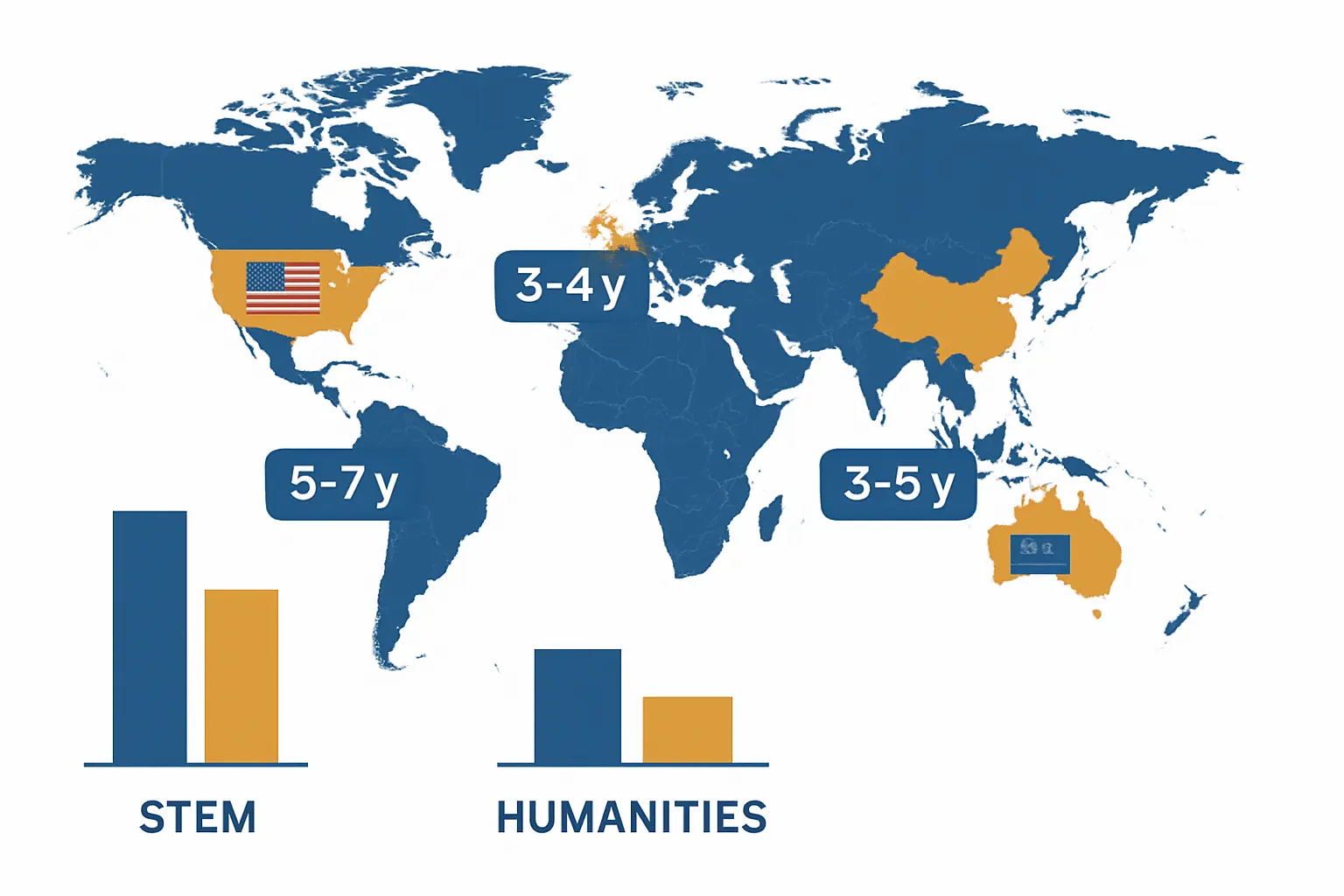
How Long Does It Take to Get a PhD in 2026? Data by Country and Field
The question sounds simple, but the answer spans continents and disciplines — and the gap between the shortest and longest PhD journeys is wider than most applicants expect. A doctoral candidate entering a structured engineering programme in the Netherlands will likely submit their thesis in four years. A humanities scholar at a US research university may still be writing their dissertation nearly a decade after finishing their bachelor’s degree. Understanding how long it takes to get a PhD — and the structural, disciplinary, and personal factors that stretch or shorten that timeline — is some of the most consequential information a prospective doctoral student can have before they apply.
This data roundup draws on the NSF Survey of Earned Doctorates (SED), the American Academy of Arts and Sciences Humanities Indicators, the Council of Graduate Schools PhD Completion Project, and official programme information from universities across the UK, Europe, and Australia. Every figure is attributed to its source and the years it covers. No number here is an estimate or a generalisation without a named data source.
US PhD Duration: The NSF Survey Data
The most authoritative source for US doctoral completion times is the Survey of Earned Doctorates (SED), an annual census administered by the National Center for Science and Engineering Statistics (NCSES) at the National Science Foundation. In 2023, the most recent year with published data, 57,862 people received doctorates from US universities — the highest annual total on record, according to the NCSES Doctorate Recipients report (NSF 25-300, December 2024).
The SED tracks three distinct time-to-degree (TTD) metrics, and conflating them is the single most common source of confusion in articles about PhD duration:
- Total time to degree: Elapsed calendar time from bachelor’s degree to doctorate, including any gaps for employment, family leave, or a separate master’s degree. This figure can exceed ten or even fifteen years in some fields.
- Graduate school time: From first enrollment in any graduate program to doctorate. Captures students who entered directly from undergraduate study but also includes the time spent on a master’s before the PhD.
- Registered (doctoral program) time: Time formally enrolled in the doctoral program itself. This is the figure most universities, rankings, and published studies report as the “average PhD duration” — and the figure used in the field breakdown below.
Across all fields combined, the median registered time in a US doctoral program has remained remarkably stable, ranging from 5.7 to 5.9 years across cohorts graduating between 2003 and 2020, according to the American Academy of Arts and Sciences Humanities Indicators, which compiles these figures directly from SED data. That overall median, however, masks dramatic variation by discipline — variation large enough to affect career planning, funding strategy, and personal financial planning in substantive ways.
When the NSF NCSES measured graduate school time (a broader metric) for the 2022 graduating cohort, it found that health sciences and social sciences both approached a median of nearly nine years to doctorate from first graduate enrollment — and non-science-and-engineering fields as a whole approached a 10-year median graduate school time to degree. The longer figure captures students who entered with no master’s degree and spent years on coursework, language training, qualifying exams, and data collection before finishing the dissertation.
Time to Degree by Field: STEM vs Humanities vs Social Sciences
The table below summarises median registered time to doctorate by broad field for US PhD recipients. The humanities figure is drawn directly from the American Academy of Arts and Sciences Humanities Indicators (covering 2003–2020 cohorts); the other field-level figures represent the range reported in SED-compiled analyses and are consistent with the AMACAD-confirmed overall median of 5.7–5.9 years.
| Field | Median Registered TTD | Context |
|---|---|---|
| Engineering | ~5.3 years | Shortest median; advisor-funded stipends accelerate progress |
| Health Sciences | ~5.0–5.7 years | Wide range; clinical programmes often longer |
| Computer & Information Sciences | ~5.6 years | Strong industry co-funding; internship culture can add time |
| Life & Biomedical Sciences | ~5.7 years | Lab-based; grant cycles and equipment availability dictate pacing |
| Physical Sciences & Mathematics | ~5.7–6.7 years | Range reflects depth of coursework in pure mathematics |
| Education | ~6.6 years | High proportion of part-time and working students |
| Social Sciences | ~7.7 years | Fieldwork, longitudinal data, and multi-phase analysis extend timelines |
| Humanities & Arts | 6.8–7.5 years | AMACAD Humanities Indicators (2003–2020 SED cohorts) |
The humanities figure deserves special attention because it is the most rigorously documented. The American Academy of Arts and Sciences Humanities Indicators — drawing on SED data across nearly two decades of graduating cohorts — found that humanities and arts PhD recipients spent a median of 6.8 years or longer in their doctoral programs for every graduation year from 2003 to 2020. The median peaked at 7.5 years for the 2003 cohort and declined gradually to approximately 6.9 years by 2011 before stabilising. The gap between humanities and the all-field median ranged from 1.0 to 1.6 years across the same period.
One structural driver: humanities students typically spend approximately four years in coursework and comprehensive exams before beginning dissertation research, compared to two to three years in natural science programs. Dissertation work then averages roughly three years across all fields — meaning the front-loaded humanities requirement, not the dissertation phase itself, accounts for most of the gap.
Completion rates, not just duration, vary across fields in ways that matter for planning. Research compiled through the Council of Graduate Schools PhD Completion Project found that engineering and biological/health science programmes had median completion rates of around 50%, while behavioural and social science programmes had the lowest rates — approximately 35%. Humanities and mathematical/physical sciences sat near 42%. These figures mean that the reported “average time to degree” for any given field reflects only the students who finished — students who extended significantly and then withdrew are not captured in the median.
UK PhD Duration: 3–4 Years Is the Standard
The UK operates on a fundamentally different model from the United States. Doctoral programmes at British universities are primarily research-based — applicants are typically expected to hold a master’s degree before entry, and the doctoral programme itself focuses almost entirely on original research from day one. There is no required coursework sequence, no qualifying exam structure equivalent to the US system, and no doctoral seminar series lasting multiple years.
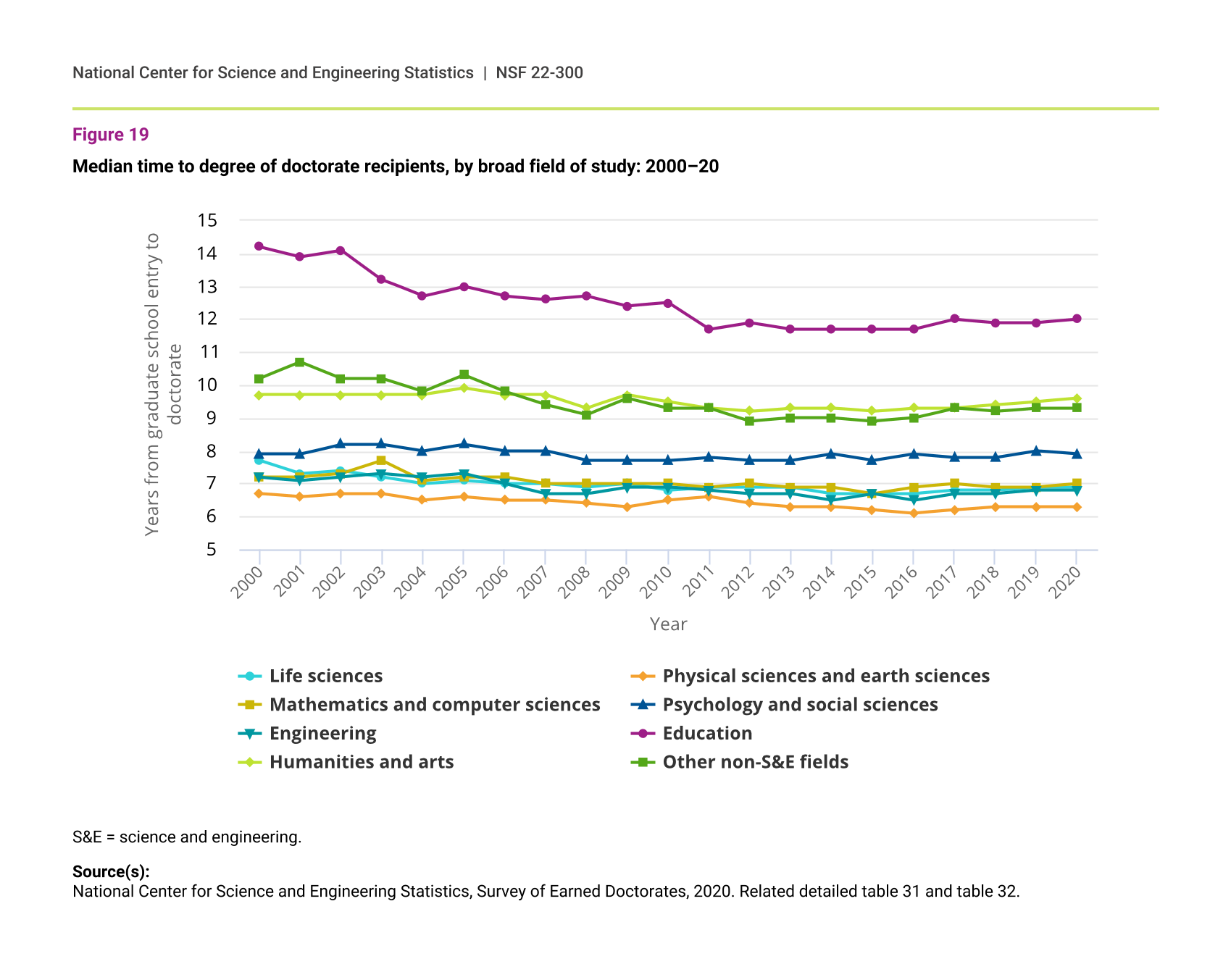
As a result, full-time PhD programmes at UK institutions — including Russell Group universities such as Oxford, Cambridge, UCL, Edinburgh, and Manchester — are formally structured for 3 to 4 years. Research councils and funding bodies operating under UK Research and Innovation (UKRI) typically award doctoral studentships for 3.5 years, with an expectation that the thesis will be submitted within that funding window.
Part-time PhDs in the UK run correspondingly longer: 5 to 7 years is the standard range, with most universities setting a firm maximum submission deadline of 7 years from initial registration for part-time students.
One important caveat: UK PhDs look much shorter on paper, but candidates typically arrive with substantially more prior training. Prospective students who do not yet hold a master’s degree should factor in a 1–2 year master’s programme before the doctoral phase, making the realistic total postgraduate investment 4–6 years from bachelor’s degree to doctorate — broadly comparable to the US once that context is acknowledged.
Europe: Germany, the Netherlands, and Beyond
European doctoral durations generally follow the UK pattern more closely than the US model, though structural differences between countries produce meaningful variation:
Germany
Germany offers two pathways to the doctorate. The traditional individual model (Individualpromotion), in which the doctoral candidate works independently under a single Doktorvater or Doktormutter, averages 4 to 6 years in practice — though formal registration periods may appear shorter. The structured PhD programmes (Strukturierte Promotion), modelled on international graduate school formats and increasingly supported by Germany’s Excellence Strategy institutions and the German Academic Exchange Service (DAAD), are designed for completion in 3 to 4 years with defined milestones and supervisory committees. DAAD recommends structured programmes specifically for international candidates because of the clearer accountability structures and institutional support systems they provide.
Netherlands
Dutch PhDs have an unusual and notably efficient model: doctoral candidates (promovendi) are typically employed as university research staff under a four-year fixed-term employment contract, with their salary funded by the university or an external grant. Completion within the four-year contract period is the strong institutional expectation, and universities track completion rates carefully. The Dutch model is the most structured in terms of timeline accountability in Europe.
France and the EU Broadly
French doctorates are formally registered for three years through doctoral schools (écoles doctorales), though actual completion typically extends to 3 to 4 years, particularly in fields requiring extensive empirical data collection or fieldwork. EU-wide, the Bologna Process third-cycle standard envisions doctoral programmes requiring 3–4 years of full-time study after a master’s degree — a target that most Western European systems formally adopt, even if actual completion rates vary.
Australia and Canada
Australia
Australian doctoral programmes are thesis-only and research-intensive, following a British-inspired model with no required coursework. The standard duration is 3 to 4 years full-time. Australian Government Research Training Programme (RTP) places are typically provisioned for 3.5 years, and most universities set a maximum enrolment ceiling of 4 years for full-time candidates and 8 years for part-time. Research-intensive programmes — particularly in biomedical sciences at the University of Melbourne, ANU, and Queensland — tend toward the shorter end of that range, while social science and humanities candidates commonly use the full four-year allocation.
Canada
Canada sits between the US and UK models. Doctoral programmes blend some required coursework and comprehensive examinations (closer to the US approach) with a shorter overall duration expectation (closer to UK practice). The typical range is 4 to 6 years. Major funding bodies — the Social Sciences and Humanities Research Council (SSHRC) and the Natural Sciences and Engineering Research Council (NSERC) — typically fund fellowships for 3–4 years, creating an implicit expectation around that timeline, even when actual completion regularly runs longer.
| Country | Full-Time Duration | Part-Time Duration |
|---|---|---|
| United States | 5.3–7.7 years (by field) | 7–10+ years |
| United Kingdom | 3–4 years | 5–7 years |
| Germany | 3–6 years (structured: 3–4) | 5–8 years |
| Netherlands | 4 years (fixed contract) | Uncommon |
| Australia | 3–4 years | Up to 8 years |
| Canada | 4–6 years | 6–8 years |
Part-Time vs Full-Time: What the Data Shows
Part-time doctoral enrolment is not a marginal path — in education, professional disciplines, and humanities, a substantial share of students pursue the degree while employed full-time. The time trade-off is straightforward: part-time students typically invest roughly half the weekly hours on their PhD, so the registered duration roughly doubles.
In the United States, the implications compound over time. When the NSF NCSES measured graduate school time for non-science-and-engineering fields in 2022, the median approached 10 years to doctorate from first graduate enrollment — a figure that reflects both the structural depth of humanities and education programmes and the prevalence of part-time and interrupted enrolment in those fields. For context, the parallel figure for engineering was substantially lower.
Beyond raw duration, the completion risk is a critical data point. Research on doctoral attrition consistently finds that part-time students face higher dropout rates than full-time equivalents — driven by competing professional obligations, reduced integration into the academic community, and funding instability during extended programmes. Our data roundup on PhD dropout rates and why students quit covers that evidence in detail, including field-level attrition figures from the Council of Graduate Schools.
For students constrained by finances, a fully funded PhD programme — covering tuition and providing a living stipend — is the structural solution that makes full-time completion viable without accumulating personal debt. Our guide to PhD scholarships in 2026 covers the major funding bodies across countries and disciplines.
What Extends Your PhD Timeline
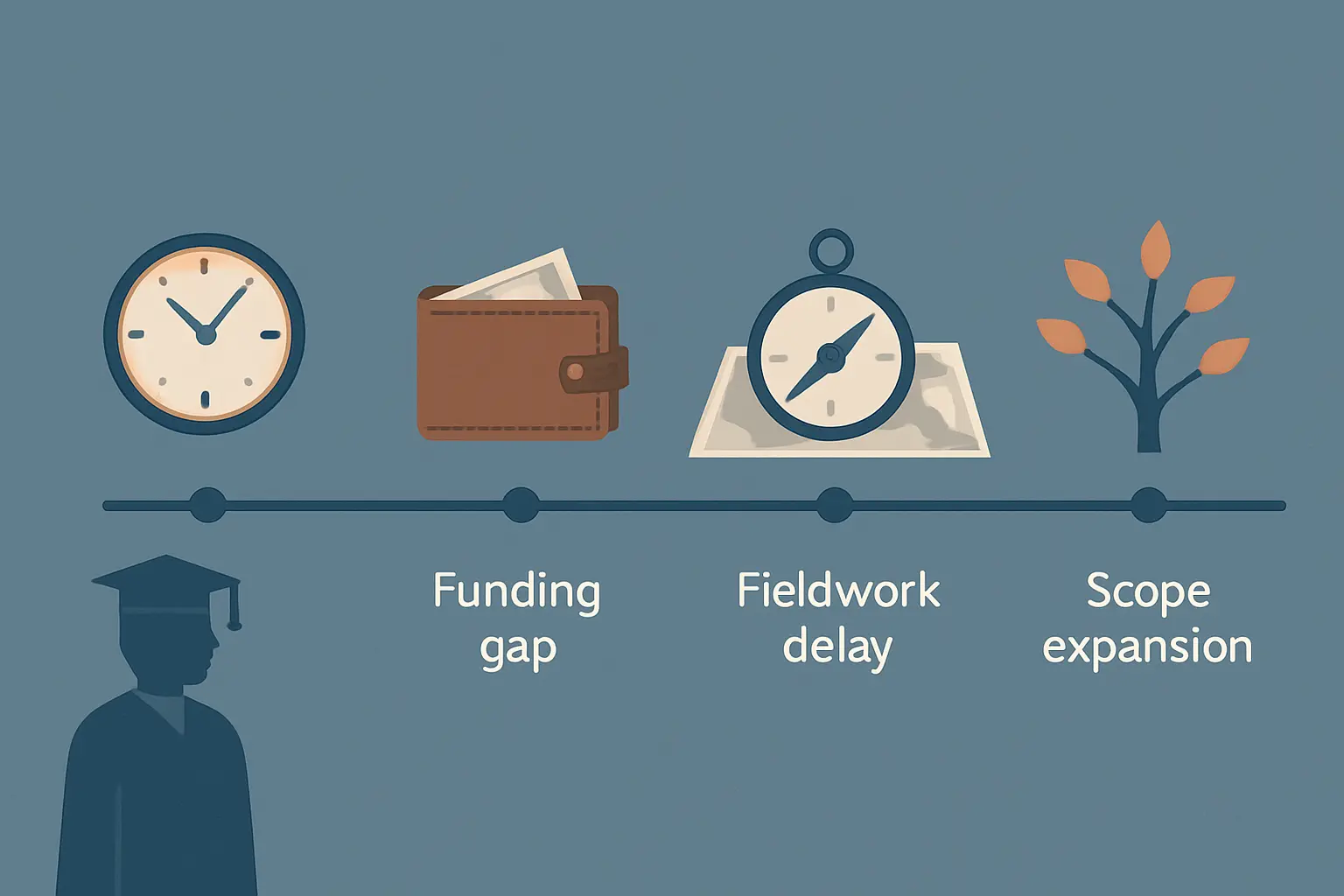
Beyond field and country, several well-documented institutional and personal factors correlate with longer time to degree. These are the levers candidates can actually identify and manage before and during their programme:
Supervisor feedback cycles
Delayed or insufficiently detailed supervisor feedback on draft chapters is among the most commonly cited causes of PhD extension in qualitative research on doctoral experience. A student waiting three to four months for comments on a substantive draft chapter loses momentum and may produce multiple redundant revisions. Before enrolling, ask potential supervisors explicitly about their expected turnaround time and whether they cap their active doctoral student load.
Funding and stipend gaps
When doctoral funding expires before the dissertation is complete, many students take temporary employment — teaching, research assistance, or industry work — to sustain themselves financially. Each such interruption extends total calendar time even when registered program time is shorter. STEM students with advisor-funded research assistantships are generally insulated from this; unfunded humanities students are acutely exposed. This dynamic is one reason why fully funded programmes produce higher and faster completion rates than self-funded ones.
Data collection and fieldwork constraints
Qualitative fieldwork, longitudinal data collection, or dependence on specialised laboratory equipment creates hard scheduling constraints. A sociologist conducting extensive interviews across multiple sites cannot compress data collection the way an engineer running simulations can. Budget for these phases honestly when building your initial PhD timeline, and confirm before enrolment how your department handles no-fault extensions caused by fieldwork delays.
Dissertation scope expansion
Dissertation research involves continuous decision-making about scope. Students who systematically expand their research questions mid-programme — adding case studies, chapters, or additional data sources during the writing phase — routinely extend their registered time by six to eighteen months beyond their original plan. Working closely with your supervisory committee to enforce a defined scope from the outset is the most reliable structural protection against this pattern.
Institutional and administrative delays
Ethics review approvals, IRB processes, committee scheduling conflicts, language requirements, and departmental administrative timelines all add friction that individual students can rarely control but can anticipate. Programmes with well-resourced graduate offices and streamlined administrative processes produce systematically faster completions than those where students must chase approvals through informal channels.
Planning for Timely Completion
The data across countries and fields points toward several consistent practices that correlate with shorter, smoother PhD trajectories:
- Secure full funding before you start. Stipend gaps are a primary driver of program extension and dropout. If your programme does not offer full funding, pursue external fellowships before matriculation — not after year two.
- Set a realistic scope agreement in year one. Work with your supervisor to document the intended scope of the dissertation in concrete terms. Revisit it annually and treat additions as formal decisions requiring supervisory approval, not informal choices made during late-night writing sessions.
- Use writing tools that support structure, not just fluency. Dissertation chapters are structured academic arguments, not just long essays. AI writing tools that help enforce chapter architecture — including properly formatted literature reviews, methodology sections, and reference lists — reduce the revision burden that extends timelines. AI in education statistics show growing adoption of writing assistance tools among doctoral students, with a clear pattern of reduced revision time in structured writing environments. Tesify is built specifically for this phase: it structures doctoral chapters from your notes, formats references in APA, MLA, Chicago, or Vancouver automatically, and runs an originality self-check so you arrive at supervision meetings with polished, citable drafts rather than rough outlines. Try Tesify free — no credit card required.
- Understand what the final examination looks like in your country. PhD timelines do not end at submission — the examination process adds weeks or months. In the UK, the oral defence (viva voce) follows thesis submission and can result in minor corrections, major corrections, or, in rare cases, resubmission. Knowing what outcomes are possible and how your examiners operate is part of realistic timeline planning. Our colleagues at Tesify.app have written a detailed guide on what happens if you fail your PhD viva and what the real odds are.
Frequently Asked Questions
How long does it take to get a PhD in the United States?
In the United States, the median registered time in a doctoral programme ranges from 5.7 to 5.9 years across all fields, according to the American Academy of Arts and Sciences Humanities Indicators drawing on NSF Survey of Earned Doctorates data. Engineering programmes average approximately 5.3 years; life sciences average approximately 5.7 years; humanities and arts average 6.8–7.5 years; and social sciences approach 7.7 years. When the broader measure of total graduate school time is used, non-science fields approach 10 years, reflecting interrupted enrolment and separate master’s degrees.
How long does a PhD take in the UK?
A full-time PhD in the UK takes 3 to 4 years. UKRI research council studentships are typically funded for 3.5 years. Part-time PhD programmes run 5 to 7 years, with most universities enforcing a maximum submission deadline of 7 years from initial registration for part-time candidates.
Do humanities PhDs take longer than STEM PhDs?
Yes, consistently and by a documented margin. The American Academy of Arts and Sciences Humanities Indicators found that humanities and arts PhD recipients spent a median of 6.8 years or longer in their doctoral programmes for every graduation year from 2003 to 2020, compared to an overall median of 5.7–5.9 years across all fields. The gap — up to 1.6 years — stems primarily from the four or more years of required coursework in humanities programmes before dissertation research begins, compared to two to three years in natural science programmes.
How long does a part-time PhD take?
Part-time PhDs typically take roughly twice as long as their full-time equivalents. In the UK, part-time programmes run 5 to 7 years. In the US, part-time and interrupted doctoral study in non-STEM fields can push total calendar time to 10 or more years, as reflected in NSF NCSES data showing non-S&E fields approaching a 10-year median graduate school time to degree. Part-time students also face higher attrition risk than full-time candidates across all fields.
Which country has the shortest PhD programmes?
The Netherlands offers one of the most efficiently structured doctoral models: candidates are employed as university research staff under a four-year fixed-term contract, with completion within that period as the institutional expectation. The UK and Australia also offer formal 3–4 year full-time doctorates, as does most of continental Europe. These are shorter than US programmes primarily because applicants are expected to hold a master’s degree before entry — doctoral study begins at a more advanced research stage.
What factors most commonly extend a PhD timeline?
The most consistently cited factors that extend PhD timelines are: slow or insufficient supervisor feedback on draft chapters; stipend or funding gaps that force temporary employment; fieldwork and data collection delays beyond the student’s control; dissertation scope expansion during the writing phase; and mental health challenges such as anxiety or depression, which multiple doctoral experience surveys document at elevated rates relative to the general working-age population. STEM students with advisor-funded research positions are generally better insulated from funding-driven extensions than students in unfunded humanities programmes.