
How to Write the Discussion Chapter of a Dissertation in 2026: Structure, Examples & Common Mistakes
The discussion chapter stops more students cold than any other part of a dissertation. You have spent months collecting data, running analyses and writing up results — and now you are expected to do something far harder: explain what those results actually mean. If you are staring at a blank page right now, you are in excellent company. Almost every student who has sat across from me in supervision has felt exactly this way at exactly this stage.
The good news is that learning how to write a discussion chapter is entirely teachable. The chapter follows a predictable structure, rewards specific types of thinking and responds very well to a clear process. This guide walks you through every element — from the chapter’s purpose to worked examples of discussion prose — so you can approach yours with the confidence that comes from knowing what you are actually trying to do.
What the Discussion Chapter Actually Does
Your dissertation’s results chapter is a faithful record of what your data showed. The discussion chapter is where you become a scholar: you step back, examine those results from multiple angles and argue for what they mean. Academic writing programmes at Oxford and MIT describe this shift as moving from reporter to analyst — a change in stance that many students find genuinely difficult because nothing in undergraduate training quite prepares you for it.
At its core, the discussion chapter does five things:
- Answers the specific research questions you posed in your introduction
- Places your findings in direct dialogue with the existing literature you reviewed
- Explains unexpected or contradictory results rather than quietly ignoring them
- Acknowledges the boundaries of your study with scholarly transparency
- Articulates what your research contributes to knowledge in your field
When these five elements work together, the discussion chapter becomes the most intellectually impressive section of the entire dissertation. It is where your own scholarly voice — distinct from any single source you have read — emerges most clearly. Examiners will spend longer reading this chapter than any other, which is both sobering and motivating.
How the Discussion Chapter Differs from the Results Chapter
Students most commonly confuse these two chapters by doing one of two things: writing results as though they are already interpretations, or writing the discussion as a second copy of the results with slightly different wording. Understanding the precise distinction unlocks the chapter immediately.
| Results Chapter | Discussion Chapter |
|---|---|
| Reports what the data showed | Explains why it matters and how it fits the field |
| Neutral, descriptive language | Analytical, interpretive language |
| No engagement with other scholars | Direct dialogue with the literature |
| States that a pattern exists | Proposes a reasoned explanation for the pattern |
| Follows your data collection order | Follows your research questions |
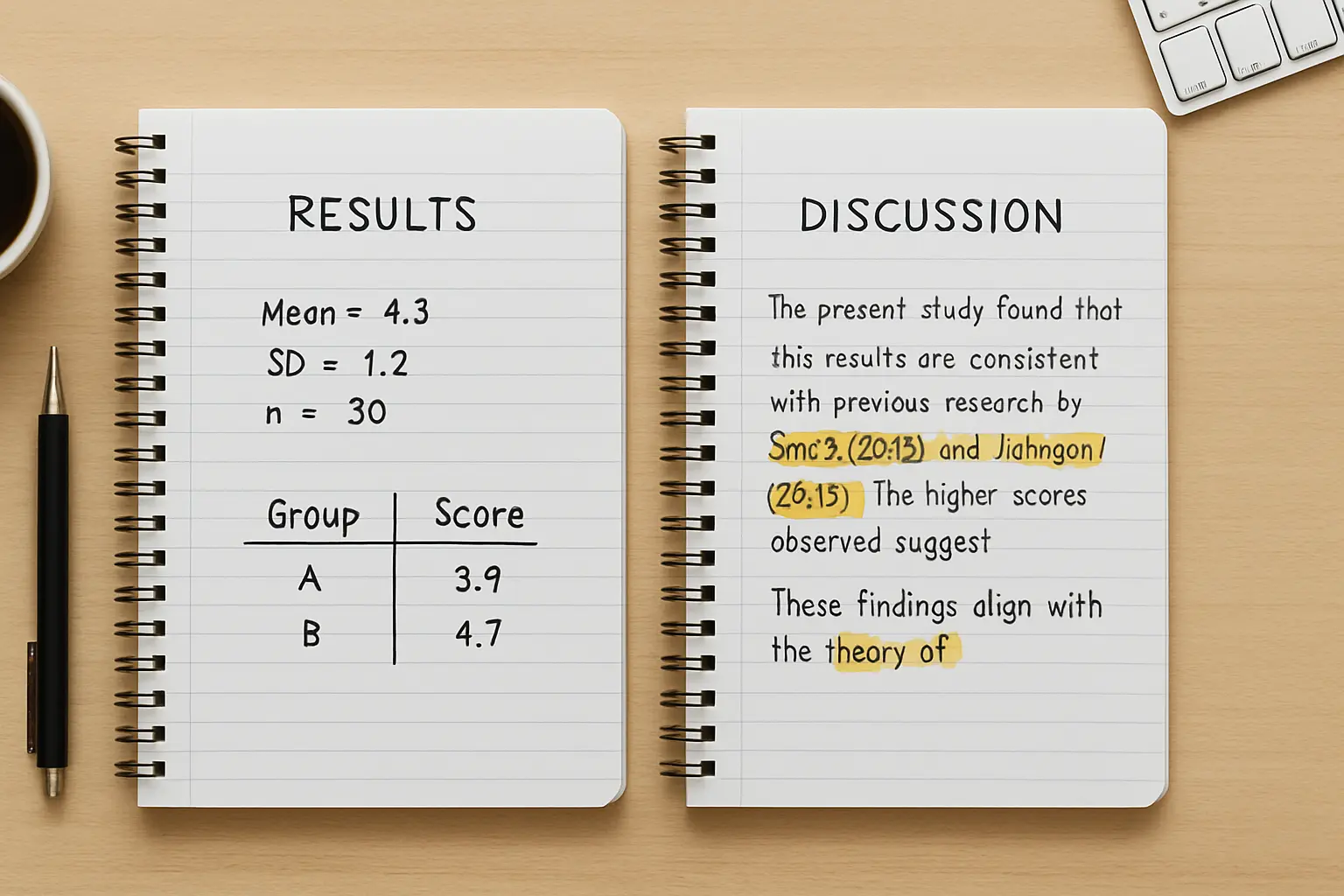
A useful mental model: think of results as the iceberg above the waterline — visible and countable — and the discussion as everything beneath the surface that explains why the iceberg exists, why it has the shape it does and why that shape matters. If your results chapter says “Theme 1 appeared in 14 of 20 interviews,” your discussion chapter asks: what does that prevalence indicate about the phenomenon you studied, and how does it confirm, challenge or extend what prior researchers argued?
If you are building a qualitative study, your methodology section will already have introduced your analytical framework. For readers who want deeper grounding in qualitative analytical approaches, our guide to thematic analysis step by step shows how the coding process shapes exactly what you will have to interpret in the discussion.
For practical support on writing your results chapter faster with AI — including templates for presenting data tables and structuring quantitative findings clearly — the dedicated guide on Tesify’s platform will help you produce clean, examiner-ready results prose before you begin interpreting it here.
The Six-Section Structure of a Discussion Chapter
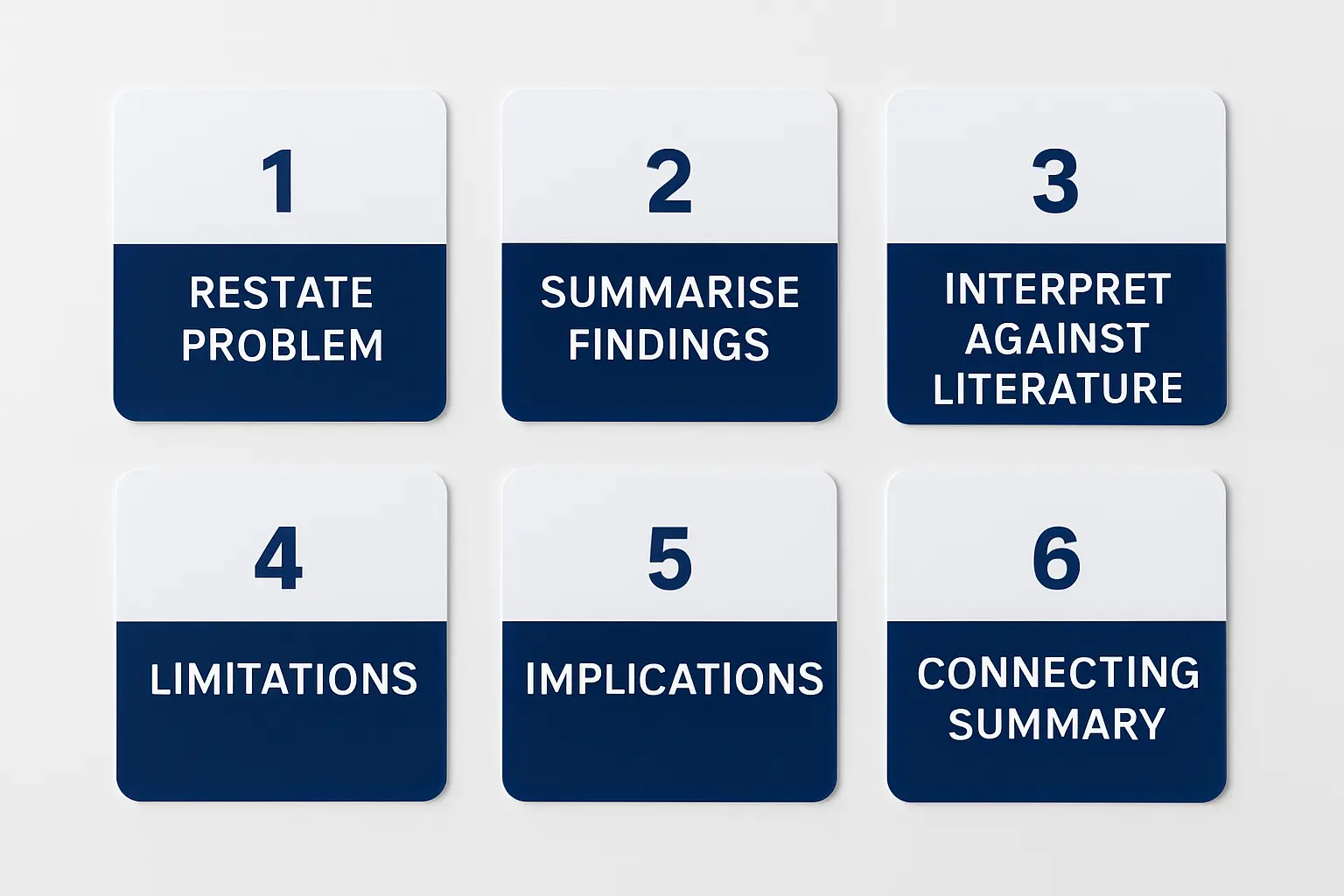
Most well-regarded dissertation guides — from the University of Southampton’s academic writing resources to Sheffield Hallam’s dissertation LibGuides — converge on a similar six-part structure. Think of these not as rigid boxes but as movements in a piece of music: each one flows naturally into the next, and the whole is more coherent than the sum of its parts.
1. Restate the Research Problem
Open with one or two sentences that remind the reader — and yourself — of the specific problem you set out to address. This is not a verbatim copy of your introduction; it is a refined restatement that sets up everything that follows. Some readers, particularly examiners pressed for time, skip from the introduction directly to the discussion. This brief anchor ensures they are fully oriented before encountering your interpretations.
2. Summarise Your Key Findings
In two to three paragraphs, present your most significant results in plain language, tied directly to your research questions or hypotheses. This is a summary — the detail lives in the results chapter. Use language such as “the data suggest,” “the analysis indicates” or “the findings point to” rather than declarative “the results prove.” This signals appropriate scholarly caution and is expected by examiners at every major institution.
3. Interpret Your Findings Against the Literature
This is the intellectual heart of the discussion and typically the longest section. For each major finding, you need to do three things:
- Confirm alignment: note where your findings are consistent with existing research and explain why this convergence is meaningful for the field
- Highlight divergence: identify where your results differ from prior studies and offer a reasoned explanation — different sample characteristics, different context, different time period or a genuine theoretical challenge
- Interpret surprises: unexpected results deserve particular attention because they often signal the most original contribution your work makes
This section is where your literature review pays dividends. If you built your literature review carefully — identifying debates, gaps and conflicting findings — you now have a ready framework for contextualising everything you discovered. For a detailed guide to building that foundation, see our article on how to write a literature review for your dissertation or thesis.
4. Acknowledge Limitations
Every study has boundaries, and naming them is a mark of scholarly maturity rather than weakness. A well-written limitations section demonstrates that you understand the methodological decisions you made and their consequences for interpretation. Common limitations include:
- Sample size or sampling strategy (convenience sampling, single institution, self-selected participants)
- Geographic or cultural context that constrains generalisability
- Self-report bias in surveys or interviews
- Cross-sectional design that prevents causal claims
- Instruments that were adapted from validated tools rather than independently validated
The key is to name each limitation, briefly explain its implications, then reaffirm why your findings remain valid and useful despite it. Choosing the right methodology from the outset reduces the weight of this section considerably; our guide to research methodology types and how to choose can help students earlier in the process make those choices deliberately.
5. State the Theoretical and Practical Implications
The implications section answers the “so what?” question that every examiner holds in mind from the first page. Implications typically fall into two categories:
- Theoretical implications: How do your findings extend, challenge or refine an existing theory or conceptual model? Does your work suggest a modification to how the field understands a particular construct?
- Practical implications: What should practitioners, policymakers or organisations consider doing differently in light of your findings? Who specifically should act on this, and how?
Be specific. “This has implications for education policy” carries no weight. “These findings suggest that secondary school transition programmes should incorporate structured peer-mentoring components, particularly for first-generation students, because the data indicate that perceived social support was the strongest predictor of academic persistence in this sample” — that is a practical implication. The more concrete your implications, the stronger your scholarly voice and the clearer your contribution.
6. Write a Connecting Summary
Close the discussion chapter — not the entire dissertation, which has its own separate conclusion chapter — with a paragraph that pulls the threads together. Briefly restate your main findings in light of the interpretation you have provided and signal what the conclusion chapter will address. Keep this tight: three to five sentences is usually sufficient. Resist the temptation to introduce new arguments here; save them for nowhere, because the discussion is their proper home.
Worked Example: Turning Results into Interpretation
The clearest way to understand the difference between results prose and discussion prose is to see them placed side by side. The following pair of paragraphs is entirely illustrative — a fictional study of student self-regulation in higher education, used here purely to model the shift in register and analytical stance.
“Across 24 semi-structured interviews, thematic analysis produced three themes: scheduled planning behaviour, emotional regulation during assessment periods and perceived social support. Scheduled planning behaviour was the most frequently coded theme, present across 20 of the 24 interviews.”
“The prominence of scheduled planning behaviour across participants aligns with established self-regulation frameworks, in which strategic forethought — including goal-setting and time allocation — is positioned as the foundational phase of effective academic self-management. That this pattern appeared consistently regardless of degree level or subject discipline suggests the behaviour may function as a domain-general strategy rather than a discipline-specific one. This finding extends existing theory to a higher education context while also raising a question that merits further investigation: whether the apparent domain-generality holds across different assessment cultures, particularly those where planning is constrained by irregular contact hours or work-based learning requirements.”
Notice what the discussion paragraph does that the results paragraph does not. It names a theoretical framework, explains convergence with that framework, makes an original claim about domain-generality, and generates a concrete question for future research — all in a single paragraph. That is the density of analytical thinking examiners are looking for.
Language That Signals Critical Thinking
Examiners across leading institutions look for the same quality in a discussion chapter: precise, appropriately hedged, analytical language that demonstrates you know the difference between what your data demonstrate and what you are inferring from them. The table below is worth keeping open as you draft.
| Function | Effective Phrases |
|---|---|
| Summarising a finding | “The data suggest…” / “The findings indicate…” / “The analysis points to…” |
| Confirming prior research | “This is consistent with…” / “These findings corroborate…” / “This aligns with the work of…” |
| Challenging prior research | “In contrast to…” / “This diverges from…” / “Unlike the findings reported by…” |
| Explaining a difference | “One possible explanation for this discrepancy is…” / “This difference may be attributable to…” |
| Acknowledging a limitation | “It should be noted that…” / “A potential constraint of this study is…” / “These findings should be interpreted in light of…” |
| Stating an implication | “This suggests a need for…” / “Practitioners may wish to consider…” / “Future research might explore…” |
One phrase to remove entirely from your discussion chapter: “This proves that.” Academic writing rarely proves anything — it provides evidence that supports or challenges claims. Replace “proves” with “suggests,” “indicates” or “appears to” and your examiner will trust your scholarly judgement far more readily.
Five Common Mistakes That Cost Students Marks
The same five errors appear in discussion chapters across disciplines and institutions. Knowing them in advance is the simplest insurance policy you have.
Mistake 1: Restating Results Rather Than Interpreting Them
The single most common error. If you find yourself copying sentences from your results chapter or simply reformatting data tables, stop. Each paragraph of the discussion must advance an argument about meaning. A reliable self-check: after writing a paragraph, ask “have I told the reader what to think about this result, or only reminded them of the result itself?” If the answer is the latter, you are still writing results.
Mistake 2: Abandoning the Literature
Some students write a thorough literature review and then never mention any of those sources again in the discussion. This severs the logical spine of the dissertation. Every significant finding should be placed in explicit dialogue with at least one prior study or theoretical position. If you cannot connect a finding to the literature, ask yourself whether the finding is truly central — or whether it belongs in a supplementary analysis.
Mistake 3: Introducing New Results
Findings that were not reported in the results chapter have no place in the discussion. If you find yourself wanting to add data at this stage — a pattern you noticed while writing, a participant quote you forgot to include — go back and add it to the results chapter first, then interpret it in the discussion. The two-chapter sequence exists precisely to keep data and interpretation cleanly separated.
Mistake 4: Catastrophising the Limitations
Phrases such as “these results cannot be generalised to any population” or “this study is too small to be meaningful” effectively argue for the irrelevance of your own research. Name limitations clearly, explain their scope and consequences, then move on. One concise paragraph per significant limitation is nearly always sufficient. Excessive self-criticism reads as a lack of confidence in your own scholarly judgement.
Mistake 5: Vague Implications
Implications stated at the level of “this is important for the field” carry no weight with examiners. Specify who should act on your findings, what they should do and why your evidence supports that recommendation. The more concrete the implication, the more convincingly it demonstrates that you have thought through the real-world relevance of your work.
If you are still working through the broader architecture of your dissertation, our complete guide to how to write a dissertation step by step in 2026 covers every chapter from the introduction through to the appendices, with the same level of structured detail you will find here.
Frequently Asked Questions
How long should the discussion chapter be?
In most dissertations, the discussion chapter accounts for roughly 15–25% of the total word count. For a standard 10,000-word master’s dissertation, that is typically 1,500–2,500 words. In a PhD thesis where the chapter stands alone and is not combined with results, it is often longer. Always check your institution’s specific guidelines, as conventions vary considerably across disciplines and universities.
Can the discussion and results chapters be combined?
Yes. In many humanities and some social science dissertations, results and discussion are written as a single integrated chapter, often called “Findings and Discussion.” This structure works well when findings are qualitative and resist clean separation from interpretation. In quantitative studies, separating the two chapters is generally preferred because it keeps raw data distinct from analysis. Always consult your supervisor before choosing your structure.
Should I use first person in the discussion chapter?
This depends on your institution and discipline. Many UK and Australian universities actively encourage first person (“I argue that,” “my findings suggest”) in the discussion chapter, while some programmes in North America still prefer passive constructions. Check your department’s style guide. Where first person is permitted, it is generally preferred — it positions you as a scholar making an argument rather than a passive observer of facts.
How do I discuss findings that contradict my hypothesis?
Contradictory findings are among the most valuable outcomes in any study. Do not minimise or apologise for them. State the result clearly, propose one or more evidence-based explanations for why it occurred — contextual factors, methodological differences from prior studies, theoretical limitations — and discuss what this contradiction reveals about the phenomenon under investigation. Examiners consistently rate honest treatment of unexpected results more highly than results that suspiciously confirm every prediction.
Is the discussion chapter the same as the conclusion?
No. The discussion chapter interprets your specific findings in relation to the literature and your research questions. The conclusion chapter is broader: it synthesises the entire dissertation, revisits the original research gap, makes final recommendations and reflects on the significance of the whole project. Some shorter dissertations combine them, but in most postgraduate work the two chapters serve distinct functions and are written separately.
Can AI tools help with writing the discussion chapter?
AI writing assistants can help you overcome the blank-page problem — structuring your argument, suggesting hedged academic language or organising paragraphs around each research question. The interpretation itself, however, must be yours: you are the only person who fully understands your data, your methodology and the specific literature you engaged with. Tools like Tesify are built to support your scholarly thinking, not replace it, keeping your original voice and academic integrity at the centre of the work.
Ready to Draft Your Discussion Chapter?
Staring at a blank page is the hardest part. Tesify gives you a structured workspace — research question mapping, chapter outlines and AI-assisted drafting — so you can move from raw results to polished interpretation without losing your own academic voice.