
Vancouver Referencing Style in 2026: Numbered In-Text Citations & Reference List Examples
Your nursing dissertation is due in four weeks and your supervisor has flagged that your in-text citations must follow Vancouver style — yet every guide you find either stops at the basics or buries the formats in footnotes. Vancouver referencing is the dominant citation system in medicine, nursing, pharmacy, dentistry, and the wider health sciences, used by thousands of journals including The Lancet, BMJ, and JAMA. Unlike author-date systems such as Harvard or APA, Vancouver assigns a number to each source the first time it appears; that number then follows the source through your entire document. Once you understand the logic, producing an accurate reference list becomes a mechanical task — which is exactly what this guide makes it.
Below you will find the complete 2026 rules for numbered in-text citations, correctly formatted reference list entries for every common source type, the authoritative et al. threshold, the five mistakes that cost health sciences students marks, and a note on the tools that automate the tedious parts.
What Is Vancouver Referencing?
Vancouver referencing — formally the ICMJE style, after the International Committee of Medical Journal Editors — was first agreed upon at a 1978 meeting in Vancouver, British Columbia. The resulting ICMJE Recommendations for the Conduct, Reporting, Editing and Publication of Scholarly Work in Medical Journals now governs how thousands of biomedical publications expect their references to be formatted. For detailed entry-level formatting, the ICMJE defers to Citing Medicine, 2nd edition, published by the U.S. National Library of Medicine (NLM) — freely available online and the authority on every edge case you will encounter.
Vancouver is a numeric citation system, not an author-date system. Where Harvard or APA would give you (Smith, 2023), Vancouver gives you 1 or [1]. The consequence matters for readers: a health sciences journal article with thirty references reads far more cleanly with superscript numbers than with thirty author-date parentheticals interrupting every sentence. That readability is precisely why the clinical literature adopted the system.
If you also need to understand how other numbered medical citation systems work — particularly AMA style, which is common in US clinical publishing — the AMA citation style guide on Tesify covers the parallels and key differences in full.
How the Numbered In-Text Citation System Works
Every source receives one number, assigned the first time it appears in your document. Subsequent citations of the same source reuse the original number. Numbers appear either as superscripts (preferred by most journals) or inside square brackets (preferred by some universities). Pick one format and apply it consistently — your institution’s guide will specify which.
| Format | Single source | Multiple sources | When used |
|---|---|---|---|
| Superscript | …randomised trials.3 | …evidence.3,5,8 | Most journals; BMJ, Lancet |
| Square brackets | …randomised trials [3]. | …evidence [3,5,8]. | Many universities; some journals |
| Ranges | — | …as shown.3–6 | Three or more consecutive sources |
Place the citation number immediately after the fact it supports — before a closing punctuation mark for superscripts, or after for bracket style when at the end of a sentence. If you name an author in your prose (“Jones et al.4 found that…”), the number follows the author’s name, not the sentence end.
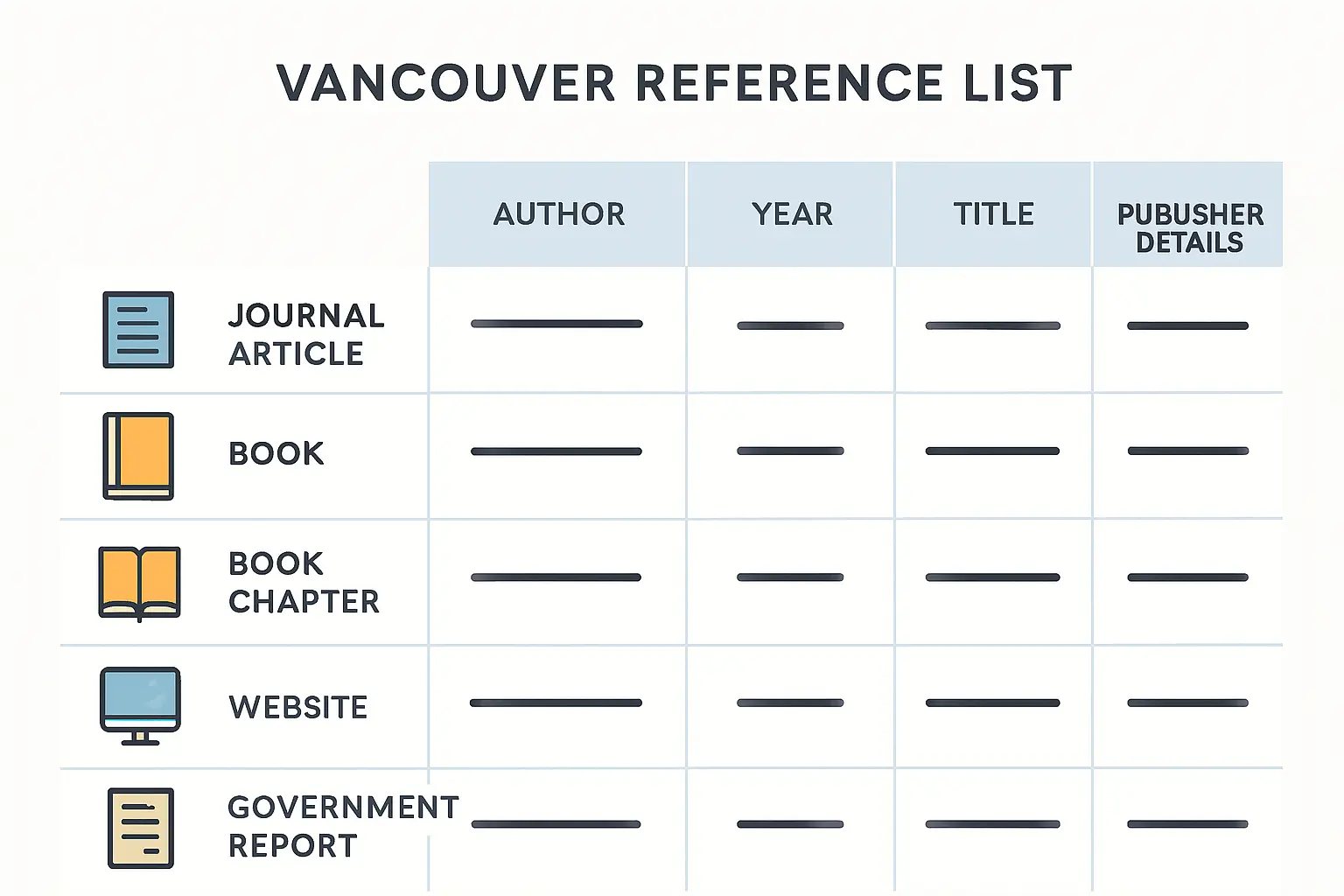
Reference List Formats by Source Type

The reference list begins on a new page, headed “References”, and is numbered in the order of first citation — not alphabetically. Use NLM journal title abbreviations throughout (look them up in the NLM Catalog). The examples below follow the current ICMJE/NLM standard.
Journal Article
Structure: Author(s). Article title. Abbrev J Title. Year;Volume(Issue):First page–Last page. doi:XXXXXXX
| Element | Rule |
|---|---|
| Authors | Surname + initials, no punctuation between initials. Up to 6, then “, et al.” |
| Article title | Sentence case; no italics |
| Journal title | NLM abbreviation; italics optional but consistent |
| Volume/issue | No “Vol.” or “No.” labels — Year;Volume(Issue):Pages |
| DOI | Include when available, formatted as doi:10.XXXX/XXXXX |
Copy-paste example (6 authors):
Jones RM, Smith AB, Williams CD, Brown EF, Taylor GH, Davis IJ. Antibiotic resistance patterns in community-acquired pneumonia: a multicentre cohort study. Lancet Infect Dis. 2024;24(3):285–94. doi:10.1016/S1473-3099(23)00543-5
Copy-paste example (7+ authors):
Patel SK, Nguyen TL, Garcia MR, Ahmed B, Chen W, Okafor N, et al. Long-term outcomes after bariatric surgery: a 10-year follow-up. N Engl J Med. 2023;389(11):1005–17. doi:10.1056/NEJMoa2305672
Book (Entire)
Structure: Author(s). Title of book. Edition (if not 1st). Place of publication: Publisher; Year.
Kumar V, Abbas AK, Aster JC. Robbins and Cotran pathologic basis of disease. 10th ed. Philadelphia (PA): Elsevier; 2021.
Chapter in an Edited Book
Structure: Chapter author(s). Chapter title. In: Editor(s), editor(s). Book title. Edition. Place: Publisher; Year. p. XX–XX.
Bloom HJG. Chemotherapy in breast cancer. In: Chabner BA, Longo DL, editors. Cancer chemotherapy and biotherapy. 5th ed. Philadelphia (PA): Lippincott Williams & Wilkins; 2011. p. 475–506.
Website or Online Source
Structure: Author(s) or Organisation. Title [Internet]. Place: Publisher; Year [updated YYYY Mon DD; cited YYYY Mon DD]. Available from: URL
World Health Organization. Global tuberculosis report 2024 [Internet]. Geneva: WHO; 2024 [cited 2026 Jun 1]. Available from: https://www.who.int/publications/i/item/9789240101531
Always record the date you accessed online sources — unlike journal articles, web pages can change or be removed. If a web page has no named author, begin with the organisation or institutional name.
Government Report or Institutional Document
NHS England. NHS long term workforce plan [Internet]. London: NHS England; 2023 [cited 2026 Mar 15]. Available from: https://www.england.nhs.uk/publication/nhs-long-term-workforce-plan/
Et Al. Rules in Vancouver
The ICMJE threshold is six authors. When a work has up to six authors, list all of them. When a work has seven or more authors, list the first six and append “, et al.” — note the comma before et al. and the period after al.
This differs from Harvard referencing, where et al. conventions vary by institution and the author-date in-text format makes author count more visible. In Vancouver, the number hides the author list in-text, so the reference list entries carry more weight for completeness.
5 Common Vancouver Referencing Mistakes
- Alphabetising the reference list. Vancouver references are numbered in order of first citation — not A-to-Z. Alphabetising is a Harvard or APA habit that creates an entirely wrong document in Vancouver. Double-check that reference 1 is the first source cited in your introduction.
- Using full journal names instead of NLM abbreviations. The New England Journal of Medicine becomes N Engl J Med. The Lancet stays Lancet (it has no abbreviation). Unabbreviated titles are a common reason examiners flag reference lists. Use the NLM Catalog to verify every abbreviation.
- Adding “Vol.” or “No.” labels. Vancouver format is Year;Volume(Issue):Pages — compact and label-free. Writing “Vol. 24, No. 3, pp. 285–294” signals unfamiliarity with the style.
- Omitting DOIs on journal articles. As of 2026, including the DOI where one exists is standard practice. A DOI makes every reference permanently traceable and is expected by peer-reviewed journals and most university examiners.
- Restarting the number sequence per chapter. In a dissertation, the reference list is cumulative across the whole document unless your institution explicitly requires per-chapter numbering. A single continuous list — numbered in order of first appearance across all chapters — is the default.
If you are also tracking how many total references your thesis needs across all chapters, the guide on how many references a thesis should have gives discipline-by-discipline benchmarks that complement the formatting rules here.
Reference Management Tools for Vancouver
Manually formatting a 40-reference list in Vancouver takes time and introduces errors. Reference managers solve both problems. Zotero, Mendeley, and EndNote all carry Vancouver as a built-in citation style, meaning they will output the correct NLM-abbreviated, numbered format directly into your word processor. If you are choosing between the two most popular free options, the comparison of Zotero vs Mendeley covers Vancouver support, browser-extension capture, and collaboration features side by side.
For students working on a full thesis rather than a single article, Tesify integrates reference management directly into the thesis-writing workflow. When you draft a chapter with Tesify, its auto-bibliography feature assembles a correctly ordered Vancouver reference list as you write — so the numbering stays consistent even when you reorganise sections. It does not write the thesis for you; it removes the mechanical burden of tracking which number belongs to which source, which is where most errors creep in.
Frequently Asked Questions
Is Vancouver referencing the same as ICMJE or NLM style?
Yes — the three names refer to the same system. “Vancouver” is the informal name from the 1978 meeting where the style originated. “ICMJE style” refers to the International Committee of Medical Journal Editors who maintain the recommendations. “NLM style” refers to the Citing Medicine manual published by the National Library of Medicine, which provides the detailed entry-level formatting rules. All three are interchangeable in practice.
Do I use superscripts or square brackets for Vancouver in-text citations?
Both are acceptable in Vancouver style. Most biomedical journals prefer superscripts (e.g., evidence from three trials1–3), while many UK and Australian universities prefer square brackets (e.g., evidence from three trials [1–3]). Check your institution’s or journal’s specific author guidelines and apply whichever format they specify consistently throughout.
How many authors do I list before using et al. in Vancouver?
Under the ICMJE recommendation — which is the standard used by most journals and universities — list the first six authors and then add “, et al.” for any work with seven or more authors. The NLM’s own Citing Medicine manual lists all authors without truncation, but the 6 + et al. rule is the practical convention in academic writing. When in doubt, follow your institution’s referencing guide.
Is the Vancouver reference list in alphabetical order?
No. The Vancouver reference list is in the order in which sources are first cited in the text, starting with reference 1 (the first source cited anywhere in the document). This is the opposite of Harvard, APA, MLA, and Chicago styles, which all use alphabetical order. Alphabetising a Vancouver reference list is one of the most common and penalised errors.
What is the NLM journal title abbreviation and where do I find it?
NLM abbreviations are standardised short forms of journal titles used in Vancouver references — for example, The New England Journal of Medicine abbreviates to N Engl J Med. Find the official abbreviation for any journal by searching the NLM Catalog. Reference managers such as Zotero and Mendeley can apply these abbreviations automatically when you select the Vancouver output style.
Can I use Vancouver referencing for non-medical dissertations?
Vancouver is prescribed by health sciences faculties (medicine, nursing, pharmacy, dentistry, physiotherapy) and is not used in the humanities or social sciences. If your institution specifies Vancouver, you must use it regardless of your topic. If it has not been prescribed, Vancouver is unnecessary outside health sciences contexts — check whether your faculty requires APA, Harvard, or another style.
Build a perfect reference list without counting author names
Keeping Vancouver reference numbers consistent across a 60-page dissertation — especially when you add a source to chapter one after finishing chapter four — is genuinely error-prone work. Tesify tracks source numbering as you draft each chapter, reassigns numbers automatically when you reorder sections, and outputs a formatted Vancouver reference list at the end. Your ideas stay yours; the mechanical bookkeeping is handled for you.