
What Is a Research Gap? How to Identify and Justify One in 2026 (with Examples)
A research gap is an unanswered question, unexplored population, untested setting, or unresolved contradiction that existing academic literature has not adequately addressed. Identifying one transforms your study from a repetition of prior work into a genuine scholarly contribution — and it is the first thing supervisors and reviewers look for when they open a proposal.
Definition and Why It Matters
A research gap is not simply a topic nobody has published on — the field may have ignored it for principled reasons. A genuine research gap is a specific, articulable deficiency in the scholarly record that, if filled, would advance understanding, inform practice, or resolve a theoretical tension.
Supervisors and examiners evaluate gap statements on three criteria:
- Existence: You can point to real published sources and show precisely where the record falls short.
- Significance: The gap has practical or theoretical consequences worth the cost and time of a study.
- Feasibility: Your proposed study is scoped and resourced to credibly address it.
Without a clearly articulated research gap, a thesis or proposal has no answer to the examiner’s foundational question: “Why does this study need to exist?” A gap statement built on all three criteria closes that question before it is asked.
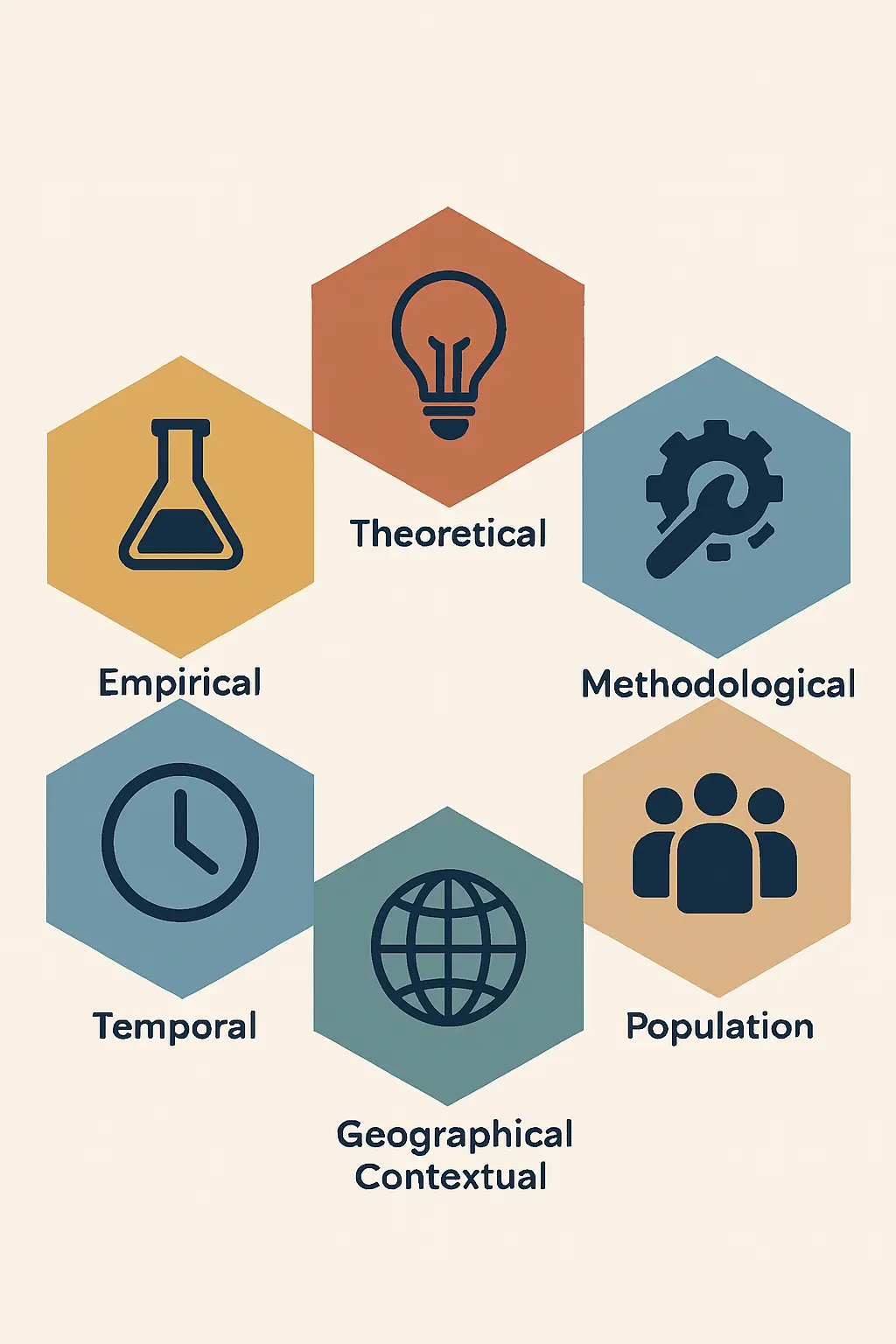
7 Types of Research Gaps
Academic writing distinguishes several distinct gap types. Naming the correct type sharpens your justification and signals methodological literacy to your committee.
| Gap type | What is missing | Signal phrase to use in writing |
|---|---|---|
| Empirical | A phenomenon theorised but never tested with data | “No empirical evidence yet exists for…” |
| Theoretical | Existing frameworks do not explain an observed phenomenon | “Current theories fail to account for…” |
| Methodological | Prior studies used methods that limit validity or generalisability | “Existing research relies exclusively on self-report measures…” |
| Population | Findings for one group have not been replicated in another | “Research has focused on adults; adolescents remain understudied…” |
| Geographical / Contextual | Evidence exists in one country or cultural setting but not another | “The majority of studies originate in North America or Western Europe…” |
| Temporal | Existing evidence predates a major change — in technology, policy, or context | “No studies have examined outcomes since the 2020 policy shift…” |
| Knowledge application | Evidence exists but has not been translated into practice or policy | “Despite robust evidence, implementation in clinical settings remains rare…” |
Most dissertations claim one primary gap type, but real studies often combine two — for example, a population gap compounded by a methodological gap when the underrepresented group has also only been studied via survey instruments.
How to Identify a Research Gap: 5 Practical Methods
A systematic approach beats intuition. Use these five methods in sequence, starting broad and narrowing to a specific, citable claim.
1. Run a Systematic Database Search
Search at least two major academic databases — PubMed, Scopus, Web of Science, or EBSCO — using controlled vocabulary and Boolean operators. As you read, note what populations, interventions, settings, and time periods appear consistently absent. This is the core engine of writing a thorough literature review; the research gap lives at its boundary.
2. Mine “Limitations” and “Future Research” Sections
Authors are required to state what their study could not establish. A limitation that recurs across multiple papers on the same topic is strong evidence of a structural gap — it isn’t one study’s weakness, it is the field’s boundary. Collect these statements verbatim; they become ready-made citations when you write your gap justification.
3. Read Recent Systematic Reviews and Meta-Analyses
Systematic reviews synthesise what is known and, under PRISMA reporting standards, must state what remains unknown. A single high-quality systematic review can map an evidence landscape faster than reading forty primary studies, and its “implications for future research” section often contains a gap statement you can build on — though you must verify and go meaningfully beyond it rather than simply restating it.
4. Use Citation Chaining
For every foundational paper in your field, check backward (what it cites) and forward (who has cited it since publication). Tools such as Google Scholar, Semantic Scholar, and Connected Papers automate forward citation search. Papers that cite a foundational work and apply it to new settings or populations frequently signal an emerging gap that has not yet been saturated by the literature.
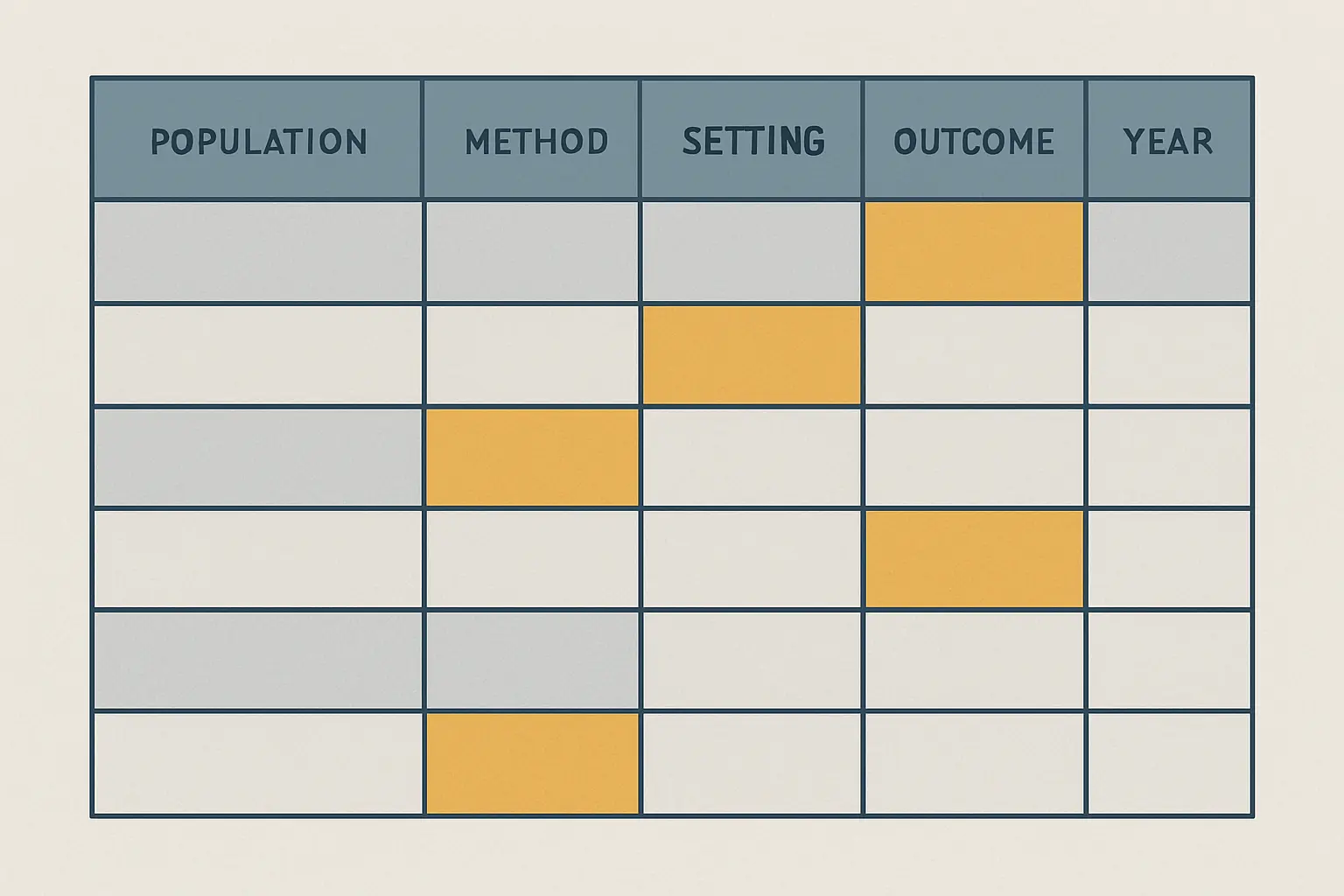
5. Build an Evidence Matrix
Create a simple table: rows are studies, columns are key variables (population, method, setting, outcome measure, publication year). Patterns of empty cells are your gaps, made visible. This audit is also useful evidence to present to a supervisor or committee when you argue that a gap is real — it shows systematic coverage, not selective reading.
How to Justify a Research Gap in Your Proposal
Identifying a gap and justifying it are distinct tasks. Identification is discovery; justification is argumentation. When you write your research proposal, the gap statement must accomplish three things explicitly.
Step 1 — Establish the Gap with Evidence
Cite multiple sources that collectively show the boundary of existing knowledge. A gap statement such as “Despite extensive research on X (Author A, 2022; Author B, 2023; Author C, 2024), no study has examined Y in Z population” is more credible than a single citation because it demonstrates you have surveyed the field rather than cherry-picked one convenient paper. Three to five converging citations is a reasonable floor for a doctoral proposal; two may suffice at master’s level.
Step 2 — Show the Gap Has Consequences
Examiners will dismiss a gap that is technically real but practically trivial. Connect the gap to a real-world problem, a theoretical contradiction that blocks progress in the field, or a policy failure with human costs. The blunt drafting heuristic “This gap matters because…” is useful — you can refine the phrasing later, but forcing yourself to complete that sentence prevents vague gap statements from surviving into your final draft.
Step 3 — Show Your Study Addresses It
Transition from the gap directly to your research questions, making the logical chain explicit. Your study should address the gap, not merely be adjacent to it. A conceptual framework reinforces this connection: it shows how the variables you plan to examine map onto the unexplored territory you have identified, and gives examiners confidence that your design was chosen to fill the gap rather than adapted from a previous project. For a structured walk-through of how to formalise your gap into PICO, SPIDER, or FINER research questions — the frameworks most used in health, social, and education research — see the research gap identification and question formulation guide.
Research Gap Examples by Discipline
Psychology — Population Gap
Mindfulness-based stress reduction programmes have been studied extensively in adult clinical populations in Western settings. A population gap exists in non-clinical adolescent samples within collectivist cultural contexts, where the individualistic assumptions embedded in standard MBSR protocols may not translate directly and where school-based delivery raises distinct ethical considerations not covered by adult clinic research.
Public Health — Temporal Gap
Remote work and occupational stress were studied intensively during 2020–2021. A temporal gap now exists around long-term outcomes (three or more years post-adoption), particularly for workers who never returned to office environments at all. Studies conducted during the acute phase of disruption cannot speak to chronic adaptation, burnout trajectories, or the effects of hybrid-work norms that only stabilised after 2022.
Computer Science — Geographical / Linguistic Gap
Hallucination detection in large language models has been benchmarked almost exclusively against English-language datasets. A clear geographical and linguistic gap exists for low-resource languages — such as Swahili, Amharic, and Welsh — where training data scarcity means hallucination patterns may be structurally different, and where existing detection benchmarks cannot be assumed to generalise.
Education — Methodological Gap
Gamification in higher education has been evaluated primarily through short-term self-reported engagement scales administered immediately after an intervention. A methodological gap exists in longitudinal retention measurement: existing studies cannot show whether gamified learning gains persist at six months, and the field’s reliance on self-report instruments introduces common-method bias that objective performance measures would avoid.
Common Mistakes to Avoid
- Asserting the gap without evidence. “Nobody has studied X” is not a justified claim unless you have actually searched and shown the literature to be empty or near-empty. An examiner who knows the field will immediately think of a counter-example.
- Confusing scarcity with absence. Fewer than ten studies on a topic is not the same as zero. Your gap must be more specific than “there isn’t enough research on X” — it must identify what dimension of X is missing.
- Choosing a gap your study cannot fill. A global multi-year longitudinal gap cannot be addressed by a six-month single-site master’s project. Align gap scope with study scope, or reviewers will flag the mismatch immediately.
- Ignoring contradictions in the literature. Conflicting findings between studies are often the most consequential gaps — they signal an unresolved theoretical or methodological problem, not just missing data. Your choice of research methodology can sometimes resolve the contradiction by accounting for the moderating variable that prior studies ignored.
- Writing the gap statement last. Your gap should drive your design, not be retrofitted to it. Identify the gap before you choose your methodology; otherwise your study risks being shaped by convenience rather than by what the evidence actually requires.
Frequently Asked Questions
What is a research gap in simple terms?
A research gap is a specific question, population, setting, or problem that existing published research has not fully answered or examined. It is the space between what is known and what still needs to be discovered, and it forms the intellectual justification for conducting a new study. Without one, there is no clear reason your study needs to exist.
How do you identify a research gap quickly?
The fastest route is to read the “limitations” and “future research” sections of three to five recent systematic reviews on your topic. Authors are obligated to state what their work could not establish. A limitation that recurs across multiple papers points directly to a structural gap in the field — one you can cite immediately.
What is the difference between a research gap and a research problem?
A research problem is the broader issue your study addresses (for example, rising rates of student anxiety). A research gap is the specific deficiency in existing literature that your study will fill (for example, no published study has measured the effect of counselling wait times on academic outcomes beyond self-report). The gap narrows the problem into a specific, studiable claim with citations to support it.
How long should a research gap statement be?
In a proposal, a gap statement is typically two to four sentences: one sentence establishing what is known, one sentence identifying what is absent or contradictory, and one sentence connecting that absence to the significance of your study. In a full literature review chapter, the gap is usually elaborated across a dedicated paragraph or sub-section at the end of the synthesis, often running to 150–300 words.
Can a research gap be based on a contradiction in the literature rather than an absence?
Yes, and contradictions are often the strongest basis for a gap statement. When two or more credible studies reach opposing conclusions, the contradiction itself signals that a moderating variable, a methodological confound, or a contextual factor has not been accounted for. Your study can be designed to resolve the contradiction rather than simply add another data point to an already mixed evidence base.
Map Your Literature Gap Faster with Tesify
Pinpointing a research gap means reading widely and tracking what is consistently absent across dozens of papers. Tesify helps you upload your collected sources, surface recurring limitations, and draft a gap statement grounded in what you have actually read — not generated from assumptions. Your intellectual argument stays yours; the synthesis gets faster. Start free at tesify.pro.