What Is Self-Plagiarism? Text Recycling Rules Every Student Should Know in 2026
You spent three weeks writing a strong research paper on climate policy last semester. Now a new assignment covers the same ground, and the temptation is real: why not reuse sections you already polished? The answer surprises many students — submitting your own previous work without disclosure is self-plagiarism, and most universities treat it as a genuine academic integrity violation, not a technicality.
Self-plagiarism, also called text recycling, is one of the least understood misconduct categories in higher education. Students are caught off guard because the logic feels backwards — how can you plagiarise yourself? This guide explains exactly what self-plagiarism is, why policies exist, when reuse is legitimate, and what practical steps protect your academic record.
What Is Self-Plagiarism?
Self-plagiarism is the practice of reusing substantial portions of your own previously submitted, published, or copyrighted work in a new context without citing the original or disclosing the reuse. The APA Publication Manual (7th edition) defines it as presenting one’s own prior work “as if it were new scholarship” — a standard that applies equally to coursework and peer-reviewed publishing.
The most common forms students encounter:
- Double submission (duplicate submission): Handing the same essay or report to two different courses — simultaneously or in consecutive semesters — without both instructors’ explicit written permission.
- Recycled sections: Copying your own methods section, literature review, or introduction from a previous paper into a new submission without citing the original.
- Incremental publishing (salami slicing): Splitting one coherent study into multiple papers to maximise publication count — a research-ethics concern for postgraduate and doctoral students.
- Prior-draft reuse: Submitting a heavily revised version of coursework originally written for another module without disclosing the earlier submission.
Notice what is not self-plagiarism: building on your own ideas (with citation), developing a research theme across multiple projects (with appropriate disclosure), or quoting yourself (with a self-citation). The violation is the lack of transparency, not the act of reuse itself.
Why Reusing Your Own Work Without Disclosure Is a Problem
The objection students raise is reasonable: “It’s my work — who am I stealing from?” The answer involves two distinct issues: academic fraud and copyright.
Academic fraud: the false-novelty problem
When you submit an assignment, you are implicitly representing it as work produced specifically for that assessment. University regulations — and the assignment brief itself — assume new, original effort. Recycling old work deceives your institution about how much genuine work you have done for this course. It is the academic equivalent of submitting a purchased essay, with the crucial distinction that the prose is yours but the represented effort is not.
Consequences range from a zero mark on the assignment to suspension or degree revocation in serious or repeated cases. Most academic misconduct panels treat intentional double submission more severely than accidental similarity in phrasing.
Copyright: when your own words no longer belong to you
For students who publish research — journal articles, conference proceedings, institutional repositories — copyright adds a second layer of risk. Journal publishing contracts typically require the transfer of copyright to the publisher on acceptance. Once signed, the text legally belongs to the journal, not to you. Reproducing substantial portions in a subsequent paper without the publisher’s permission is a copyright infringement, regardless of authorship.
This is why the Committee on Publication Ethics (COPE) maintains dedicated text recycling guidelines that editors use to evaluate manuscripts. CrossCheck and iThenticate — plagiarism-detection systems used by most major publishers — flag self-overlap as readily as they flag copying from other sources.
Legitimate vs Problematic Text Recycling
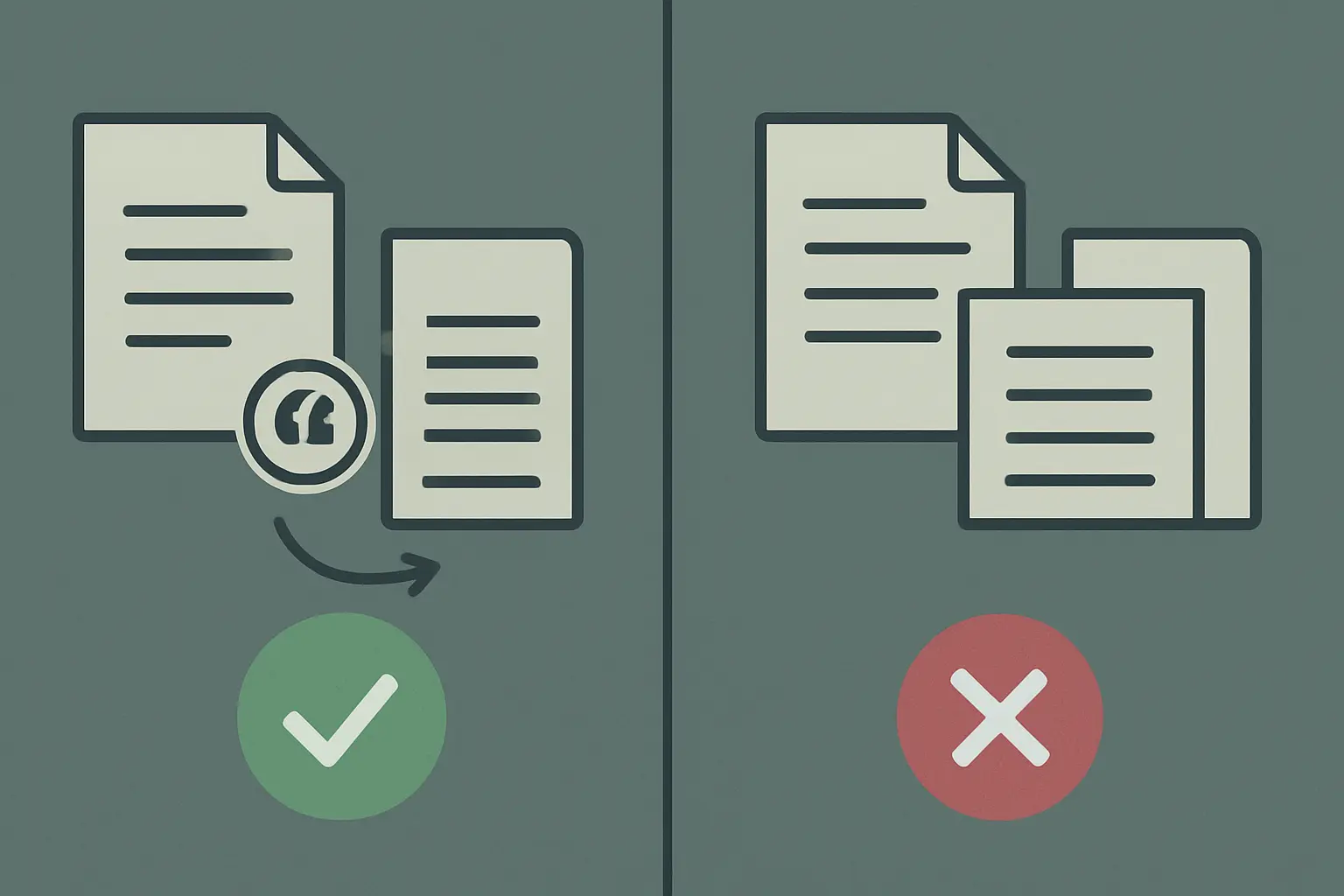
| Scenario | Status | Why |
|---|---|---|
| Citing your published article in a new paper | Legitimate | Source is disclosed; reader knows the origin |
| Reusing your dissertation chapter in a journal article with permission and citation | Legitimate | Transparent disclosure; most journals explicitly allow thesis-derived articles |
| Submitting the same coursework to two modules with both instructors’ written permission | Legitimate | Instructor permission removes the false-novelty problem |
| Submitting an old essay to a new module without disclosure | Problematic | Double submission; misrepresents effort for this assessment |
| Copying your own methods section into a new paper without citing the original | Problematic | Potential copyright violation; undisclosed overlap inflates apparent novelty |
| Reusing published text after copyright transfer, without publisher permission | Problematic | Copyright infringement regardless of original authorship |
| Building on your own ideas with new analysis, citing the prior work in a footnote | Legitimate | Ideas are not copyrightable; transparent reference maintains integrity |
When Text Recycling Is Acceptable
Three conditions make reuse legitimate: disclosure, permission, and substantial reworking.
1. Disclose and cite the original
Cite your own prior work exactly as you would cite any other source. If you wrote a conference paper on renewable energy last year and want to build on it in a journal article, cite the conference paper and note which elements derive from it. Standard citation styles — Harvard, APA 7, MLA — all support self-citation. A self-citation does not diminish your paper’s contribution; it demonstrates that your work forms part of a developing, traceable body of scholarship.
2. Obtain permission in writing
For coursework: ask your instructor before you build on a previous submission. Most instructors will agree if the new assignment asks you to develop or critically evaluate earlier work — but the permission must be explicit and documented. For publishing: check the copyright terms of your previous journal. Many open-access licences (CC BY, CC BY-NC) permit reuse with attribution. If copyright was transferred exclusively to the publisher, write to their permissions team.
3. Rework substantially and explain what is new
Borrowing a concept from earlier work and extending it with new data, fresh analysis, or a different theoretical lens is normal scholarly development. The test is whether the new work meaningfully advances the original. Simply repackaging old content for a new audience without adding intellectual value — even with a citation — sits in ethically grey territory and should be discussed with your supervisor or instructor.
Journal Publishing vs Academic Coursework Norms
The rules differ meaningfully between research publishing and undergraduate or postgraduate coursework. Students who are also early-career researchers need to navigate both.
Coursework norms
The dominant rule is: one piece of work, one submission. Exceptions exist for portfolio modules (where earlier drafts are explicit scaffolding) and capstone projects (where a literature review is designed to carry across adjacent modules). Always read your module handbook carefully. If the policy is ambiguous, ask your module coordinator before submitting — not after. A brief email creates a paper trail that protects you if a similarity report later raises questions.
Turnitin flags self-overlap when a previous submission was added to your institution’s student paper repository. Many universities automatically archive submissions, so work from prior years can trigger high similarity scores on a later assignment covering related ground.
Journal and conference publishing norms
Most peer-reviewed journals follow COPE guidelines and treat substantial text overlap with a prior publication as requiring disclosure. Preprints posted to arXiv, SSRN, or bioRxiv before peer review are generally treated as prior disclosure rather than duplicate submission — but check the target journal’s policy, since practices vary by discipline.
Thesis-to-article conversion is a well-established and widely accepted exception. Journals in most disciplines permit articles derived from doctoral theses, provided the original thesis is cited, the article contributes new synthesis or interpretation, and the author follows the journal’s specific author guidelines.
For a broader grounding in all categories of academic misconduct — and how they are handled across different institution types — the Academic Integrity & Plagiarism Complete Student Guide covers the full spectrum of issues students face across their degree.
How to Avoid Self-Plagiarism
The practical steps are straightforward once the underlying principle is clear.
- Keep a personal archive of prior submissions. Maintain a folder — organised by module and date — with PDFs of every essay, lab report, and paper you submit. This makes it easy to check whether a new assignment genuinely requires original work or whether it is designed to build on previous output.
- Disclose proactively. If a new assignment asks you to build on or evaluate prior work, say so in your introduction and cite the earlier submission in your reference list. Proactive disclosure costs nothing and pre-empts any misconduct concern before it can become one.
- Write from understanding, not from text. If your previous essay covered similar territory, re-read it, set it aside, and draft the new piece from memory and fresh sources. This naturally produces new prose and prevents recycled phrasing from appearing.
- Run an originality check before you submit. Checking for plagiarism against your own prior submissions surfaces self-overlap you may have missed. Tesify’s originality self-check flags sections likely to generate a high similarity score — so you can add the necessary citation or rephrase before your instructor or reviewer sees the report.
- Ask when in doubt. Writing centres, academic integrity officers, and module coordinators exist precisely to answer these questions before a submission. A five-minute conversation can prevent a formal misconduct hearing.
The habits that protect you from self-plagiarism are the same ones that protect you from all forms of misconduct: accurate citation, honest disclosure, and genuine intellectual engagement with your sources. For a full breakdown of those habits, see our guide on how to avoid plagiarism across every common scenario.
AI-generated text introduces a related question worth naming: if an AI tool drafts a section you already used in a previous submission — because you gave it the same prompt — does that constitute self-plagiarism? Institutional policies are still developing, but the principle is the same: disclose any reuse and ensure the submitted work reflects your current intellectual contribution. Our guide on citing AI-generated content covers the latest citation formats across APA, MLA, and Chicago styles.
Frequently Asked Questions
Is self-plagiarism the same as duplicate submission?
Duplicate submission is one type of self-plagiarism — specifically, submitting the same work to two courses or journals without disclosure. Self-plagiarism is the broader category, which also includes recycling sections of prior work, salami slicing, and reusing published text after copyright transfer. All forms share the same root problem: presenting previously submitted or published material as if it were new original work.
Can I cite myself to avoid self-plagiarism?
Yes — self-citation is the correct mechanism for reusing your own prior work with integrity. Cite your previous submission or publication exactly as you would any other source, using your chosen citation style. For coursework, add a note in your introduction explaining that the new assignment develops ideas from a prior submission, and confirm with your instructor that this is acceptable for the specific assessment brief.
Will Turnitin detect self-plagiarism?
Turnitin can detect self-overlap if your previous submission was stored in your institution’s student paper database. Many universities automatically archive all submissions, which means resubmitting your own work — even from a previous year — will generate a high similarity score. Whether that score triggers a misconduct review depends on your institution’s policies and the threshold your department has configured.
Is it self-plagiarism to expand my dissertation into a journal article?
Not if handled correctly. Thesis-to-article conversion is widely accepted in academic publishing. Cite the original thesis, ensure the article contains substantial new analysis or contribution, and check the target journal’s author guidelines — most address thesis-derived submissions explicitly. Some funding bodies and institutional open-access mandates also require the thesis to be deposited publicly, which creates a citable prior version and reduces any ambiguity.
Does self-plagiarism apply to my own unpublished drafts?
For coursework purposes, yes. An unpublished draft that was formally submitted for assessment and received a mark counts as prior submitted work at most universities. Resubmitting it for a new assessment without instructor permission is double submission. Unpublished personal notes or brainstorming documents that were never formally submitted do not typically fall under self-plagiarism policies.
What is the difference between text recycling and paraphrasing?
Paraphrasing means restating another author’s ideas in your own words, with citation. Text recycling means reusing substantial portions of your own prior text — including previously paraphrased passages — in a new submission without disclosure. The remedy for text recycling is not to paraphrase yourself (which produces the same content in slightly different words), but to cite the original submission, obtain permission, or produce genuinely new analysis.
Verify Your Originality Before You Submit
The safest way to know your submission is clean — from both external sources and your own prior work — is to run an originality check before the deadline. Tesify helps students structure and verify their academic writing so every submission reflects genuine original work. Academic integrity is a skill worth building — start your self-check today.