
Case Study Research Design in 2026: Types (Yin & Stake), When to Use It & How to Defend It
Every doctoral candidate who chooses a case study research design eventually faces the same examination question: “How can you generalise from a single case?” It is a reasonable challenge, and researchers who cannot answer it — not because the design is weak, but because they have not thought through their epistemological positioning — leave the room bruised. The case study is, in fact, one of the most powerful designs in the social-scientific toolkit. Yin, Stake, and Creswell have each spent careers demonstrating why. What this guide does is give you the conceptual architecture and the precise language to choose this design deliberately and defend every element of it with authority.
The discussion below covers the definition, the two dominant traditions (Yin’s post-positivist protocol and Stake’s interpretivist craft), the full design taxonomy, data-source triangulation, validity and trustworthiness criteria, the logic of analytic generalisation, a worked mini-example, and the pitfalls that cause examiners to pause.
What Case Study Research Design Actually Is
Robert Yin’s enduring contribution to methodology is a precise definition that separates case study from anecdote or journalistic narrative. A case study is an empirical inquiry that investigates a contemporary phenomenon in depth and within its real-world context, particularly when the boundaries between the phenomenon and its context cannot be sharply delineated. This distinguishes it from experiments, where context is deliberately controlled out, and from surveys, where context is deliberately held constant.
What makes something a “case”? John Creswell, drawing on Stake’s vocabulary, describes the case as a bounded system — bounded in time, in place, or in some other coherent unit of analysis. A bounded system might be a single organisation, a policy implementation in one municipality, a student cohort in one academic year, a professional team during a product launch, or a social movement over a defined period. The binding is not arbitrary; it must reflect a real-world boundary that the researcher can justify on conceptual grounds.
Case study is also distinguished from other qualitative traditions — phenomenology, grounded theory, ethnography, narrative inquiry — by its unit of analysis. Where phenomenology privileges lived experience and grounded theory targets emerging theory, case study takes the case itself as the primary unit and seeks to understand it in full, contextualised complexity.
To situate this within your broader research methodology design, it is worth noting that case study sits most comfortably within a qualitative or mixed-methods paradigm, though Yin’s tradition admits quantitative data when relevant. The case study research design is not inherently interpretive or post-positivist — the epistemological framing is a separate choice, and it is the key differentiator between the Yin and Stake traditions. For a comprehensive overview of the full range of qualitative traditions — phenomenology, grounded theory, ethnography, and narrative inquiry alongside case study — the qualitative research methods complete guide on Tesify maps each approach by epistemological stance and situates case study within the broader landscape.
Yin vs Stake: Two Traditions Compared
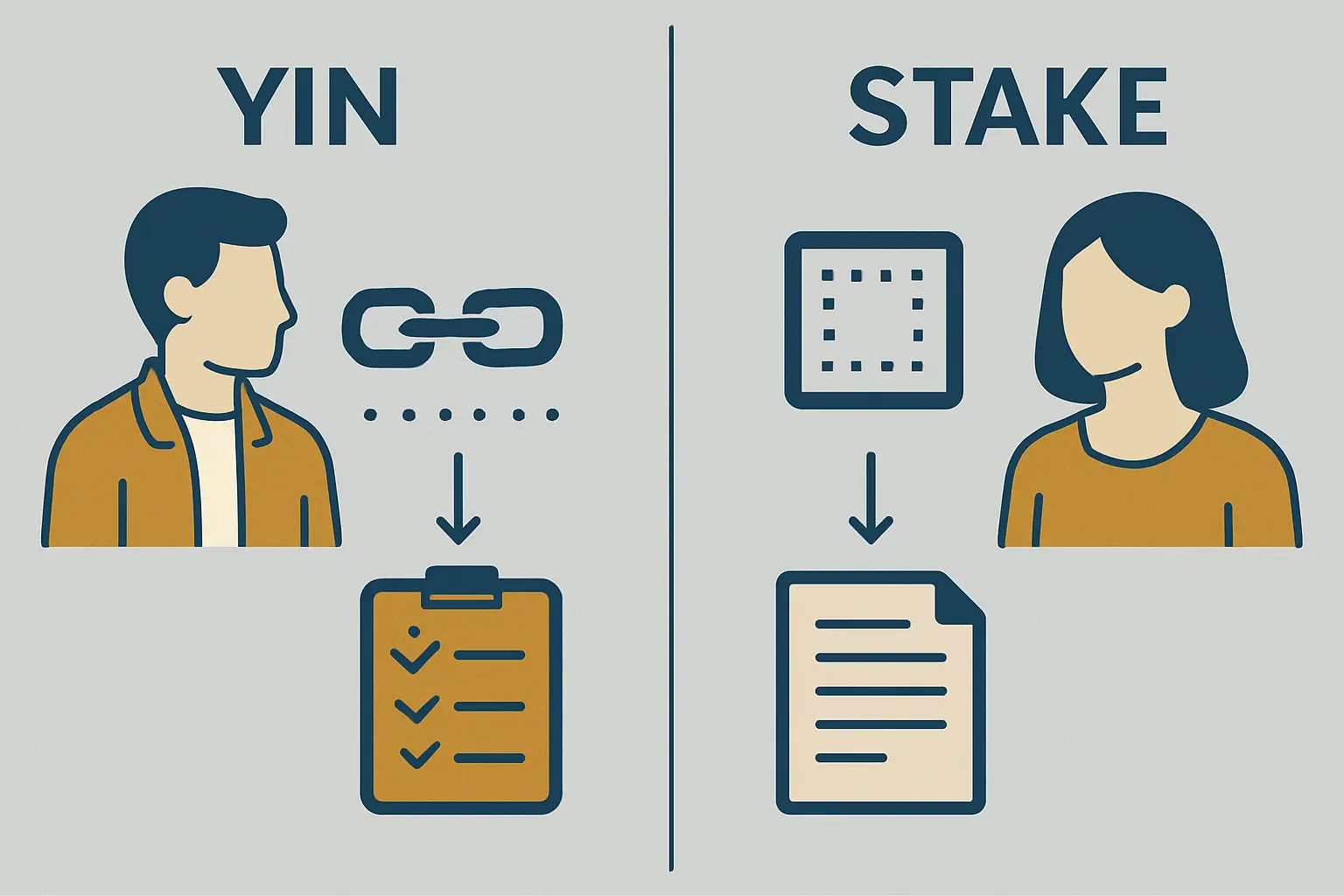
The field’s two major theorists share a commitment to rigorous, contextualised inquiry but diverge substantially in orientation, vocabulary, and what they consider good evidence. Understanding the differences is not merely academic: the tradition you align with will determine the criteria by which your committee evaluates your work.
| Dimension | Yin (post-positivist) | Stake (interpretivist) |
|---|---|---|
| Epistemological stance | Post-positivist; seeks to minimise researcher bias | Constructivist; researcher as instrument |
| Purpose of case | Understand a phenomenon; build or test theory | Understand the particular case in its complexity |
| Case selection logic | Theoretical/replication logic (literal or theoretical replication) | Maximum opportunity to learn (purposive, intrinsic interest) |
| Generalisation goal | Analytic generalisation to theory | Naturalistic generalisation; vicarious experience for readers |
| Rigour vocabulary | Construct, internal, and external validity; reliability | Credibility, transferability, dependability, confirmability |
| Data emphasis | Multiple sources, chain of evidence, case study protocol | Thick description, progressive focussing, naturalistic observation |
| Key text | Case Study Research and Applications (2018) | The Art of Case Study Research (1995) |
Neither tradition is inherently superior. A Yin-oriented design suits researchers who want to build or test mid-range theory and who anticipate committee scrutiny through a post-positivist lens — common in business, public administration, and applied social science. A Stake-oriented design suits researchers whose interest is the particularity of their case — the school, the community, the individual project — and who are working within interpretivist or critical paradigms. Creswell straddles both, treating case study as a qualitative tradition while borrowing Yin’s bounded-system terminology alongside Stake’s emphasis on thick description.
Yin’s Design Matrix: Single, Multiple, Holistic, Embedded
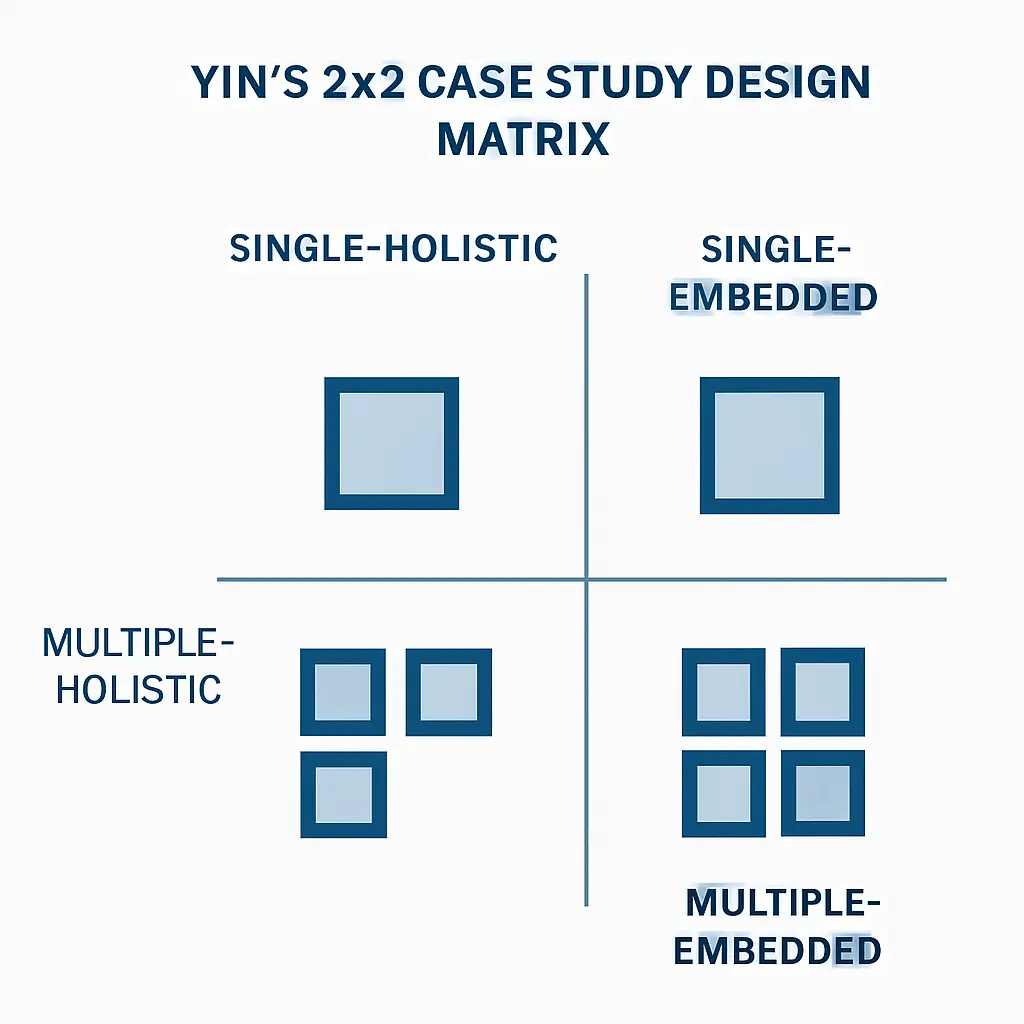
Yin’s 2×2 design matrix is one of the most practical tools in the methodologist’s repertoire. The two axes are: (1) number of cases — single or multiple — and (2) unit of analysis — holistic (single unit) or embedded (multiple units). This produces four design types.
Single-holistic: One case, one unit of analysis. You study a single organisation as a whole, or a single programme, without decomposing it into sub-units. This is appropriate for critical, unique, revelatory, or longitudinal cases, or for cases that test a well-formulated theory. The single-holistic design is powerful but vulnerable: if the case turns out to be unrepresentative of the phenomenon you theorised, you have limited protection. A critical case — one that definitively tests a theory’s predictions — justifies this risk.
Single-embedded: One case, multiple units of analysis. You study a single hospital but examine data from multiple wards, patient cohorts, or departments as embedded sub-units. This gives analytical flexibility while preserving focus on the overarching case. The danger is losing the case-level perspective entirely — becoming so absorbed in sub-unit comparisons that the case as a bounded system disappears.
Multiple-holistic: Multiple cases, each treated as a whole. You study three municipal governments implementing the same policy, treating each city as one unit. The logic here is replication, not sampling: each case is chosen because it either predicts similar results (literal replication) or predicts contrasting results for theoretically anticipated reasons (theoretical replication).
Multiple-embedded: Multiple cases, each with internal sub-units. The most resource-intensive design, but the one offering the richest comparative structure.
A crucial corollary: multiple-case designs are not automatically more rigorous than single-case designs. If a single case is genuinely critical — the one case that can confirm, challenge, or extend a theory — it may be more informative than a collection of mundane replications. The justification must be theoretical, not merely a hedge against examiner scepticism.
Stake’s Typology: Intrinsic, Instrumental, Collective
Stake’s classification scheme is organised around the researcher’s interest in the case rather than the structural design of the inquiry.
An intrinsic case study is conducted because the researcher has a genuine interest in understanding the particular case — this school, this patient, this artist’s residency. The case is not chosen to illuminate a broader abstract issue; the case is the point. Intrinsic case studies are common in education, clinical practice, and cultural studies.
An instrumental case study uses the case to gain insight into an issue or to refine a theoretical claim that extends beyond the case itself. The case is of secondary interest; it provides a window. A researcher studying how professional identity forms might use a single law firm as an instrumental case — the firm is not the subject; professional identity formation is.
A collective (or multiple) case study extends the instrumental logic across several cases simultaneously. Each case is studied individually and in its context, but the goal is a general understanding of the phenomenon across cases. This is closer to Yin’s multiple-case design in practice, though Stake’s epistemological orientation remains interpretivist throughout.
Choosing between Stake’s types helps you articulate your motivation with precision. “I chose this school because it is the only comprehensive secondary school in the country to have adopted this policy within its first year of enactment” — that is an intrinsic selection with a clear justification. “I chose this school because policy adoption in educational settings illustrates a theoretical claim about institutional inertia” — that is an instrumental framing. Supervisors and examiners need to hear which logic is operating.
Data Sources and Triangulation
One of the defining features of case study research is its reliance on multiple data sources. Yin identifies six canonical sources: documentation, archival records, interviews, direct observation, participant-observation, and physical artefacts. Rarely does a case study draw on all six simultaneously, but using at least three is the disciplinary norm, and the principle governing their use is triangulation.
Triangulation is not simply collecting the same data by multiple means. It is the deliberate attempt to build convergent evidence from independent sources addressing the same factual question or interpretive claim. When three separate data sources point to the same conclusion, confidence in that conclusion increases — not because any single source has been verified, but because independent errors are unlikely to converge.
There are four triangulation types worth knowing for your methodology chapter:
- Data triangulation: use of different data sources (e.g., interviews, documents, observations) within the same study.
- Investigator triangulation: use of multiple researchers to collect or interpret data, reducing individual bias.
- Theory triangulation: use of multiple theoretical perspectives to interpret the same data set.
- Methodological triangulation: combining qualitative and quantitative methods — within-method or between-method — to address the same research question.
Interviews are the most common primary source in case study research. In selecting participants, purposive rather than probability sampling is standard — you want respondents who have direct experience of the phenomenon under study. For guidance on the full spectrum of purposive sampling approaches and their justifications, see the companion article on sampling methods in research.
When analysing qualitative data gathered across multiple sources, thematic analysis following Braun and Clarke’s reflexive framework is a well-established approach for constructing coherent patterns across interview transcripts, field notes, and documents alike.
Validity, Reliability, and Qualitative Trustworthiness
Rigour criteria in case study research depend on which tradition you are working within. Yin’s framework adopts the conventional social-science vocabulary of construct validity, internal validity, external validity, and reliability. Lincoln and Guba’s alternative — credibility, transferability, dependability, and confirmability — is typically adopted by researchers working within Stake’s interpretivist tradition. You must select one framework, apply it coherently, and articulate the specific tactics you used.
For a thorough treatment of these criteria with reporting guidance relevant to your methodology chapter, see the full article on reliability and validity in research. The summary below maps the key tactics specific to case study design.
Construct validity (Yin): Are you actually measuring the concept you claim to be measuring? Tactics: use multiple sources of evidence; establish a chain of evidence; have key informants review draft case study reports.
Internal validity (Yin, explanatory studies only): Have you established plausible causal relationships? Tactics: pattern matching (comparing empirically observed patterns against theoretically predicted ones); explanation building; addressing rival explanations; logic models.
External validity (Yin): Can findings be generalised beyond the immediate case? Tactics: use replication logic across multiple cases; ground single cases in explicit theory that specifies the domain of applicability.
Reliability (Yin): Can the study be repeated by another researcher to obtain the same results? Tactics: document a case study protocol; maintain a case study database of all raw data and evidence.
Within the Lincoln-Guba framework: credibility is enhanced through member checking and prolonged engagement; transferability through thick, detailed description that allows readers to judge applicability to their context; dependability through an audit trail; and confirmability through reflexive bracketing of the researcher’s prior assumptions.
How to Defend Generalisability
The question of generalisation is the one most likely to arise in a viva or during committee review, and it is the one most commonly mishandled. The error is attempting to defend statistical generalisation — the claim that findings from the case represent findings in a larger population — when the design does not support it. Case study findings are not statistically generalisable, and asserting otherwise will sink the defence.
The correct move is to articulate clearly which type of generalisation you are making.
Within Yin’s framework, the appropriate concept is analytic generalisation: findings are generalised not to a population but to a theoretical proposition. The case provides an empirical test, elaboration, or modification of a theoretical claim. This is precisely how science advances — a single well-designed experiment does not establish a universal truth by surveying a population; it tests a theory. Case study operates by the same logic.
Within Stake’s framework, the mechanism is naturalistic generalisation: through thick, vivid description of the case, readers accumulate vicarious experience that they then apply — tacitly, intuitively — to situations in their own professional and personal lives. The researcher does not generalise; the reader does. The researcher’s obligation is therefore to describe in sufficient depth and particularity that such transfer is possible.
A third option, increasingly adopted in applied fields, is transferability (Lincoln and Guba): rather than claiming generalisation, the researcher provides rich contextual description and invites readers to judge whether the findings transfer to their context. This shifts the burden of proof appropriately.
When writing your methodology chapter or preparing for a defence, state explicitly: “I am claiming analytic generalisation to the theoretical framework of [X], and I demonstrate this by [Y].” Or: “I am claiming transferability, and I support this by providing thick description of context, including [A, B, C].” Vagueness here is the most common source of examiner scepticism.
A Worked Mini-Example
To make the taxonomy concrete, consider the following scenario.
A researcher wants to understand how a small technology firm maintained organisational resilience during a prolonged supply-chain disruption. The phenomenon of interest is organisational resilience; the case is the specific firm. The boundary — a single organisation over an eighteen-month period — is clearly articulated.
The researcher frames this as a single-embedded case study in Yin’s terms: one case (the firm), with three embedded units of analysis (the executive leadership team, the operations division, and the supplier-relations function). The choice is justified as instrumental in Stake’s terms: the firm was selected not for its own sake but because it offers an unusual opportunity to examine resilience under conditions of severe constraint — making it a critical case in Yin’s typology.
Data sources: semi-structured interviews with twelve participants across the three embedded units; internal documents (board minutes, procurement logs, internal communications); and brief observation of two cross-functional crisis-response meetings. Three sources, independently collected — data triangulation is established.
Rigour strategy: construct validity through member checking of the case narrative with three senior participants; internal validity through pattern matching against the prior theoretical literature on dynamic capabilities; reliability through a documented case study protocol and a structured data archive. The claim of generalisation is analytic: findings are offered as an elaboration and partial revision of existing dynamic-capabilities theory, not as a claim about technology firms in general.
At the defence, when asked “How can you generalise from one firm?”, the researcher responds: “I do not claim statistical generalisation. I claim analytic generalisation to the theoretical framework of dynamic capabilities, and I demonstrate this by showing where empirical patterns from the case confirm, extend, and in two instances challenge the existing theoretical predictions.”
Common Pitfalls
The following errors appear with sufficient regularity that supervisors keep them as standing checklist items.
Underbounded case. Failing to define clearly what is inside and outside the case. If the reader cannot identify where the case begins and ends — in time, geography, or organisational scope — the methodology chapter will not hold.
Selecting on the dependent variable. Choosing cases only where the outcome of interest (resilience, success, failure) is present, without also studying cases where it is absent. This makes causal inference logically impossible and is one of the most common design errors in single-case and small-N studies.
Confusing the case with the site. The case is the phenomenon; the site is where you collect data. Studying a school is not necessarily a school case study — if the phenomenon is classroom pedagogy, the case is pedagogy-in-practice, not the school as an institution.
Missing the chain of evidence. Yin’s concept of a chain of evidence requires that a reader be able to trace any finding back through the analysis to the raw data sources. Without a documented protocol and data archive, this chain is broken.
Using the wrong generalisation vocabulary. Defending statistical representativeness for a case study is a category error. Defending no generalisation at all (“this is just one case, so it only applies here”) undersells the design. The language of analytic generalisation or transferability is the correct register.
Over-relying on a single data source. Interview-only case studies are the most common culprit. Triangulating across interviews, documents, and at least one form of observation substantially strengthens any validity claim.
You will also want to cross-check your qualitative approach choice early, before design is finalised — the reasoning that leads you to a case study rather than, say, grounded theory or ethnography should be explicit in your methodology chapter.
Tesify’s methodology editing service can help you stress-test your design rationale, triangulation strategy, and generalisation claims before submission, so that committee feedback is incorporated at draft stage rather than after the viva.
Frequently Asked Questions
What is the difference between a case study and an ethnography?
Ethnography requires prolonged immersion in a cultural setting, typically months or years, with the goal of understanding shared meaning-making from the inside. Case study is bounded by phenomenon and context but does not require cultural immersion or an extended field presence. A case study might use observational data as one of several sources; an ethnography is constituted by participant-observation as its primary epistemic mode. The unit of analysis also differs: ethnography centres on cultural practice and shared belief systems; case study centres on the case as a bounded empirical system.
How many cases do I need for a multiple-case study?
There is no universal rule, but Yin’s replication logic provides the governing principle. For literal replication — cases predicted to produce similar results — three to four cases are typically sufficient to establish a pattern. For theoretical replication — cases selected to produce contrasting results for theoretically anticipated reasons — two to three cases per contrasting condition are a reasonable baseline. The number is determined by theoretical purpose, not by statistical power. Adding cases beyond what replication logic requires adds cost without proportionate analytical gain.
Can a case study include quantitative data?
Yes. Yin’s tradition explicitly accommodates quantitative data as one of several evidence sources. Archival records might include numerical performance data; surveys might supplement interviews to provide contextual scale. What matters is that quantitative data is used to understand the case in context — not to make population-level statistical inferences. Case study with quantitative components operates within a mixed-methods logic: the case study design frames the overall inquiry, and the quantitative data serve an embedded, contextual function.
How do I justify selecting a single case?
Yin identifies five rationales for single-case selection, any one of which is sufficient: (1) critical — the case meets all conditions for testing a well-formulated theory; (2) unusual or extreme — the case represents a condition rare enough to be worth documenting in its own right; (3) common — the case captures what is typical, illustrating circumstances experienced by many; (4) revelatory — the researcher has access to a phenomenon previously inaccessible to scientific inquiry; (5) longitudinal — the same case is studied at two or more points in time to observe change. Your justification should name one or more of these categories explicitly.
What is the difference between within-case and cross-case analysis?
Within-case analysis examines the evidence from a single case in depth — building a thick account of what happened, why, and with what consequences within that bounded system. Cross-case analysis, used in multiple-case designs, compares patterns and themes across cases to identify convergences and divergences. Yin recommends completing each within-case analysis as a standalone report before attempting cross-case synthesis, so that the particularities of each case are not lost in premature aggregation. Stake makes a similar point: you must know each case well before you can say anything meaningful about cases in the plural.
What should a case study research question look like?
Case study research questions typically begin with “how” or “why” and focus on a contemporary phenomenon in a real-world context. For example: “How do mid-sized manufacturing firms adapt their quality-assurance processes following a major regulatory change?” or “Why did a nationally recognised social enterprise fail to scale beyond its founding region despite significant funding?” Questions that ask “how many” or “what proportion” signal survey or administrative-data designs. For detailed guidance on framing questions that align with your design choice, the guide on how to write research questions step by step walks through FINER criteria and worked examples by discipline.
Strengthen Your Methodology Before Submission
A well-constructed case study research design can withstand the most rigorous examination — provided the epistemological positioning, the bounding of the case, the triangulation strategy, and the generalisation claim are all explicitly articulated and internally consistent. If any of those elements is underdeveloped, a committee will find it. Tesify works with researchers at the methodology stage — before chapters are locked — to identify and address the structural vulnerabilities in your design rationale, so you arrive at your viva with a coherent, defensible case.