IEEE Referencing Style in 2026: Numbered Citations & Reference List Examples (Engineering & CS)
Engineering and computer science papers live and die by precision — and the same standard applies to their citations. IEEE referencing style is the dominant system for electrical engineering, computer science, electronics, and related technical disciplines, used across the IEEE’s 200+ journals and thousands of conference proceedings. If your department mandates IEEE, or your target journal sits inside the IEEE portfolio, getting the format exactly right is non-negotiable: reviewers and copy-editors will flag deviations, and sloppy references undermine the credibility of otherwise strong work.
The system looks deceptively simple at first glance — just numbers in square brackets — but its rules on author name format, journal abbreviations, punctuation order, and the distinction between what gets italicised versus quoted trip up even experienced researchers. This guide covers every rule you need, with copy-paste-ready examples for journal articles, conference papers, books, websites, standards, and datasets, plus a head-to-head comparison with Vancouver and APA so you can switch styles without losing your footing.
How IEEE Numbering Works
Every source receives a unique integer the first time it is cited. That integer is enclosed in square brackets and placed inline in the text. The numbering is strictly sequential — source [1] is the first source cited anywhere in the paper, source [2] is the second new source cited, and so on. Order of appearance drives the numbering, not the author’s name or the date.
When you cite the same source a second (or third, or tenth) time, you reuse the same number. You never create a new entry in the reference list for a repeated citation. This differs from author-date systems like APA or Harvard, where every in-text parenthetical restates the author and year.
Multiple sources cited at the same point are listed together inside a single pair of brackets, separated by commas, and written in ascending numerical order:
Several studies confirm this relationship [2], [5], [7].
The effect has been replicated across different hardware platforms [3]–[6].
Use a dash (en dash) to express a consecutive range: [3]–[6] rather than [3], [4], [5], [6]. When the range is non-consecutive, list each number individually.
In-Text Bracketed Citations: Rules and Variations
The bracket sits at the point in the sentence where the cited claim appears, typically before the full stop:
The proposed algorithm reduces inference latency by half [4].
When the citation applies to the entire sentence or paragraph, it goes at the sentence end before the period. When it applies to a specific phrase mid-sentence, it follows that phrase directly. You may also integrate the reference number into the sentence structure grammatically:
As demonstrated in [4], the inference latency drops by half under these conditions.
In [4] and [8], Smith et al. show that...
IEEE does not require you to name the author in the text at all. Referring only to the number — “as shown in [4]” — is perfectly acceptable and standard practice. If you choose to name an author, the convention is last name only: “Smith [4] argues that…” Do not write first names or initials in the running text.
For page-specific references (direct quotations, specific tables, or equations), include the page after a comma inside the bracket:
The bandwidth constraint is derived in [4, p. 47].
See the confusion matrix in [12, Tab. III].
Reference List Format and Key Conventions
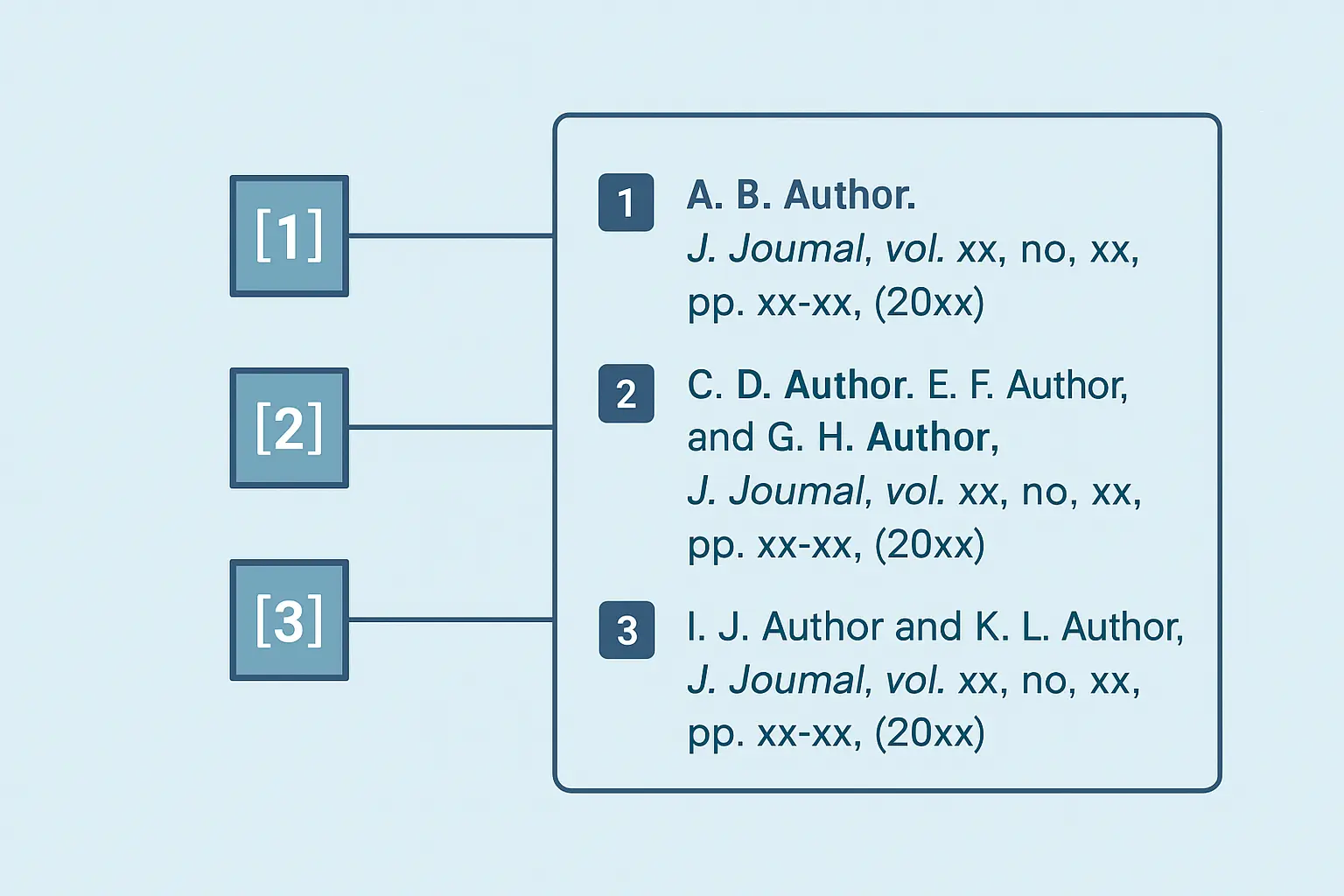
The reference list appears at the end of the paper under the heading References (not “Bibliography” or “Works Cited”). Entries are numbered and arranged in the order they were cited — [1] first, [2] second — never alphabetically. This is the single most important structural rule to internalise: if you sort by author name, you have broken the system.
Author name format
Write initials before the last name, with a space between initials and a period after each: J. R. Smith, not “John R. Smith” or “Smith, J. R.” For two authors, separate with “and”: J. R. Smith and A. K. Patel. For three or more, separate all but the last with commas, then add “and” before the final author: J. R. Smith, A. K. Patel, and L. M. Torres. When a work has more than six authors, list the first author followed by et al. in italics.
Titles
Article and paper titles go in double quotation marks in sentence case (capitalise only the first word and proper nouns). Journal names, book titles, and conference proceeding titles are italicised and use title abbreviations for journals (e.g., IEEE Trans. Ind. Inform. not the full title). The IEEE Editorial Style Manual maintains the official abbreviation list.
Punctuation and field order
Fields within each entry are separated by commas, with a period ending the entire entry. Volume and issue numbers are written as “vol. x, no. x”. Page ranges use “pp.” for multiple pages and “p.” for a single page. Month abbreviations follow a fixed list: Jan., Feb., Mar., Apr., May, Jun., Jul., Aug., Sep., Oct., Nov., Dec.
Copy-Paste Reference Examples by Source Type
Journal article
[1] J. R. Smith, A. K. Patel, and L. M. Torres, "Deep learning approaches for real-time anomaly detection in industrial IoT networks," IEEE Trans. Ind. Inform., vol. 19, no. 4, pp. 3847–3856, Apr. 2023.
Fields in order: authors — “article title” — Abbreviated Journal — vol. — no. — pp. — Month Year.
Conference paper
[2] M. A. Hassan and R. J. Nguyen, "Attention mechanisms in transformer models for code generation," in Proc. Int. Conf. Mach. Learn. (ICML), Honolulu, HI, USA, 2023, pp. 12456–12470.
Note the preposition “in” before the proceedings title, the city and country after the title, and the year before the page range. The conference acronym in parentheses after the full name is optional but recommended for readability.
Book
[3] D. E. Knuth, The Art of Computer Programming, Vol. 1: Fundamental Algorithms, 3rd ed. Reading, MA, USA: Addison-Wesley, 1997.
Edition appears after the title as “2nd ed.” or “3rd ed.” Place of publication and publisher follow a colon, then the year closes the entry.
Book chapter (in an edited volume)
[4] C. M. Bishop, "Kernel methods," in Pattern Recognition and Machine Learning, New York, NY, USA: Springer, 2006, pp. 291–322.
When the chapter has a separate editor, add “E. Editor, Ed.,” after the book title. If there are multiple editors, use “Eds.”
Website or web page
[5] P. A. Brown. (2025, Mar. 10). An introduction to RISC-V architecture. [Online]. Available: https://riscv.org/technical/specifications/. [Accessed: Jun. 15, 2026].
The “[Online].” label and “[Accessed: …].” at the end are mandatory for web sources. The access date matters because web content can change or disappear.
Technical standard
[6] IEEE Standard for Ethernet, IEEE Std 802.3-2022, IEEE, Nov. 2022.
The standard title is italicised. The standard number and issuing body follow, then the date. No author is listed when the standard has no individual authors — the issuing organisation serves as the corporate author.
Dataset
[7] P. A. Brown and S. Q. Lee. (2024). Traffic flow dataset for urban intersections (v2.1) [Dataset]. Zenodo. https://doi.org/10.5281/zenodo.7654321
Dataset references follow the general web/online format but add the version number in parentheses and the “[Dataset]” type label before the repository name. Include a DOI wherever one exists; DOIs are more stable than direct URLs.
Common IEEE Mistakes to Avoid
| Mistake | Why it’s wrong | Correct practice |
|---|---|---|
| Alphabetising the reference list | Breaks the link between in-text number and list position | Order by first citation in text |
| Assigning a new number to a repeated source | Creates duplicate entries and inflates the reference count | Reuse the original number every time |
| Writing full first names | IEEE uses initials only, not full given names | J. R. Smith, not John Robert Smith |
| Italicising article titles | In IEEE, article and paper titles take double quotes, not italics | Italics for journals and books only |
| Spelling out journal names in full | IEEE mandates official journal abbreviations | Use the IEEE abbreviation list |
| Omitting “[Online]” and access date for websites | Required fields for all web sources | Always include both |
| Using (Author, Year) in text | Author-date is APA/Harvard, not IEEE | Use [1] format only |
IEEE vs Vancouver vs APA: Key Differences at a Glance
Both IEEE and Vancouver use sequential numbered citations, which often causes confusion. IEEE is the engineering standard; Vancouver referencing is the biomedical and clinical research standard. The surface structure — numbers in brackets — looks identical, but the two systems handle author names, punctuation, and field order differently. For instance, Vancouver writes author surnames followed by initials without periods (Smith JR), while IEEE writes initials first, each followed by a period (J. R. Smith). Vancouver also typically spells out abbreviated journal names in many non-IEEE implementations, while IEEE enforces strict IEEE-standard abbreviations.
Harvard referencing and APA use the author-date system — (Smith, 2023) in text — which is common in social sciences and humanities but almost never used in IEEE journals. The key practical implication is that in author-date systems the reference list is alphabetical; in IEEE and Vancouver it is numerical. If you need to understand when to use each system, consider your field: engineering and CS departments nearly universally accept IEEE; medical journals use Vancouver; and social science and education disciplines lean towards APA or Harvard.
Chicago style and MLA 9 are almost never required in STEM disciplines, though interdisciplinary work occasionally calls for them. The table below shows the critical differences between the three most commonly confused systems:
| Feature | IEEE | Vancouver | APA 7 |
|---|---|---|---|
| In-text format | [1] | (1) or superscript¹ | (Smith, 2023) |
| Reference list order | Numerical (citation order) | Numerical (citation order) | Alphabetical by author |
| Author name order | Initials then surname (J. R. Smith) | Surname then initials (Smith JR) | Surname, Initials (Smith, J. R.) |
| Article title treatment | Double quotes, sentence case | No quotes, sentence case | No quotes, sentence case |
| Journal name format | IEEE abbreviation, italic | NLM abbreviation, italic | Full name, italic |
| Primary disciplines | Engineering, CS, electronics | Medicine, nursing, health sciences | Social sciences, education, psychology |
If you are writing a thesis that spans multiple disciplines — say, a biomedical engineering dissertation — check your department’s style guide rather than assuming IEEE applies. When in doubt, also check how many references your discipline expects: see the benchmarks in our guide on how many references a thesis should have. A reference manager that exports IEEE-formatted bibliographies automatically, such as Zotero, can save hours of manual formatting — our Zotero vs Mendeley comparison covers which tool handles IEEE output best. If you later need to switch your entire thesis from one citation style to another, the step-by-step workflow in this guide on reformatting a thesis to a new citation style can save you hours of manual work.
Frequently Asked Questions
Is the IEEE reference list in alphabetical or numerical order?
Numerical order, based on the sequence in which each source is first cited in the text. [1] is the first source mentioned, [2] the second new source mentioned, and so on. Never sort IEEE references alphabetically by author name — that is an APA/Harvard convention, not an IEEE one.
How do I cite a source more than once in IEEE style?
Reuse the original number every time you cite the same source. If a paper was assigned [4] on first citation, every subsequent reference to it in the text also uses [4]. You do not create a second entry in the reference list. If you need to point to a specific page, add it inside the bracket: [4, p. 23].
Do I have to abbreviate journal names in IEEE referencing?
Yes. IEEE mandates the use of its official journal title abbreviations (published in the IEEE Editorial Style Manual and the IEEE Xplore journal list). For example, IEEE Transactions on Industrial Informatics becomes IEEE Trans. Ind. Inform. Writing the full journal name is technically incorrect in IEEE-formatted references, though some institutional style guides relax this rule for student work.
What is the difference between IEEE and Vancouver referencing?
Both systems assign sequential numbers to sources in citation order and list references numerically. The differences lie in author name format (IEEE: initials-then-surname with periods; Vancouver: surname-then-initials without periods), article title treatment (IEEE: double quotes; Vancouver: no quotes), journal abbreviation conventions (IEEE vs NLM), and discipline (IEEE for engineering and CS; Vancouver for medicine and health sciences).
How do I cite a technical standard in IEEE style?
Italicise the standard title, then list the standard number, the issuing body, and the year. For example: IEEE Standard for Ethernet, IEEE Std 802.3-2022, IEEE, Nov. 2022. If the standard was published by a different organisation (e.g., ISO, ANSI), replace “IEEE” with the correct body name.
Does IEEE referencing require an access date for websites?
Yes. All online sources in IEEE referencing must include both the “[Online]. Available: URL” label and a “[Accessed: Month Day, Year].” date at the end of the entry. This is a mandatory field, not optional, because web content can be updated or removed after your paper is written.