
How to Write the Conclusion Chapter of a Dissertation in 2026: Structure, Examples & What Not to Repeat
Your conclusion chapter is the last thing an examiner reads before they put a mark on your dissertation — and the chapter most students write badly. After months of data collection, analysis, and drafting, many writers arrive at the conclusion exhausted and produce little more than a compressed paste of their discussion section: the same points, the same hedging language, half the word count. Examiners notice. Knowing how to write a conclusion chapter that genuinely closes your argument, rather than merely restating it, is one of the clearest signals that you understand your own research.
This guide gives you a complete, mentor-tested approach for 2026: the function of the chapter, a seven-part structure you can follow paragraph by paragraph, worked example snippets across three disciplines, a side-by-side table of what belongs in the discussion versus the conclusion, the mistakes that cost students marks, and a pre-submission checklist. If you have already written — or are still drafting — the earlier chapters, keep the full discussion chapter guide open alongside this one, because the two chapters must work as a complementary pair rather than as a repetitive echo.
What the Conclusion Chapter Actually Does
The conclusion chapter serves a different cognitive function from every other chapter in your dissertation. The introduction opened a research problem. The literature review located that problem within existing knowledge. The methodology explained how you investigated it. The results reported what you found. The discussion interpreted those findings and weighed them against prior work. The conclusion takes a step back from all of that and answers one overriding question: so what?
Specifically, it must do four things that no other chapter does:
- Close the loop with your research questions. You stated aims and questions at the start. The conclusion confirms, directly and explicitly, whether each one was answered and how.
- Declare your contribution. What does scholarship now know — or know differently — because of your study? This is often the hardest sentence to write, but examiners look for it.
- Point beyond your study. Implications and recommendations look outward: to practice, to policy, to the next researcher who picks up this thread.
- End memorably. A good closing sentence leaves the examiner with a clear sense of why your study existed and what it has changed. Trailing off with a list of limitations is the single most common way to undermine an otherwise strong dissertation.
Notice that re-analysing data, re-engaging with theory, and re-debating your interpretation do not appear in that list. That work belongs in the discussion. Understanding this boundary is the whole game when you learn how to write a conclusion chapter that stands on its own.
Conclusion vs Discussion: The Critical Difference
The distinction between these two chapters confuses even experienced writers. The following table maps each chapter’s purpose, scope, and typical language so you can keep them cleanly separated.
| Dimension | Discussion Chapter | Conclusion Chapter |
|---|---|---|
| Primary purpose | Interpret findings; engage with theory and prior literature | Answer the research questions; state contribution; look forward |
| Relationship to data | Deep engagement — unpacks patterns, surprises, mechanisms | Summary only — no new analysis or data citation |
| Reference to literature | Extensive — compares, contrasts, challenges sources | Minimal — only when positioning your contribution |
| Tense and stance | Past tense for findings; nuanced hedging (“this may suggest…”) | Present/past tense; confident declarations (“this study demonstrates…”) |
| Limitations | Sometimes touched on when qualifying an interpretation | Stated explicitly as a dedicated section |
| Future directions | Rarely — only incidentally | Always — a required structural element |
| Typical word count (Master’s) | 1,500–3,500 words | 800–1,500 words |
The practical rule: if a sentence requires you to refer to a specific finding and explain why it matters in relation to theory X, it belongs in the discussion. If you are simply confirming that the finding answers research question 2, it belongs in the conclusion. For a comprehensive reference on structuring the preceding chapter, see how to write a discussion chapter in 2026 and how to write the results chapter before you draft your conclusion. For practical strategies to write your discussion chapter faster using AI assistance while keeping your analysis intact, see the guide to writing your discussion chapter faster in 2026.
The Seven-Part Structure
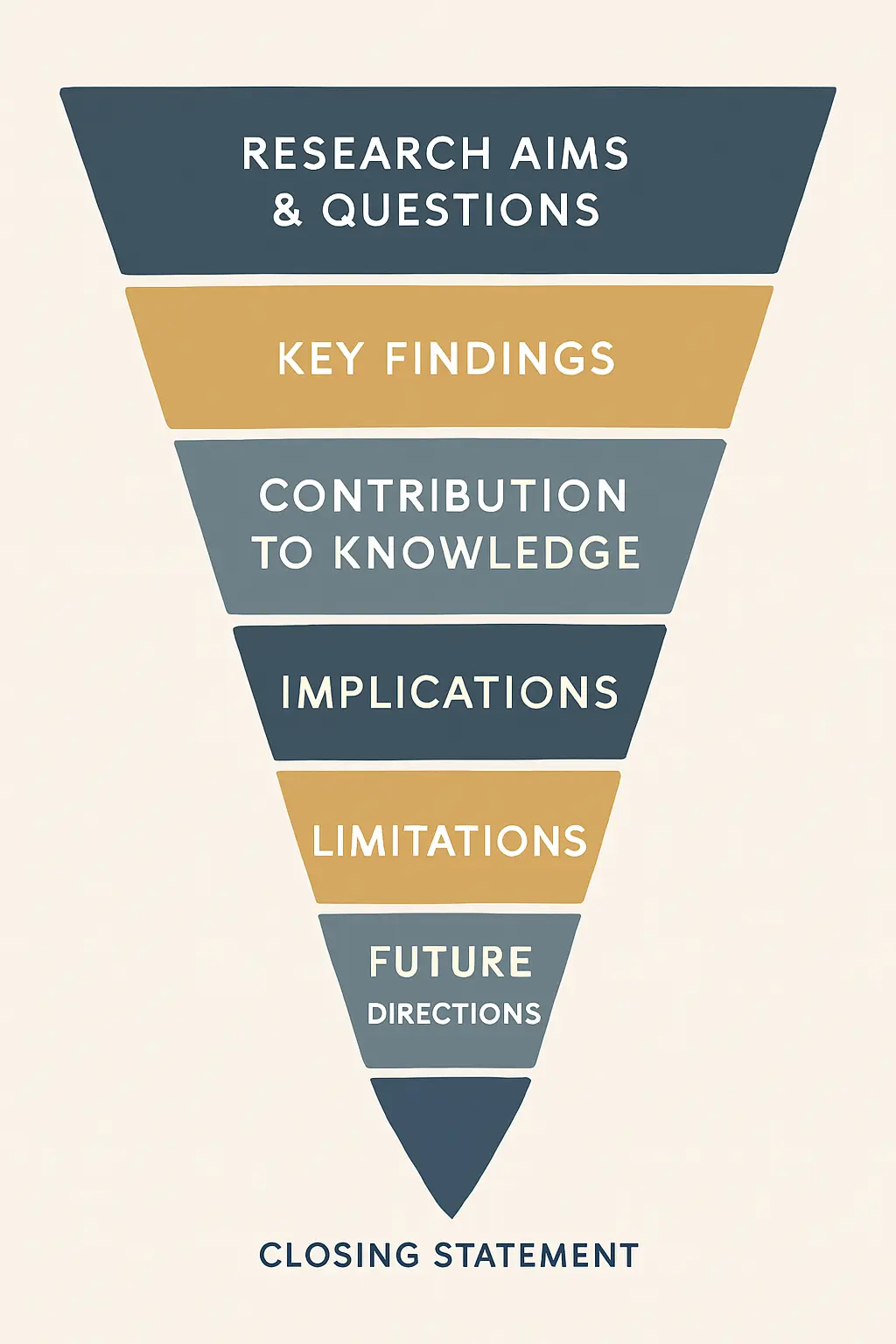
A well-organised conclusion chapter follows a predictable internal logic. Each of the seven parts below performs a specific function. Not every dissertation needs all seven as separate headings — some work best as a flowing, lightly signposted narrative — but every function must be present.
1. Restate Your Research Aims and Questions
Open by reminding the reader — and yourself — what the study set out to do. Do not copy your introduction verbatim; paraphrase with slightly more confidence, because you have now done the work. A single compact paragraph is usually sufficient. Examiners use this moment to orientate themselves before they read your answers, so keep it tight and precise. If your study had one overarching aim and three subsidiary research questions, name them all here.
2. Summarise the Key Findings
This is the most structurally distinct section from the discussion. State what your study found in plain, direct language — one or two sentences per research question. Avoid inserting the analytical reasoning here; that scaffolding was built in the discussion. The conclusion restates the verdict, not the trial. Use phrases such as “the study found that…”, “analysis revealed…”, or “contrary to initial expectations, data showed…”. Bullet points can help when you have three or more distinct findings to summarise.
3. State Your Contribution to Knowledge
This is the section most students either skip entirely or write with too much timidity. Your contribution paragraph should answer: what does the field now know that it did not know before? Or: what existing debate has your evidence shifted? A Master’s dissertation typically makes a contextual or empirical contribution (“the first study to examine X in population Y using method Z”). A PhD makes a more substantive theoretical or methodological contribution. Knowing your level helps you calibrate the claim appropriately — neither inflated nor invisible.
4. Draw Out Implications
Implications split naturally into two types, and it is worth treating them separately.
Theoretical implications address the scholarly conversation: does your finding support, challenge, refine, or complicate an existing theory or model? Do not repeat what you argued at length in the discussion — distil it to one or two crisp sentences.
Practical implications address real-world application: what should practitioners, policymakers, educators, clinicians, or organisations actually do differently in light of your findings? Be concrete. “Future policy should consider…” is weaker than “Healthcare managers in community settings should prioritise peer-support integration at the point of diagnosis.”
5. Acknowledge Limitations
Limitations in the conclusion serve a different purpose from the brief methodological caveats you may have noted elsewhere. Here, you are being transparent with the reader about the boundaries of what your conclusions can legitimately claim. A strong limitations section demonstrates scholarly maturity; a missing or minimised one signals defensiveness. List two to four genuine constraints — sampling scope, measurement choices, generalisability, temporal cross-section — and connect each to how it bounds your conclusions. Do not use this section to apologise for your study; use it to define its precise scope. You refined your research design earlier — for a refresher on how sampling decisions flow forward into limitations, writing clear research questions from the start is where those scoping decisions originate.
6. Recommendations for Future Research
This section is the gift you leave to the next researcher. Draw directly from your limitations: each constraint is a gap that a follow-up study could fill. Recommendations should be specific (“a longitudinal cohort study tracking the same population over five years would establish whether the pattern persists beyond a single academic cycle”) rather than vague (“more research is needed”). Three to five well-targeted recommendations are more valuable than an exhaustive but shallow list.
7. The Closing Statement
The final paragraph — sometimes just one sentence — is your last word to the examiner. It should echo the significance you established in your introduction, now ratified by evidence. Think of it as the answer to the question your opening paragraph implicitly posed. Avoid ending on limitations, on future research, or on a quotation from someone else’s work. End on your study’s meaning. Experienced examiners remember the last line of a conclusion more reliably than almost any other sentence in a dissertation.
Worked Example Snippets
The following brief examples illustrate how the same structural move looks across three different disciplines. Each snippet targets a specific part of the chapter.
Restatement of Aims — Social Work (Master’s)
“This study aimed to examine how frontline social workers in urban local authorities perceive organisational barriers to trauma-informed care following the implementation of the 2022 Care Act guidance. Three research questions guided the investigation: what barriers are most frequently reported; how do workers distinguish structural from cultural barriers; and whether perceived barriers differ by years of experience.”
Summary of Findings — Biochemistry (PhD)
“The study found that overexpression of miR-342-3p in HCT116 cells significantly reduced tumour necrosis factor alpha-induced apoptosis. Analysis further revealed that this protective effect was partially mediated through upregulation of the PI3K/Akt pathway, consistent with the proposed regulatory mechanism but extending it to the colorectal context where it had not previously been characterised.”
Contribution Statement — Education (Doctoral)
“This study makes two contributions to knowledge. Empirically, it provides the first mixed-methods evidence base on formative AI-feedback uptake among secondary school English teachers in an English-medium context outside North America or Australia. Theoretically, it extends Carless and Boud’s (2018) sustainable feedback framework by incorporating teacher agency as a mediating variable — a dimension the original model did not address.”
Notice that none of these snippets re-argue findings or cite literature at length. They state, they claim, and they move on. That compression is what distinguishes a conclusion from a second discussion.
Common Mistakes That Cost Marks
Most conclusion chapter failures fall into a small number of recurring patterns. Recognising them before you draft is faster than fixing them after.
Repeating the Discussion
This is far and away the most common error. Students paste discussion paragraphs into the conclusion, perhaps with light paraphrasing, and call it done. Examiners read hundreds of dissertations; they recognise recycled content immediately. Your conclusion should feel categorically different from the chapter that precedes it — tighter, more assertive, and forward-facing rather than explanatory.
Introducing New Evidence
A conclusion that brings in a new citation, new data point, or new theoretical concept has a structural problem. If the evidence was important enough to include, it needed to be introduced and argued for in an earlier chapter. New material in a conclusion reads as an afterthought and undermines the chapter’s role as a synthesis of completed work.
Burying the Contribution
Some students write around their contribution without stating it directly, perhaps from modesty or uncertainty. Sentences like “this study provides some useful insights into…” obscure rather than declare. Be direct: “this study demonstrates,” “this study provides the first evidence,” “this study challenges the assumption that.” Examiners are not looking for arrogance; they are looking for scholarly confidence.
Understating Limitations
Failing to acknowledge real constraints does not protect your study — it signals that you have not thought critically about it. A limitation honestly stated is a sign of intellectual maturity. A limitation that the examiner spots and you did not mention is a much larger problem in the viva or feedback report.
Vague Recommendations
“Further research is needed” appears in so many conclusions that it has become meaningless. Specify who should conduct that research, with which population, using which method, to answer which question. The same applies to practical recommendations: name the actor, name the action, name the context.
Ending with Limitations
Structuring your chapter so that limitations and future research are the final words leaves the examiner with a list of what your study did not do. That is an anti-climax. Always close with your closing statement — the positive declaration of significance — after the limitations and recommendations, not before them.
Pre-Submission Checklist
Before you submit, verify each item below. This checklist works alongside the broader dissertation workflow — for context on what examiners look for across all chapters, the complete dissertation writing guide covers each chapter’s expectations. Tools such as a well-structured literature review upstream ensure that the contribution you claim in your conclusion is properly grounded in existing scholarship.
- Research aims and questions are restated — paraphrased, not copied — in the opening paragraph.
- Every research question receives a direct, explicit answer.
- Findings summary contains no new analysis, no raw data, and no new citations.
- A contribution to knowledge is stated clearly and assertively.
- Theoretical and practical implications are distinct and specific.
- Two to four genuine limitations are named and linked to the scope of your conclusions.
- Recommendations are targeted (who, what, how) rather than generic.
- The closing statement ends positively on your study’s significance.
- The chapter reads as categorically different from your discussion — more assertive, less explanatory.
- No new evidence, citations, or concepts are introduced.
- Word count is proportionate: typically 5–10% of your total dissertation length.
If you are writing up your abstract after finalising the conclusion, you will find that the abstract step-by-step guide follows naturally from this chapter, since a well-written abstract is essentially the conclusion in even more compressed form. Tesify’s drafting tools can help you tighten the language in both, though the intellectual content and judgments in your conclusion must be yours alone.
Frequently Asked Questions
How long should the conclusion chapter be in a Master’s dissertation?
For a typical 15,000–20,000 word Master’s dissertation, the conclusion chapter runs between 800 and 1,500 words — roughly 5–8% of the total word count. Longer is not better here; a tight, decisive chapter of 900 words that covers all seven structural elements is more impressive than a sprawling 2,000-word chapter that paddles back into the discussion. PhD conclusions can be longer, particularly if the thesis spans multiple studies, but the same proportionality principle applies.
Can I use headings inside my conclusion chapter?
Yes, and for longer conclusions — especially at PhD level — subheadings for “Contributions to Knowledge,” “Limitations,” and “Recommendations for Future Research” make the chapter easier to navigate and signal to the examiner that each function is explicitly addressed. For shorter Master’s conclusions, a flowing narrative with clear transitional signposts (“Turning to limitations…”, “This study makes two contributions…”) can work equally well and may feel more cohesive. Follow your institutional style guide if one specifies heading use within chapters.
Should I cite references in my conclusion chapter?
Sparingly. The conclusion chapter is not the place for sustained engagement with the literature — that happened in the discussion. References are acceptable when you are positioning your specific contribution against one or two landmark works, or when acknowledging a methodological limitation that connects to a recognised theoretical boundary. You should not be introducing new sources that were not discussed earlier. If you find yourself citing heavily in the conclusion, it is usually a sign that analysis has spilled over from the discussion where it belongs.
What is the difference between implications and recommendations?
Implications describe what your findings mean — for theory, for practice, for policy. They answer “so what does this tell us?” Recommendations prescribe what should be done in response — by practitioners, policymakers, or future researchers. They answer “so what should happen next?” Keep them distinct in your writing. A useful test: if the sentence starts with “this finding suggests that organisations should consider…” it has drifted from implication into recommendation. Most conclusions benefit from having both, clearly labelled, rather than blending them into a single undifferentiated section.
Is it acceptable to say a research question was “not fully answered” in the conclusion?
Yes — and it is often the honest thing to say. Examiners prefer intellectual integrity over false closure. If your data provided partial evidence for one research question, say so directly and explain why the partial finding still advances understanding. Frame it constructively: “While the study could not definitively resolve RQ3 due to the cross-sectional design, the trend in the data suggests that…” This also feeds naturally into your limitations and future research sections, where a follow-up study can be proposed to close the gap your study identified.
How is the conclusion chapter different from the abstract?
The conclusion chapter is a full structural component of your dissertation — typically 800–1,500 words — that a reader encounters at the end of the document. The abstract is a standalone summary of the entire study, usually 150–300 words, that appears before the main text and is read in isolation. The abstract covers all chapters (aims, methods, findings, conclusions); the conclusion chapter covers only the final interpretive layer (answers, contributions, implications, limitations, recommendations). Writing your abstract after you finalise your conclusion is good practice, because your conclusion language will feed directly into the abstract’s findings and conclusions sentences. For detailed abstract guidance, see the abstract writing step-by-step guide.